A Comprehensive Travel Guide: Frankfurt to Nuremberg via Germany’s Romantic Heart
This guide details a classic German itinerary, taking you from the financial hub of Frankfurt through the world-famous Rhine Valley, historic university towns, the fairytale castles of Bavaria, the breathtaking alpine scenery of Berchtesgaden, and finally into the charming medieval towns of Franconia. It is a journey through time, culture, and some of Europe’s most stunning landscapes.
1. Frankfurt am Main
Often the gateway to Germany due to its major international airport, Frankfurt is a city of contrasts, where sleek skyscrapers stand alongside meticulously reconstructed historical buildings.
Overview & Vibe
Frankfurt is Germany’s financial capital, home to the European Central Bank and a bustling business center. However, beyond its modern facade lies a charming Altstadt (Old Town) and a vibrant cultural scene. The vibe is efficient and cosmopolitan, with a surprisingly traditional core.
Key Attractions
Römerberg: The historic heart of Frankfurt, this picturesque square is lined with beautifully reconstructed half-timbered houses. The Römer itself is the city’s town hall.
Frankfurt Cathedral (Kaiserdom): A stunning Gothic cathedral that was the election and coronation site for Holy Roman Emperors. Climb the tower for panoramic city views.
Museumsufer (Museum Embankment): A unique concentration of museums on both sides of the River Main, including the Städel Museum (fine arts), the German Film Museum, and the Communications Museum.
Main Tower: The only skyscraper with a public viewing platform, offering the best views of Frankfurt’s impressive skyline.
Palmengarten: One of the largest botanical gardens in Germany, a peaceful oasis with greenhouses showcasing plants from around the world.
Practical Information
Getting There: Frankfurt Airport (FRA) is one of Europe’s busiest hubs. The main train station (Hauptbahnhof) is a major national and international rail nexus.
Getting Around: An excellent network of U-Bahn (subway), S-Bahn (commuter rail), and trams makes getting around easy. Consider a Frankfurt Card for unlimited travel and discounts.
Food & Drink: Try Frankfurter Würstchen (small sausages), Grüne Soße (a herb sauce served with eggs and potatoes), and Handkäse mit Musik (a regional cheese specialty). Apfelwein (hard apple cider) is the local beverage.
Suggested Stay: 1-2 days.
2. Rüdesheim am Rhein
A charming wine town nestled in the UNESCO World Heritage Rhine Gorge, Rüdesheim is the epitome of Rhine Valley romance.
Overview & Vibe
The vibe is festive and wine-focused. Narrow streets, cozy wine taverns, and the sound of music from traditional bands create a lively, welcoming atmosphere. It’s a primary stop for Rhine river cruises.
Key Attractions
Drosselgasse: A famous, narrow alley just 144 meters long, packed with wine bars, restaurants, and live music. It’s incredibly lively, especially in the evening.
Niederwalddenkmal: A monumental statue commemorating the founding of the German Empire. Reach it via a scenic cable car ride from Rüdesheim, offering spectacular views of the Rhine Valley.
Rhine River Cruise: Essential. Take a boat from Rüdesheim to St. Goar or beyond to see countless castles, vineyards, and the legendary Loreley Rock.
Siegfried’s Mechanical Music Cabinet: A fascinating museum showcasing a collection of self-playing musical instruments from past centuries.
Vineyard Hikes: Walk through the steep vineyards on marked trails for breathtaking views and a taste of the local Riesling at a Straußwirtschaft (a temporary wine tavern run by vintners).
Practical Information
Getting There: A direct train from Frankfurt Hauptbahnhof takes about 1 hour. It’s also a key stop on the Rhine cruise routes.
Getting Around: The town is very walkable. The cable car and river boats are the main modes for sightseeing.
Food & Drink: This is Riesling country. Sample the local wines in any Weingut (winery) or Weinstube (wine tavern). Food is hearty German fare, perfect with wine.
Suggested Stay: 1 night.
3. Heidelberg
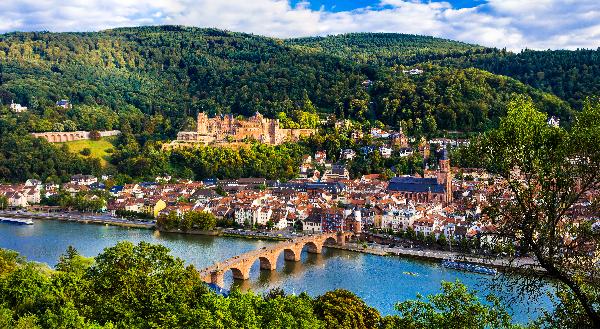
Famed for its romantic castle ruins and Germany’s oldest university, Heidelberg captivates visitors with its intellectual history and beautiful setting on the Neckar River.
Overview & Vibe
The vibe is academic and romantic. The presence of over 30,000 students gives the city a youthful, energetic pulse, while the historic core and castle ruins evoke a sense of bygone grandeur.
Key Attractions
Heidelberg Castle: The iconic red sandstone ruin towering over the city. Take the funicular railway or walk up. Don’t miss the Great Vat (a massive wine barrel) and the Apothecary Museum.
Old Town (Altstadt): A long, cobblestone main street (Hauptstraße) lined with beautiful buildings, shops, cafes, and restaurants.
Old Bridge (Karl-Theodor-Brücke): A beautiful stone bridge with gate towers, offering a classic photo opportunity of the castle and old town.
Philosophers’ Walk (Philosophenweg): A path on the sunny side of the Neckar River opposite the old town, offering the best panoramic views of Heidelberg.
Student Prison (Studentenkarzer): A unique museum where misbehaving university students were incarcerated from 1778 to 1914, their walls covered in graffiti.
Practical Information
Getting There: Direct trains from Frankfurt (approx. 1 hour) and Rüdesheim (requires a change in Mainz).
Getting Around: The city center is very walkable. A funicular railway goes to the castle and onward to the Königstuhl mountain.
Food & Drink: Look for student-friendly pubs and traditional German restaurants. Try a “Heidelberger Studentenkuss” (Heidelberg Student Kiss), a famous local chocolate praline.
Suggested Stay: 1-2 days.
4. Southern German Towns (e.g., Baden-Baden & Freiburg)
The “Southern Town” on your itinerary could refer to several gems in the Black Forest region. Two excellent options are Baden-Baden for luxury and Freiburg for vibrant city life.
A) Baden-Baden
A world-renowned spa town nestled at the edge of the Black Forest, known for its elegance and Belle Époque architecture.
Attractions: Friedrichsbad (a historic Roman-Irish bath), Caracalla Therme (modern spa complex), Lichtentaler Allee (a beautiful parkland avenue), and the Casino Baden-Baden.
Vibe: Sophisticated, luxurious, and relaxing.
B) Freiburg im Breisgau
A vibrant university city known as the “Capital of the Black Forest,” famous for its sunny weather, eco-culture, and charming Bächle (small water-filled runnels).
Attractions: Freiburg Münster (a magnificent Gothic cathedral with a towering spire), hiking in the Black Forest, Schlossberg hill for city views, and the historic Augustiner Museum.
Vibe: Lively, eco-conscious, and youthful.
Practical Information
Getting There: Both are accessible by train from Heidelberg (approx. 1 hour to Baden-Baden, 2 hours to Freiburg).
Food & Drink: In the Black Forest region, you must try Black Forest Gateau (Schwarzwälder Kirschtorte). The area is also known for its wine and cured ham.
Suggested Stay: 1-2 nights in either town.
5. Neuschwanstein Castle
The quintessential fairytale castle, built by the enigmatic King Ludwig II of Bavaria. It was the inspiration for Disney’s Sleeping Beauty Castle.
Overview & Vibe
The vibe is one of awe and fantasy. Perched on a rugged hill against a backdrop of alpine peaks, the castle’s appearance is breathtaking. Be prepared for crowds; this is one of Germany’s most popular tourist destinations.
Key Attractions
Neuschwanstein Castle Interior: Accessible by guided tour only. Book tickets *weeks* in advance online. The interior is lavishly decorated with scenes from Wagner’s operas.
Marienbrücke (Mary’s Bridge): The iconic viewpoint for photographing the castle. It spans a gorge directly behind Neuschwanstein.
Hohenschwangau Castle: The less dramatic but still beautiful childhood home of King Ludwig II, located in the same village at the foot of the hill.
Tegelbergbahn: A cable car near the castles that takes you up Mount Tegelberg for hiking, paragliding, and stunning views of the Alps and castles below.
Practical Information
Getting There: The nearest town is Füssen. Take a train to Füssen (from Freiburg/Baden-Baden, you’ll change in Ulm or Augsburg), then a local bus (#73 or #78) to the castles.
Tickets: You MUST book tickets for Neuschwanstein and Hohenschwangau in advance via the official ticket center in Hohenschwangau village. You cannot buy tickets at the castle itself.
The Visit: Tickets are for a specific timed tour. You must walk (~40 minutes), take a shuttle bus, or ride a horse-drawn carriage up the steep hill to Neuschwanstein from the ticket center.
Base Town: Füssen is a charming town to stay in. Alternatively, consider Garmisch-Partenkirchen for a larger alpine resort base.
Suggested Stay: 1 night in Füssen or Garmisch-Partenkirchen.
(Return to Southern Town)
The itinerary suggests returning to a southern town after visiting Neuschwanstein. This makes logistical sense if using Füssen or Garmisch-Partenkirchen as your base for both Neuschwanstein and your next destination, Königssee.
6. Königssee (King’s Lake)
Located in Berchtesgaden National Park near the Austrian border, Königssee is often considered Germany’s most beautiful lake. Its emerald-green waters are surrounded by steep mountain walls.
Overview & Vibe
The vibe is one of pristine natural beauty and serenity. The area is protected as a national park, ensuring clean air, quiet (only electric boats are allowed on the lake), and spectacular alpine scenery.
Key Attractions
Electric Boat Tour: The only way to explore the lake. The boats are silent, and during the trip, a crewmember plays a flugelhorn to demonstrate the famous echo.
St. Bartholomew’s Pilgrimage Church (St. Bartholomä): A picturesque red-domed church on a peninsula halfway down the lake. It’s a popular stop with a hunting lodge and beer garden.
Salet:The final boat stop at the southern end of the lake. From here, it’s a 15-minute walk to the smaller Obersee lake, an even more secluded and stunning body of water framed by the Röthwand mountain.
Eagle’s Nest (Kehlsteinhaus):A mountaintop retreat built for Hitler, now a restaurant with one of the most dramatic views in Germany. Access is via a special bus and a brass elevator carved through the mountain. Note: It’s only open from mid-May to October.
Berchtesgaden Salt Mine: A fun and family-friendly attraction where you don miners’ outfits, slide down wooden chutes, and cross an underground salt lake on a raft.