A Comprehensive Travel Guide: Rome to Venice via Italy’s Heart
This guide details a classic Italian itinerary, taking you from the ancient wonders of Rome, through the rolling hills of Tuscany, to the dramatic coastline of Cinque Terre, and culminating in the romantic waterways of Venice. It is designed to provide a thorough and practical overview for planning an unforgettable journey.
1. Rome: The Eternal City
Rome, Italy’s capital, is a sprawling metropolis where history echoes around every corner. From the awe-inspiring ruins of the Roman Empire to the spiritual heart of the Vatican City, Rome is a city that demands time and exploration.
Key Attractions
The Colosseum: The iconic Roman amphitheater. Booking a skip-the-line ticket with a guided tour is highly recommended to understand its gruesome history.
Roman Forum: The political and social heart of ancient Rome, located just next to the Colosseum. A combined ticket grants access to both sites.
Pantheon: A marvel of ancient engineering with its massive unsupported dome. Admission is free, and its preservation is breathtaking.
Trevi Fountain: The largest Baroque fountain in the city. Toss a coin with your right hand over your left shoulder to ensure your return to Rome.
Spanish Steps: A famous staircase leading from Piazza di Spagna to the Trinità dei Monti church. A great spot for people-watching.
Vatican City: An independent city-state and the center of the Catholic Church. Must-sees include:
St. Peter’s Basilica: The world’s largest church, home to Michelangelo’s “Pietà.” Climb the dome for a stunning panoramic view.
Vatican Museums: A vast complex of art collections, culminating in the Sistine Chapel with Michelangelo’s ceiling frescoes. Book tickets online well in advance.
Practical Information
Getting Around: Rome has a comprehensive metro, bus, and tram system. A Roma Pass can offer discounts and free public transport. The historic center is best explored on foot.
Food & Drink: Try classic Roman dishes like Carbonara, Cacio e Pepe, and Saltimbocca alla Romana. Enjoy gelato from a local gelateria.
Accommodation: Stay in central neighborhoods like Trastevere, Monti, or near the Pantheon for easy access to major sites.
2. Civita di Bagnoregio: The “Dying Town” (Sky City)
Perched precariously on a eroding tuff cliff, Civita di Bagnoregio is a stunning, isolated village often called “Il Paese che Muore” (The Dying Town) or the “Sky City.” It is accessible only by a long, steep footbridge.
Key Attractions
The Footbridge: The only entrance to the town, offering dramatic and photogenic views of Civita rising from the valley.
The Main Gate: An ancient gateway with lion statues holding human heads in their claws.
Piazza San Donato: The main square, home to the former cathedral and a tranquil well.
The Views: The primary attraction is the town itself and the breathtaking views of the surrounding “calanchi” (badlands) valleys.
Practical Information
Getting There: Civita is best reached by car. The nearest major train station is in Orvieto. From there, you can take a local bus or taxi to Bagnoregio, the modern town at the base of the bridge.
Visiting Tip: Visit early in the morning or late in the afternoon to avoid day-trip crowds. Wear comfortable shoes for the steep walk.
Facilities: There are a few small restaurants and shops within Civita, but options are limited due to its size.
3. Siena: The Medieval Masterpiece
Siena is the embodiment of a medieval Gothic city. Its red-brick buildings, shell-shaped main square, and fierce civic pride make it one of Tuscany’s most captivating destinations.
Key Attractions
Piazza del Campo: One of Europe’s greatest medieval squares, known for its unique shell shape and gentle slope. It is the site of the famous Palio horse race.
Siena Duomo (Cathedral): A stunning black and white marble striped cathedral. Don’t miss the Piccolomini Library with its vibrant frescoes and the intricate marble floor.
Torre del Mangia: The tall tower overlooking Piazza del Campo. Climbing the 400 steps rewards you with an unparalleled view of the city and surrounding countryside.
Palazzo Pubblico: The city’s Gothic town hall, housing the Civic Museum with important works of Sienese art.
Practical Information
Getting There: Siena is well-connected by bus from Florence. The train station is located a few kilometers outside the city center, requiring a bus ride up to the historic core.
Food & Drink: Siena is known for rich dishes like Pici pasta (a thick, hand-rolled pasta) and Panforte (a dense, spicy fruit and nut cake).
The Palio: If you wish to experience the Palio (held on July 2 and August 16), book accommodation many months in advance.
4. Florence: The Cradle of the Renaissance
Florence is an open-air museum, overflowing with some of the world’s most famous art and architecture from the Renaissance period. It is a compact city where masterpieces are found around nearly every corner.
Key Attractions
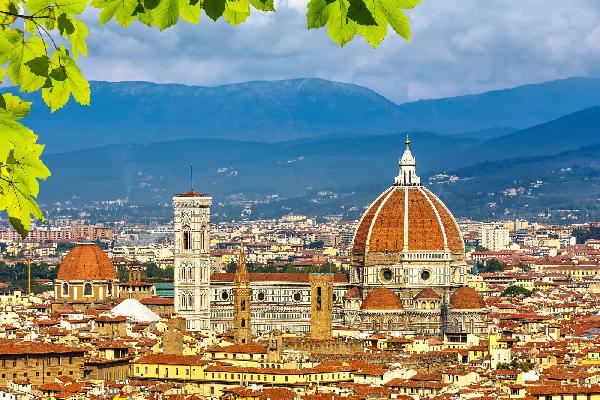
Florence Cathedral (Duomo): Dominating the skyline with its magnificent dome engineered by Brunelleschi. Climb the dome for a close-up view of Vasari’s frescoes and a spectacular city view.
Uffizi Gallery: One of the world’s top art museums, housing works by Botticelli (“The Birth of Venus”), Leonardo da Vinci, Michelangelo, and Raphael. Pre-booking is essential.
Accademia Gallery: Home to Michelangelo’s iconic statue of David, as well as his unfinished “Slaves.” Book tickets online to avoid long queues.
Ponte Vecchio: The medieval bridge spanning the Arno River, famous for its shops built into its structure, historically occupied by jewelers.
Piazzale Michelangelo: A square across the river offering the most famous panoramic postcard view of Florence. Best visited at sunset.
Practical Information
Getting Around: Florence’s historic center is very walkable. Buses are available for longer distances, like going to Piazzale Michelangelo.
Food & Drink: Enjoy a Fiorentina steak (T-bone steak), Ribollita (a hearty vegetable soup), and lampredotto (tripe sandwich). Florence is also the heart of Chianti wine country.
Museum Bookings: For the Uffizi and Accademia, booking tickets weeks or even months in advance is non-negotiable during peak season.
5. Pisa: More Than Just a Tower
While globally famous for its Leaning Tower, Pisa offers a beautiful historic center beyond the Field of Miracles. It is a convenient half-day trip from Florence.
Key Attractions
Piazza dei Miracoli (Field of Miracles): A UNESCO World Heritage site containing:
The Leaning Tower: The freestanding bell tower known for its unintended tilt. You can climb it, but bookings are required.
The Cathedral (Duomo): A magnificent example of Pisan Romanesque architecture. Entry is often included with a ticket for another monument.
The Baptistery: The largest baptistery in Italy, known for its remarkable acoustics.
Camposanto Monumentale: A monumental cemetery with historic frescoes and sculptures.
The Medieval Town: Explore the charming streets along the Arno River, including Borgo Stretto and Piazza dei Cavalieri.
Practical Information
Getting There: Pisa is easily reached by train from Florence (about 1 hour). The Pisa Centrale station is about a 25-minute walk from the Tower.
Visiting Tip: It’s possible to see the main sights in a few hours. Book your Tower climb in advance if you wish to go up.
6. Cinque Terre: The Five Lands
Cinque Terre is a string of five centuries-old seaside villages clinging to the rugged Italian Riviera coastline. The villages—Monterosso al Mare, Vernazza, Corniglia, Manarola, and Riomaggiore—are connected by hiking trails, a local train, and boats.
The Villages
Monterosso al Mare:The largest village, with the most extensive sandy beach and a more resort-like feel.
Vernazza: Often considered the most picturesque, with a natural harbor, a small beach, and a castle overlooking the town.
Corniglia:The only village not directly on the sea, perched high on a cliff. It requires climbing nearly 400 steps (or taking a shuttle bus) from the train station.
Manarola:Famous for its stunning sunset views and postcard-perfect harbor. The scenic walking path to Riomaggiore (Via dell’Amore) often starts here.
Riomaggiore:The southernmost village, with a colorful harbor and a lively main street lined with shops and restaurants.
Practical Information
Getting Around:The Cinque Terre Treno MS Card is essential. It provides unlimited travel on the Cinque Terre Express train between the villages (and to La Spezia) and access to the paid hiking trails.
Hiking:The coastal trails offer incredible views. Check for trail closures before you go, as landslides can sometimes close paths. Wear proper footwear.
Boat Tours:A boat trip from one of the villages offers a unique perspective of the Cinque Terre from the water.
Food & Drink:Savor fresh seafood, anchovies (a local specialty), and pesto Genovese, which originates from this region. Enjoy a glass of Sciacchetrà, a local sweet wine.
Accommodation:Book far in advance, especially in high season. Consider staying in La Spezia for more options and lower prices, as it’s just one train stop away.
7. Milan: The Fashion & Finance Capital
A modern and sophisticated metropolis, Milan offers a different vibe from the rest of Italy. It is a global capital of design, fashion, and finance, but it also holds incredible historical and artistic treasures.
Key Attractions
The Duomo:The magnificent Gothic cathedral that is the symbol of Milan. You can walk on its roof among the spires for an unforgettable experience.
Galleria Vittorio Emanuele II:A stunning 19th-century shopping arcade next to the Duomo, housing luxury boutiques and historic cafes.
Teatro alla Scala:One of the world’s most famous opera houses. Take a tour of the museum to see the interior if you can’t attend a performance.
“The Last Supper” by Leonardo da Vinci:Housed in the refectory of the Convent of Santa Maria delle Grazie. Reservations must be made months in advance due to high demand and strict conservation limits.
Sforza Castle:A vast castle complex housing several museums, including Michelangelo’s final sculpture, the Rondanini Pietà.
Practical Information
Getting Around:Milan has an excellent metro system (Metropolitana Milano) that is easy to navigate and connects all major sights.
The Quadrilatero della Moda:The fashion district around Via Montenapoleone is a must for shopping enthusiasts, even if just for window-shopping.
Sirmione: The Jewel of Lake Garda
A Picturesque Peninsula Town
Sirmione is a stunning fortified town on a long, narrow peninsula jutting into Lake Garda, Italy’s largest lake. Known for its thermal springs, dramatic castle, and romantic atmosphere, it’s a popular day-trip destination from Milan or Verona.