Rome: The Eternal City
Rome, Italy’s capital, is a sprawling, cosmopolitan city with nearly 3,000 years of globally influential art, architecture, and culture on display. Ancient ruins like the Forum and the Colosseum evoke the power of the former Roman Empire.
Top Attractions in Rome
The Colosseum: The iconic Roman amphitheater, commissioned in A.D. 72. Booking a skip-the-line ticket or a guided tour that includes access to the underground chambers is highly recommended.
Roman Forum: The political, commercial, and religious heart of ancient Rome, located right next to the Colosseum. It’s a vast archaeological site best explored with a guide or a good audio guide.
Pantheon: A remarkably preserved Roman temple, now a church, with the world’s largest unreinforced concrete dome. Admission is free.
Trevi Fountain: The largest Baroque fountain in the city and one of the most famous in the world. Tradition says throwing a coin with your right hand over your left shoulder ensures your return to Rome.
Vatican City: An independent city-state within Rome, home to the Pope.
St. Peter’s Basilica: The world’s largest church, featuring Michelangelo’s “Pietà” and the stunning dome offering panoramic city views.
Vatican Museums: A massive complex of art galleries, culminating in the Sistine Chapel with Michelangelo’s legendary ceiling frescoes. Book tickets online weeks in advance to avoid extremely long queues.
Piazza Navona: A beautiful Baroque square featuring Bernini’s Fountain of the Four Rivers.
Spanish Steps: A famous staircase climbing from Piazza di Spagna to the Trinità dei Monti church. It’s a popular spot for people-watching.
Practical Information for Rome
Getting Around: Rome has a comprehensive public transport system (metro, buses, trams). The historic center is best explored on foot. Beware of pickpockets on crowded buses and metro lines.
Accommodation: Stay in areas like Trastevere for a lively, local feel, near Termini Station for convenience, or in the historic center to be close to major sights.
Food & Drink: Must-try dishes include Cacio e Pepe, Carbonara, Supplì (fried rice balls), and Roman-style pizza (thin and crispy). Enjoy gelato from artisanal gelaterias (avoid brightly colored, piled-high displays).
Recommended Stay: 3-4 days minimum.
Civita di Bagnoregio: The Dying Town
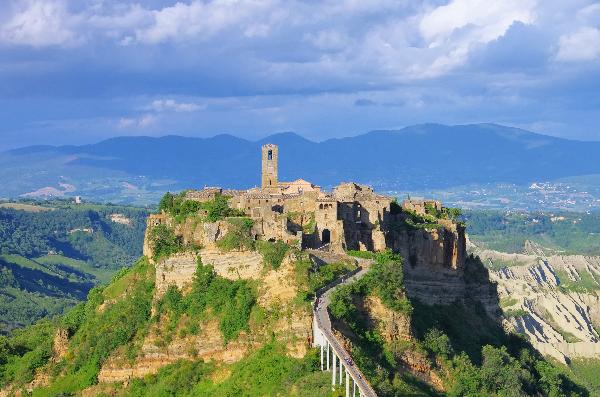
Often called “Il Paese che Muore” (The Dying Town) or the “Sky City,” Civita di Bagnoregio is a stunning medieval village perched atop a crumbling tufa rock plateau. It is accessible only by a long pedestrian bridge from its sister town, Bagnoregio.
Top Attractions in Civita
The Footbridge: The dramatic entrance to the town, offering incredible photo opportunities.
San Donato Church: The main church in the central piazza, which houses a wooden crucifix from the 15th century.
The Geological Landscape: The main attraction is the town itself and the breathtaking views of the surrounding “calanchi” (badlands) valleys.
Explore the Alleys: Wander the quiet, flower-decked lanes, discover ancient Etruscan caves, and enjoy the serene atmosphere.
Practical Information for Civita
Getting There: Civita is best reached by car. It is roughly a 2-hour drive north of Rome. Public transport is possible but involves multiple trains and buses to Bagnoregio. Organized day trips from Rome or Orvieto are also available.
The Footbridge Fee: There is a small fee to cross the bridge, which helps with the town’s preservation.
Amenities: There are very few residents and limited services. A couple of restaurants and small shops operate seasonally. It’s advisable to carry water and some snacks.
Recommended Stay: A half-day visit is sufficient. It can be visited as a day trip from Rome or as a stop between Rome and Siena/Florence.
Siena: The Medieval Masterpiece
Siena is the embodiment of a medieval Italian city. Its historic center, a UNESCO World Heritage site, is built around the magnificent Piazza del Campo and retains its Gothic character from the 12th-15th centuries.
Top Attractions in Siena
Piazza del Campo: The shell-shaped main square, renowned for its beauty and architectural unity. It’s the site of the famous Palio horse race twice a year.
Siena Cathedral (Duomo): A stunning example of Italian Romanesque-Gothic architecture. The interior is a masterpiece with striped marble pillars, a magnificent mosaic floor, works by Donatello and Michelangelo, and the Piccolomini Library.
Climb the Torre del Mangia: The tall tower overlooking Piazza del Campo. Climbing its 400 steps rewards you with an unparalleled view of the city and surrounding countryside.
Palazzo Pubblico: The city hall located in the Piazza del Campo, housing the Civic Museum with famous frescoes like Simone Martini’s “Maestà.”
Explore the Contrade: Siena is divided into 17 contrade (districts), each with its own museum, fountain, and church. Exploring these neighborhoods offers a deep dive into local culture.
Practical Information for Siena
Getting There: Siena is well-connected by bus from Florence (about 1.5 hours). Trains also run, but the station is located downhill from the city center, requiring a bus ride up.
Getting Around: The historic center is entirely pedestrianized and best explored on foot. Be prepared for steep hills.
The Palio: If you wish to experience the Palio (July 2 and August 16), book accommodation many months in advance. The city is extremely crowded during this time.
Food & Drink: Try Pici (a thick, hand-rolled Sienese pasta), Panforte (a dense fruit and nut cake), and Ricciarelli (almond cookies).
Recommended Stay: 1-2 full days.
Florence: The Cradle of the Renaissance
Florence is an open-air museum of Renaissance art and architecture. As the birthplace of the Renaissance, it was home to masters like Michelangelo, Leonardo da Vinci, and Dante.
Top Attractions in Florence
Florence Cathedral (Duomo): The city’s iconic landmark with its magnificent red-tiled dome engineered by Brunelleschi. You can climb the dome for spectacular views (reservations required).
Uffizi Gallery: One of the world’s greatest art museums, housing masterpieces by Botticelli (“The Birth of Venus”), Leonardo da Vinci, Michelangelo, and Raphael. Pre-book tickets online to avoid waiting for hours.
Accademia Gallery: Home to Michelangelo’s colossal statue of “David.” Pre-booking is absolutely essential.
Ponte Vecchio: A medieval stone bridge spanning the Arno River, famous for its shops built along it, traditionally occupied by jewellers.
Piazzale Michelangelo: A square on a hillside offering the most famous panoramic postcard view of Florence. It’s especially beautiful at sunset.
Palazzo Vecchio: The imposing town hall overlooking Piazza della Signoria, which is itself an open-air sculpture gallery.
The Boboli Gardens: Extensive and elegant gardens behind the Pitti Palace, offering a peaceful escape with beautiful landscaping and fountains.
Practical Information for Florence
Getting Around: Florence’s historic center is very compact and walkable. Buses are available for longer distances (e.g., to Piazzale Michelangelo).
Accommodation: Stay in or near the historic center to be within walking distance of all major sites.
Ticketing: For the Uffizi, Accademia, and Duomo climbs, book tickets online as far in advance as possible (often weeks or months). Consider the Firenze Card for priority access to multiple museums if you plan a busy itinerary.
Food & Drink: Enjoy a Fiorentina steak (T-bone steak), Ribollita (a hearty vegetable and bread soup), and Lampredotto (a tripe sandwich). Don’t forget to try Chianti wine from the surrounding region.
Recommended Stay: 3-4 days minimum to fully appreciate the art and atmosphere.
Pisa: More Than Just a Tower
While globally famous for its Leaning Tower, Pisa offers a beautiful historic center beyond the Field of Miracles (Campo dei Miracoli).
Top Attractions in Pisa
The Leaning Tower (Torre Pendente): The freestanding bell tower of the cathedral, known for its nearly four-degree lean. You can climb the 294 steps to the top (book tickets well in advance).
Pisa Cathedral (Duomo): A magnificent example of Pisan Romanesque architecture located next to the Tower. Entry is included with a ticket to the other monuments (but requires a free timed ticket).
The Baptistery: The largest baptistery in Italy, located opposite the cathedral. Its acoustics are phenomenal.
Camposanto Monumentale: A monumental cemetery on the north side of the square, said to have been built with holy soil brought back from Golgotha during the Crusades.
The Medieval Town: Walk along the Arno River on Lungarno streets and explore Piazza dei Cavalieri, a historic square that was the political center in medieval times.
Practical Information for Pisa
Getting There: Pisa is an easy day trip from Florence by train (about 1 hour). The Pisa Centrale station is about a 25-30 minute walk from the Leaning Tower.
Ticketing: You can buy single tickets for monuments or combined passes for the Cathedral, Baptistery, Camposanto, and two museums. Tickets for climbing the Tower must be purchased separately and are for a specific time slot.
The “Holding Up the Tower” Photo: It’s a tourist cliché, but fun! Go early in the morning or late in the afternoon to avoid the largest crowds.
Recommended Stay: A half-day is sufficient for the main sights on Campo dei Miracoli. It can easily be combined with a visit to Lucca on a day trip from Florence.
The Cinque Terre: The Five Lands
The Cinque Terre is a string of five centuries-old seaside villages on the rugged Italian Riviera coastline. The villages (Monterosso al Mare, Vernazza, Corniglia, Manarola, and Riomaggiore) are known for their colorful houses, vineyards, steep terraces, and breathtaking coastal trails. It is a UNESCO World Heritage site.
The Five Villages
Monterosso al Mare:The largest village with the best sand beach and a more resort-like feel. It has the most accommodation options.
Vernazza: Often considered the most picturesque village, with a natural harbor, a small beach, and a castle ruin overlooking the town.
Corniglia:The only village not directly on the sea. It sits atop a 100-meter-high promontory, requiring a climb of 382 steps (or a shuttle bus) from the station. It’s quieter and offers stunning views.
Manarola:A postcard-perfect village with colorful houses stacked along a cliffside. The scenic path “Via dell’Amore” towards Riomaggiore starts here (check for opening status).
Riomaggiore:The southernmost village, characterized by its steeply stacked houses and a small harbor. It’s a great spot for sunset aperitifs.
Practical Information for Cinque Terre
Getting There & Around:The easiest way to travel between villages is by train. The Cinque Terre Express train runs frequently between La Spezia and Levanto, stopping at all five villages.
Cinque Terre Trekking Card:Covers access to the coastal hiking trails and use of village shuttle buses.
Cinque Terre Treno MS Card:The best value option. Includes unlimited train travel on the Cinque Terre Express line (La Spezia to Levanto) plus access to hiking trails and buses. Highly recommended for visitors.
Trekking:The famous coastal trail connecting all five villages can be subject to closures due to landslides or maintenance. Always check the official park website for current trail conditions before planning your hike. The most scenic sections are typically between Monterosso-Vernazza and Vernazza-Corniglia.
By Boat:A ferry service connects the villages (except Corniglia) from spring to autumn, offering spectacular views from the water.
Accommodation:Book far in advance, especially for summer. Options include hotels, B&Bs, and vacation rentals. Staying in one village and day-tripping to the others is common.
Try fresh anchovies (acciughe), pesto Genovese (the region is its birthplace), focaccia, and Sciacchetrà, a prized sweet dessert wine.