A Grand Tour of Germany: From Frankfurt to Berlin
This comprehensive travel guide outlines a classic route through the heart of Germany, blending bustling modern cities, enchanting medieval towns, fairy-tale castles, and breathtaking alpine landscapes. The journey spans from the financial hub of Frankfurt, through the romantic south, and culminates in the historic and dynamic capital, Berlin, offering a deep dive into Germany’s rich culture, history, and culinary delights.
1. Frankfurt: The Gateway
Often the first point of entry for international travelers, Frankfurt am Main is a city of contrasts, where sleek skyscrapers stand alongside reconstructed historical buildings.
Main Attractions
Römerberg: The historic heart of Frankfurt, featuring the Römer city hall and charming, reconstructed half-timbered houses. It’s a picturesque square that evokes the city’s pre-war past.
St. Bartholomew’s Cathedral (Frankfurter Dom): A grand Gothic cathedral that was the election and coronation site for Holy Roman Emperors. Climbing the tower offers panoramic views of the city.
Museum Embankment (Museumsufer): A unique concentration of museums on both sides of the River Main, including the Städel Museum, known for its outstanding European art collection.
Main Tower: The only skyscraper with a public viewing platform, providing an unparalleled 360-degree view of Frankfurt’s impressive skyline.
Food & Drink
Grüne Soße (Green Sauce): A Frankfurt specialty made with seven fresh herbs, sour cream, and yogurt, typically served with boiled potatoes and eggs.
Apfelwein (Ebbelwoi): A tart, fermented apple cider. Experience it in a traditional apple wine pub in the Sachsenhausen district.
Frankfurter Würstchen: The original Frankfurter sausage, a fine, smoked pork sausage.
Transportation & Accommodation
Frankfurt Airport (FRA) is a major international hub. The city has an excellent public transport system (U-Bahn, S-Bahn, trams). Stay in the city center (Innenstadt) for proximity to main sights or near the Hauptbahnhof (main station) for transit convenience.
2. Heidelberg: The Romantic City
A short train ride south from Frankfurt leads to Heidelberg, a city that has inspired poets and artists for centuries with its picturesque setting on the Neckar River.
Main Attractions
Heidelberg Castle: The magnificent red sandstone ruins towering over the city. Take the funicular railway up and explore the vast grounds and the world’s largest wine barrel.
Old Town (Altstadt): A beautiful baroque district with a lively main street (Hauptstrasse), perfect for strolling and shopping.
Old Bridge (Karl-Theodor-Brücke): An iconic bridge offering classic postcard views of the castle and old town.
Philosophers’ Walk (Philosophenweg): A scenic path on the opposite side of the Neckar River, providing breathtaking views of the castle and city.
Food & Drink
Heidelberger Studentenkuss: A local chocolate praline, the “Student’s Kiss,” originally used as a discreet token of affection.
- Regional wines from the Baden wine region.
3. Hohenzollern Castle: The Ancestral Seat
Perched on Mount Hohenzollern, this is the ancestral seat of the Prussian Royal House and German Emperors. It is a masterpiece of 19th-century military architecture and offers stunning views of the Swabian Alb.
Travel Tip
The castle is best accessed by car. Public transport involves trains to Hechingen station followed by a shuttle bus. It’s a dramatic, less-crowded alternative to Neuschwanstein, brimming with Prussian history.
4. Southern German Towns & The Romantic Road
The route now delves into the quintessential charm of Southern Germany, characterized by rolling hills, dense forests, and storybook villages.
Füssen & The Southern Towns
Füssen is the primary gateway to the castles and a charming town in its own right, with a colorful old town set against the Alps. Other southern towns in the region, such as Oberammergau, are known for their Luftmalerei (air painting) – beautifully painted frescoes on house façades depicting biblical scenes or fairy tales.
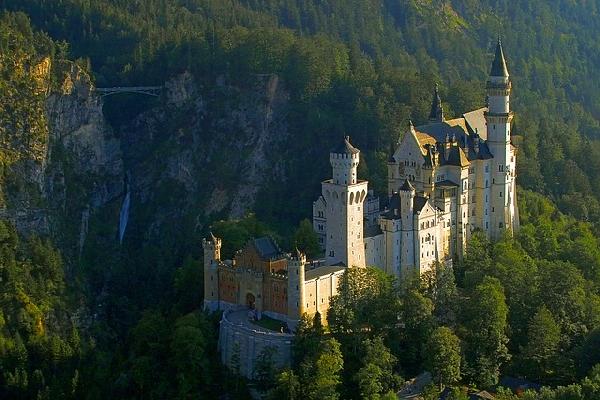
5. Neuschwanstein Castle: The Fairy-Tale King’s Dream
The world-famous castle built by the eccentric King Ludwig II. It was the inspiration for Disney’s Sleeping Beauty Castle and is Germany’s most photographed building.
Visiting Information
Tickets: Must be booked online well in advance. Tickets are for timed entry and are collected at the ticket center in Hohenschwangau at the foot of the hill.
Access: From the ticket center, you can walk ~30-40 minutes uphill, take a shuttle bus (to Marienbrücke bridge for the famous photo spot), or a horse-drawn carriage.
Marienbrücke (Mary’s Bridge): Do not miss this bridge for the iconic, direct frontal view of the castle.
6. Oberammergau: The Passion Play Village
This charming village is internationally renowned for its Passion Play, performed every ten years by the locals (next in 2030). Even outside of play years, it’s worth visiting for its exceptional woodcarving tradition and stunning Lüftlmalerei.
Main Attractions
- Admire the painted houses, such as the “Pilatushaus.”
- Visit workshops of woodcarvers (Schnitzerei).
- Take a short trip to the nearby Ettal Abbey to see its magnificent Baroque basilica.
7. Königssee (King’s Lake): Bavaria’s Pristine Jewel
Located in Berchtesgaden National Park, Königssee is Germany’s cleanest and arguably most beautiful lake, emerald-green and surrounded by steep mountain walls.
Main Attractions
Electric Boat Tour: The only powered boats allowed on the lake are electric, preserving its serenity. The boat stops at:
St. Bartholomä: A picturesque pilgrimage chapel with onion domes. Enjoy some fresh fish from the smokehouse nearby.
Salet: From here, a 15-minute walk leads to the smaller and equally stunning Obersee lake.
Echo Wall: During the boat ride, a crewmember will play a flugelhorn to demonstrate the remarkable echo.
Travel Tip
The nearby Eagle’s Nest (Kehlsteinhaus), Hitler’s former mountain retreat, offers another perspective with its dramatic history and views. Book a separate tour bus to reach it.
8. Munich (München): The Capital of Bavaria
A vibrant metropolis that seamlessly blends traditional Bavarian culture with modern innovation and technology.
Main Attractions
Marienplatz: The central square, home to the New Town Hall and its famous Glockenspiel show.
Hofbräuhaus: The world’s most famous beer hall for a quintessential Bavarian experience.
English Garden: One of the world’s largest urban parks, where you can see surfers on the Eisbach river and relax at the Chinese Tower beer garden.
Nymphenburg Palace: The stunning summer residence of the Bavarian monarchs.
Deutsches Museum: One of the world’s largest and oldest museums of science and technology.
Food & Drink
Weisswurst: A traditional white veal sausage, typically eaten before noon with sweet mustard and a pretzel.
Schweinshaxe: Crispy roasted pork knuckle.
Beer: Munich is the birthplace of Oktoberfest. Visit one of the many historic beer gardens.
9. Rothenburg ob der Tauber: The Medieval Dream
A perfectly preserved medieval town on the Romantic Road, Rothenburg seems frozen in time, enclosed by intact town walls.
Main Attractions
Town Walls: Walk the entire circumference on the covered sentry walk for fantastic views.
Plönlein: The most photographed spot in Rothenburg – a small fork with a half-timbered house, framed by two towers.
Market Square (Marktplatz): Home to the Town Hall and the Councillors’ Tavern with its mechanical clock.
Criminal Museum (Mittelalterliches Kriminalmuseum): A fascinating look at medieval law and order.
The Night Watchman Tour: A highly entertaining and informative evening walking tour led by a costumed guide.
Food & Drink
Schneeballen (Snowballs): Strips of pastry dough formed into a ball and dusted with powdered sugar or coated in chocolate.
10. Würzburg: The Baroque Pearl
A city at the northern end of Bavaria’s Romantic Road, famous for its wine, architecture, and as the gateway to the Franconian wine country.
Main Attractions
Würzburg Residence: A UNESCO World Heritage Site, this magnificent Baroque palace boasts a grand staircase and the world’s largest fresco by Giovanni Battista Tiepolo.
Marienberg Fortress: The former home of the prince-bishops, perched high above the Main River. Offers excellent views of the city and vineyards.
Old Main Bridge (Alte Mainbrücke): A charming bridge lined with statues of saints, reminiscent of Prague’s Charles Bridge. A popular spot to enjoy a glass of local Franconian wine.
11. Dresden: The Florence on the Elbe
The capital of Saxony, Dresden was famously firebombed in WWII and has been meticulously rebuilt, restoring its breathtaking Baroque splendor.
Main Attractions
Frauenkirche: The Church of Our Lady, destroyed in the war and miraculously rebuilt using original stones. Its reconstruction is a symbol of reconciliation.
Zwinger Palace: A stunning complex of pavilions and galleries housing Old Masters like Raphael’s “Sistine Madonna.”
Semperoper: One of the world’s most beautiful opera houses. Attend a performance or take a guided tour.
Brühl’s Terrace: Known as “The Balcony of Europe,” this promenade offers lovely views over the Elbe River.
12. Potsdam: Prussian Grandeur
A short train or S-Bahn ride from Berlin, Potsdam is known for its immense parklands and spectacular palaces, which served as the seat of Prussian kings.
Main Attractions
Sanssouci Park: A vast park containing several palaces.
Sanssouci Palace: Frederick the Great’s elegant summer retreat, often compared to Versailles.
New Palace (Neues Palais):A much larger and more grandiose palace built to demonstrate Prussian power.
Cecilienhof Palace: Where the 1945 Potsdam Conference was held by Truman, Churchill (later Attlee), and Stalin.
Dutch Quarter (Holländisches Viertel):A unique district with over 100 red-brick houses built in the Dutch style.
13. Berlin: The Dynamic Capital
The journey concludes in Berlin, a city defined by its turbulent 20th-century history, vibrant arts scene, and relentless modernity.
Main Attractions
Brandenburg Gate:The iconic symbol of German unity and peace.
Reichstag Building:The seat of the German parliament. Advance registration is required to visit the spectacular glass dome.
Berlin Wall Memorial & East Side Gallery:Sections of the Wall preserved as a memorial and as the world’s longest open-air gallery.
Museum Island (Museumsinsel):A UNESCO World Heritage complex of five world-class museums, including the Pergamonmuseum.
Checkpoint Charlie:The most famous border crossing between East and West Berlin during the Cold War.
The Holocaust Memorial (Memorial to the Murdered Jews of Europe):A powerful and somber field of 2,711 concrete stelae.