Iberian Adventure: A Comprehensive Travel Guide to Spain & Portugal
This guide provides an objective and practical itinerary for exploring the rich cultural heritage, stunning landscapes, and historic cities of Portugal and Spain, covering Lisbon, Sintra, Évora, Seville, Ronda, Mijas, Granada, Cordoba, Toledo, Madrid, Segovia, Zaragoza, and Barcelona.
Introduction to the Iberian Peninsula
The Iberian Peninsula, comprising Spain and Portugal, offers a diverse tapestry of experiences from dramatic coastlines and mountainous regions to world-renowned historical sites and vibrant urban centers. This itinerary is designed as a loop starting and ending in Lisbon, Portugal, moving through southern Spain (Andalusia), central Spain, and northeastern Spain, concluding in Barcelona. The journey spans approximately 2-3 weeks, depending on pace, and covers over 2,000 kilometers by road or rail. The best times to visit are during the shoulder seasons of spring (April-May) and autumn (September-October) for pleasant weather and fewer crowds. Summers can be extremely hot, especially in inland Andalusia.
Part 1: Portugal (Lisbon, Sintra, and the Alentejo)
Lisbon (Lisboa)
Lisbon, Portugal’s hilly, coastal capital, is known for its café culture, iconic yellow trams, and Fado music. The city’s history dates back to Phoenician times, and its architecture reflects various periods, including Romanesque, Gothic, Manueline, and Baroque.
Key Attractions: Belém Tower (a 16th-century fortification on the Tagus River), Jerónimos Monastery (a masterpiece of Manueline architecture), Alfama District (the oldest neighborhood with narrow streets and Fado houses), São Jorge Castle (offering panoramic city views), and the Monument to the Discoveries.
Practical Information: Lisbon Airport (LIS) is the main international gateway. The city has an extensive public transport system including metro, trams, and buses. The Lisboa Card offers discounts on transport and entry fees. Accommodation ranges from hostels in Bairro Alto to luxury hotels along the Avenida da Liberdade.
Local Cuisine: Try Pastéis de Belém (custard tarts), Bacalhau (salted cod), and grilled sardines.
Day Trip to Sintra and Cabo da Roca
A day trip from Lisbon takes you to the mystical town of Sintra and the westernmost point of continental Europe.
Sintra: A UNESCO World Heritage site known for its 19th-century Romantic architecture. Key sites include the colorful Pena Palace, the Moorish Castle ruins, and the Quinta da Regaleira estate with its initiation wells. Practical Info: Reach Sintra by train from Lisbon’s Rossio Station (approx. 40 minutes). Consider purchasing a combined ticket for major palaces to save time.
Cabo da Roca (Roca Cape): The westernmost point of mainland Europe, marked by a lighthouse and a stone monument. The cliffs offer dramatic Atlantic Ocean views. Practical Info: Accessible by bus from Sintra (Scotturb bus 403). The area is often windy, so bring a jacket.
Évora
Évora, a UNESCO World Heritage city in the Alentejo region, is a museum-city with roots in Roman times. Its well-preserved historic center is enclosed by medieval walls.
Key Attractions: Roman Temple of Évora (Templo de Diana), Évora Cathedral (Sé de Évora), Chapel of Bones (Capela dos Ossos), and the historic town square (Praça do Giraldo).
Practical Information: Évora is about a 1.5-hour drive or bus ride east of Lisbon. The city is easily explored on foot. It serves as a good stopover en route to Spain.
Local Cuisine: Alentejo pork with clams, Açorda (bread-based soup), and local wines.
Part 2: Andalusia, Spain (Seville to Granada)
Seville (Sevilla)
Seville, the capital of Andalusia, is a passionate city famous for Flamenco, Moorish heritage, and vibrant festivals. Its history as a Roman, Moorish, and Christian center is evident in its architecture.
Key Attractions: Seville Cathedral and La Giralda Tower (the world’s largest Gothic cathedral), Real Alcázar (a stunning royal palace with Mudejar architecture), Plaza de España (built for the 1929 Expo), and the Barrio Santa Cruz (the old Jewish quarter).
Practical Information: Seville Airport (SVQ) or a train/bus from Portugal. The city center is walkable, but taxis and trams are available. Book Alcázar tickets online in advance to avoid long queues.
Local Cuisine: Tapas bars abound; try espinacas con garbanzos (spinach with chickpeas) and pescaíto frito (fried fish).
Ronda
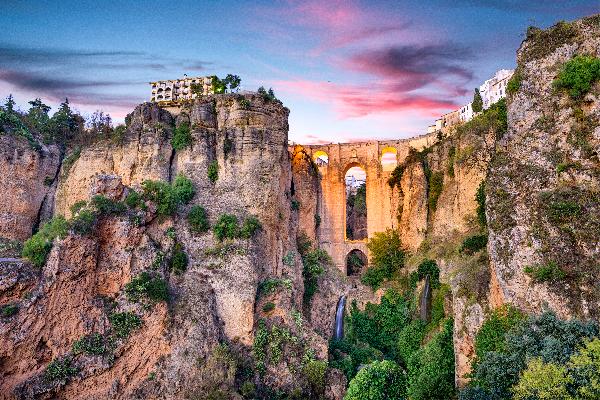
Ronda is a mountaintop city dramatically set on either side of the El Tajo gorge, which is spanned by the iconic Puente Nuevo bridge.
Key Attractions: Puente Nuevo (New Bridge), the Old Town (La Ciudad), Plaza de Toros (one of Spain’s oldest bullrings), and the Arab Baths.
Practical Information: Ronda is about a 1.5-2 hour drive from Seville. Parking can be challenging in the old town. It’s a perfect stop for a few hours or an overnight stay.
Mijas
Mijas is a picturesque white village (pueblo blanco) perched on the mountainside overlooking the Costa del Sol. It offers traditional Andalusian charm with whitewashed houses and narrow streets.
Key Attractions: The village itself, with its plaza de toros, artisan shops, and donkey taxis. The views of the coast are spectacular.
Practical Information: Mijas is easily accessible from Málaga or Fuengirola by bus or car. It’s often visited as a half-day trip.
Granada
Granada is home to the Alhambra, one of the most magnificent examples of Moorish architecture in the world. The city lies at the foot of the Sierra Nevada mountains.
Key Attractions: The Alhambra and Generalife Gardens (a vast palace and fortress complex requiring advance booking), the Albayzín quarter (a maze of narrow streets with Moroccan tea houses), and the Sacromonte district (known for its cave dwellings and Flamenco shows).
Practical Information: Granada Airport (GRX) or train/bus from other Andalusian cities. Book Alhambra tickets online months in advance, as they sell out. The city is hilly; comfortable shoes are essential.
Local Cuisine: Free tapas are traditionally served with drinks. Try Habas con Jamón (broad beans with ham).
Cordoba (Córdoba)
Cordoba’s major draw is the Mezquita-Catedral, a breathtaking mosque-cathedral that symbolizes the city’s layered history as a Roman, Moorish, and Christian center.
Key Attractions: Mezquita-Catedral de Córdoba (notable for its forest of arches and columns), the Jewish Quarter (Judería) with its Synagogue, Alcázar de los Reyes Cristianos, and the Roman Bridge.
Practical Information: Cordoba is on the high-speed AVE train line between Seville and Madrid. The historic center is compact and walkable. Visit the Mezquita early in the morning to avoid crowds.
Local Cuisine: Salmorejo (a thicker version of gazpacho), Rabo de Toro (oxtail stew).
Part 3: Central Spain (Toledo and Madrid)
Toledo
Toledo, a UNESCO World Heritage city, is known as the “City of Three Cultures” for its historical co-existence of Christian, Muslim, and Jewish communities. It sits on a hill above the Tagus River.
Key Attractions: Toledo Cathedral (a prime example of High Gothic architecture), Alcázar of Toledo (a massive fortress), Synagogue of Santa María la Blanca, and the Monastery of San Juan de los Reyes.
Practical Information: Toledo is a 30-minute high-speed train ride from Madrid’s Atocha station. The city is extremely hilly; public escalators help access the center from parking areas.
Local Cuisine: Marzipan (mazapán), Perdiz Estofado (stewed partridge), and Carcamusas (a pork stew).
Madrid
Madrid, Spain’s vibrant capital located in the center of the country, is known for its elegant boulevards, expansive parks, world-class art museums, and bustling nightlife.
Key Attractions: The Prado Museum (housing works by Goya, Velázquez, and El Greco), Royal Palace of Madrid (the official residence of the Spanish Royal Family), Retiro Park (a large park with a lake), Puerta del Sol and Plaza Mayor.
Practical Information: Madrid-Barajas Airport (MAD) is a major international hub. The city has an excellent metro system. The Madrid Card offers museum discounts and transport. Consider a multi-day pass for public transport.
Local Cuisine: Cocido Madrileño (a hearty chickpea stew), Churros con Chocolate from San Ginés, and tapas in the La Latina neighborhood.
Day Trip to Segovia
A day trip from Madrid reveals Segovia, a historic city famous for its well-preserved Roman aqueduct and fairy-tale castle.
Key Attractions: Roman Aqueduct (a monumental engineering feat), Alcázar of Segovia (a castle that inspired Disney’s Cinderella castle), and Segovia Cathedral.
Practical Information: Segovia is accessible by high-speed train (AVE) from Madrid Chamartín station (approx. 30 minutes) or by bus (approx. 1.5 hours). The aqueduct is a short walk from the bus/train stations.
Local Cuisine: Cochinillo Asado (roast suckling pig) is the local specialty.
Part 4: Northeastern Spain (Zaragoza to Barcelona)
Zaragoza
Zaragoza, the capital of the Aragon region, is a major city with a rich history centered around the Ebro River. It is known for its Basilica dedicated to the Virgin Mary.
Key Attractions: Basilica del Pilar (a large baroque church with domes and towers), Aljafería Palace (an 11th-century Moorish palace), and La Seo Cathedral.
Practical Information: Zaragoza is on the high-speed train line between Madrid and Barcelona, making it a convenient stopover. The city has its own airport (ZAZ). The main sights are within walking distance of each other.
Local Cuisine: Ternasco de Aragón (roast lamb), Migas (fried breadcrumbs with pork).
Barcelona
Barcelona, the cosmopolitan capital of Spain’s Catalonia region, is famed for its unique art and architecture, vibrant street life, and Mediterranean beaches.
Key Attractions: The Sagrada Família basilica (Antoni Gaudí’s unfinished masterpiece), Park Güell (a whimsical public park also by Gaudí), Gothic Quarter (Barri Gòtic) with its medieval streets, La Rambla (a bustling pedestrian street), and Casa Batlló.
Practical Information: Barcelona-El Prat Airport (BCN) is a major international airport. The city has an efficient metro and bus system. The Hola BCN! card offers unlimited public transport travel. Book tickets for major Gaudí sites online well in advance due to high demand and timed entry slots.
Local Cuisine: Paella (though Valencian in origin), Tapas in El Born or Gràcia neighborhoods, Crema Catalana for dessert.
Transportation & Logistics
Getting Around
This itinerary assumes travel by rental car or a combination of high-speed train and regional buses.Car Rental: Offers maximum flexibility for visiting smaller towns like Ronda and Mijas. Pick up in Lisbon, drop off in Barcelona (check for one-way fees). Be aware of parking challenges and ZBE (Low Emission Zones) in city centers like Madrid and Barcelona.
Trains: Spain’s high-speed AVE network efficiently connects major cities like Seville, Cordoba, Madrid, Zaragoza, and Barcelona. Portugal’s train network is less extensive but connects Lisbon to Sintra.
Buses: Companies like ALSA and Avanza provide extensive coverage for routes not served by train.