Ultimate Italy Itinerary: Milan, Venice, Rome, Florence & More
This comprehensive guide covers a classic yet extensive loop through Northern and Central Italy, blending iconic cities with charming towns and coastal gems.
Itinerary Overview
This route forms a logical loop, starting and ending in Milan, a major international travel hub. The journey covers the fashion capital of Milan, the romantic canals of Venice, the rolling hills of Emilia-Romagna and Tuscany, the historic heart of the Roman Empire, and the stunning Ligurian coast.
Start & End: Milan (Malpensa MXP, Linate LIN, or Bergamo BGY airports)
Primary Transport: High-speed trains between major cities, regional trains for smaller towns, and potentially a rental car for the “Italian小镇” (small towns) segment for maximum flexibility.
Recommended Duration: 14-21 days to fully appreciate all locations without being rushed.
Milan (Milano)
Italy’s financial and fashion capital is a dynamic metropolis that blends cutting-edge design with profound historical and artistic heritage.
Key Attractions
Duomo di Milano (Milan Cathedral): The city’s iconic centerpiece. A stunning Gothic masterpiece. Ascend to the terraces for breathtaking views.
Galleria Vittorio Emanuele II: A magnificent 19th-century shopping arcade next to the Duomo, known as “Milan’s drawing room.”
Teatro alla Scala: One of the world’s most famous opera houses. Consider a tour or, if possible, a performance.
Santa Maria delle Grazie: A UNESCO World Heritage site housing Leonardo da Vinci’s “The Last Supper.” Booking months in advance is essential.
Sforzesco Castle (Castello Sforzesco): A vast castle complex housing several museums and art collections, including Michelangelo’s final sculpture.
Brera District: A charming, bohemian neighborhood with the Pinacoteca di Brera art gallery, cobbled streets, and trendy cafes.
Practical Information
Getting There: Served by three airports: Malpensa (MXP, international), Linate (LIN, domestic/European), and Bergamo (BGY, budget airlines). Train connections to the city center are excellent.
Getting Around: The city center is very walkable. An efficient Metro (subway) system covers longer distances.
Food Specialties: Risotto alla Milanese (saffron risotto), Cotoletta alla Milanese (breaded veal cutlet), and Panettone (sweet bread loaf).
Suggested Stay: 2-3 days.
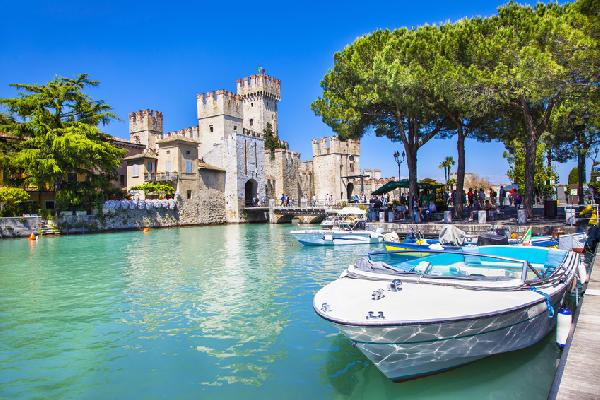
Sirmione
A picturesque town on a narrow peninsula jutting into Lake Garda, Italy’s largest lake. Known for its thermal spas and dramatic castle.
Key Attractions
Rocca Scaligera (Scaliger Castle): A stunning 13th-century moated castle guarding the town’s entrance. Climb the tower for panoramic views.
Grotte di Catullo (Grottoes of Catullus): The extensive ruins of a vast Roman villa at the very tip of the peninsula. The site offers incredible lake views.
Spa Treatments: Sirmione is famous for its thermal waters. Many hotels and public spas offer treatments.
Lakeside Promenade: Stroll along the beautiful shores, enjoy a gelato, and take in the serene atmosphere.
Practical Information
Getting There: From Milan or Venice, take a train to Desenzano del Garda/Sirmione station, then a short local bus ride to the town center. Access to the historic center is limited for non-resident vehicles.
Getting Around: The town is best explored on foot. Small boats can be taken to other lakeside towns.
Food Specialties: Fresh lake fish, such as trout and perch, and local olive oil.
Suggested Stay: 1-2 days as a tranquil interlude.
Venice (Venezia)
A city of unparalleled romance, built on over 100 small islands in a lagoon. Its canals, architecture, and art create a truly magical atmosphere.
Key Attractions
Piazza San Marco (St. Mark’s Square): The city’s main public square, surrounded by iconic landmarks.
Basilica di San Marco (St. Mark’s Basilica): A breathtaking Byzantine cathedral adorned with golden mosaics.
Palazzo Ducale (Doge’s Palace): The former seat of Venetian government, connected to the infamous prisons by the Bridge of Sighs.
Grand Canal: Take a vaporetto (water bus) along the main waterway to see the magnificent palazzos lining its banks.
Rialto Bridge: The oldest and most famous bridge spanning the Grand Canal, surrounded by a vibrant market.
Get Lost: The true magic of Venice lies in wandering its maze of narrow alleyways and small canals, away from the main tourist spots.
Practical Information
Getting There: The Venezia Santa Lucia train station is located right on the Grand Canal. Marco Polo Airport (VCE) is the main airport, with boat and bus transfers to the city.
Getting Around: Walking and Vaporetto are the only ways. Gondolas are a romantic but expensive tourist experience.
Food Specialties: Cicchetti (Venetian tapas), seafood risotto, fresh pasta with cuttlefish ink, and Prosecco.
Suggested Stay: 2-3 days.
Rimini
A major beach resort on the Adriatic Coast, known for its vibrant nightlife and long sandy beaches, but also boasting significant Roman history.
Key Attractions
Tempio Malatestiano (Malatesta Temple): A stunning Renaissance church designed by Leon Battista Alberti.
Arch of Augustus (Arco d’Augusto): The oldest surviving Roman triumphal arch, dating from 27 BC.
Ponte di Tiberio (Tiberius’ Bridge): A remarkably preserved Roman bridge still in use today.
The Beach: Miles of organized beaches with rows of sun loungers and umbrellas (stabilimenti balneari), which require a rental fee.
Fellini Connection: Rimini is the birthplace of famed director Federico Fellini; there are various tributes to him around the city.
Practical Information
Getting There: Well-connected by train on the main Bologna-Lecce line. Federico Fellini International Airport (RMI) is nearby.
Getting Around:The historic center is walkable. Buses connect the center to the beach areas.
Food Specialties: Piadina (a flatbread sandwich), fresh seafood from the Adriatic.
Suggested Stay: 1-2 days, primarily as a beach stop or for history enthusiasts.
Assisi
A sacred hilltown in Umbria, bathed in a pink hue from its local stone. It is the birthplace of St. Francis and a major pilgrimage site.
Key Attractions
Basilica di San Francesco (Basilica of St. Francis):A UNESCO site comprising two churches (Upper and Lower) adorned with magnificent frescoes by Giotto and Cimabue depicting the life of St. Francis.
Piazza del Comune:The heart of the medieval town, featuring the Roman Temple of Minerva.
Basilica di Santa Chiara (Basilica of St. Clare):Dedicated to St. Clare, founder of the Poor Clares, offering beautiful views of the valley.
Rocca Maggiore:A massive fortress overlooking the town, providing spectacular panoramic views of the Umbrian countryside.
Practical Information
Getting There:The closest train station is Assisi Santa Maria degli Angeli at the foot of the hill, with regular buses up to the old town. It’s also accessible by bus from Perugia or Florence.
Getting Around:The town is entirely walkable, but be prepared for steep hills and staircases.
Food Specialties:Umbrian cuisine like wild boar (cinghiale), truffles, lentils from Castelluccio, and Sagrantino wine.
Suggested Stay:1-2 days. The atmosphere is particularly serene in the early morning and evening.
The Italian Small Towns (“意大利小镇”)
The journey between Assisi and Rome cuts through the heart of Umbria and Lazio, regions dotted with enchanting hilltop villages. This is best explored with a rental car.
Suggestion 1: Umbrian Hill Towns
Todi:A perfectly preserved medieval gem with a beautiful central square.
Orvieto:A spectacular town perched on a tufa cliff, famous for its stunning striped Duomo and its network of underground caves.
Civita di Bagnoregio:The “Dying City” or “Sky City” (see next section). Often visited as a day trip from Orvieto.
Spoleto:A historic town with a Roman theater, a grand aqueduct (Ponte delle Torri), and a renowned annual festival.
Suggestion 2: Tuscan Hill Towns (Southern Part)
(If routing towards Siena after Rome)
Montepulciano:Renowned for its Vino Nobile wine and elegant Renaissance palaces.
Pienza:A perfect Renaissance town planned by Pope Pius II, famous for its pecorino cheese.
Montalcino:
The home of the prestigious Brunello di Montalcino wine.