Ultimate Italy Itinerary: A Grand Tour of Culture, Coast, and Countryside
Introduction
This comprehensive travel guide outlines a classic and enriching circuit of Italy, perfect for a two to three-week journey. The route is designed as a loop starting and ending in Rome, minimizing backtracking and maximizing the diversity of experiences. You will encounter the pinnacle of Renaissance art, medieval hill towns, dramatic coastal scenery, bustling modern cities, and serene spiritual centers. The itinerary balances iconic, must-see sights with lesser-known gems, providing a deep and varied impression of Italian culture, history, and cuisine.
The suggested route is:
Rome → Civita di Bagnoregio → Siena → Florence → Pisa → Cinque Terre → Milan → Sirmione → Venice → Rimini → Assisi → Rome. This guide provides objective descriptions and practical information for each destination to assist in planning your trip.
1. Rome (Roma)
Rome, the Eternal City, serves as the perfect start and end point for your Italian adventure. As the capital of Italy and the former heart of the Roman Empire, it is a sprawling open-air museum layered with over two millennia of history. From the awe-inspiring ruins of antiquity to the grandeur of the Vatican and the vibrant life of its piazzas, Rome is an overwhelming but unforgettable immersion in art, culture, and la dolce vita.
Key Attractions
The Colosseum: The iconic Flavian Amphitheatre, a symbol of Imperial Rome’s power and engineering prowess. Its massive structure hosted gladiatorial contests and public spectacles.
Roman Forum: The political, religious, and commercial center of ancient Rome. Walking through its ruins offers a tangible connection to the Roman Republic and Empire.
Pantheon: A remarkably preserved Roman temple, now a church, famed for its massive unsupported dome and oculus. It is a masterpiece of ancient engineering.
Vatican City: An independent city-state and the epicenter of the Catholic Church. Must-sees include St. Peter’s Basilica, with its Michelangelo-designed dome and Bernini’s baldachin, and the Vatican Museums, home to the Sistine Chapel and its legendary ceiling painted by Michelangelo.
Trevi Fountain: The largest Baroque fountain in the city. The tradition of throwing a coin into the fountain ensures your return to Rome.
Piazza Navona: A magnificent Baroque square built on the site of an ancient stadium, featuring Bernini’s Fountain of the Four Rivers and Borromini’s church of Sant’Agnese in Agone.
Spanish Steps: A grand staircase rising from the Piazza di Spagna to the Trinità dei Monti church, a popular spot for people-watching.
Practical Information
Getting There: Rome is served by two major airports: Leonardo da Vinci (Fiumicino, FCO) and Ciampino (CIA). The central Termini train station is a major hub for national and regional trains.
Getting Around: The historic center is best explored on foot. The Metro (subway), buses, and trams are efficient for longer distances. A Roma Pass can offer discounts and free public transport.
Accommodation: Areas like Trastevere, Monti, and near Termini Station offer a range of options from boutique hotels to hostels.
Food & Drink: Try classic Roman pasta dishes like Cacio e Pepe, Carbonara, and Amatriciana. Enjoy a coffee at a historic café and gelato from a local gelateria.
Tip: Book tickets for the Colosseum and Vatican Museums online well in advance to avoid extremely long queues.
2. Civita di Bagnoregio (The “Dying Town” / “Sky City”)
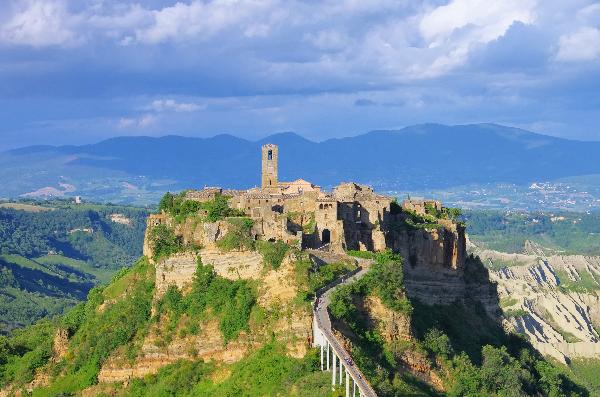
Perched precariously on a pinnacle of volcanic tuff in a vast canyon, Civita di Bagnoregio is often called “La Città che Muore” (The Dying Town) due to the ongoing erosion that threatens its existence. Accessible only by a long, steep footbridge, this tiny, isolated village feels suspended in time. Its magical, almost surreal appearance has earned it the nickname “Sky City.”
Key Attractions
The Footbridge: The dramatic entrance to Civita, offering stunning panoramic views of the calanchi (badlands) valley below.
San Donato Church: The main church on the central piazza, which houses a wooden crucifix from the 15th century.
The Medieval Village: The primary attraction is the village itself. Wander its silent, narrow lanes, admire ancient stone houses adorned with vines, and discover hidden gardens with breathtaking drop-off views.
Geological Museum: A small museum explaining the unique geology and erosion challenges facing the town.
Practical Information
Getting There: Civita is best reached by car or regional bus from Viterbo or Orvieto. There is a paid parking lot at the base of the footbridge in Bagnoregio.
Getting Around: The town is tiny and entirely pedestrianized. The only way to explore is on foot.
Accommodation: Very limited within Civita itself; more options are available in the modern town of Bagnoregio or nearby Orvieto.
Food & Drink: A few small trattorias and cafes operate within Civita. It’s a great place for a simple lunch with a view.
Tip: Visit early in the morning or late in the afternoon to avoid the day-trip crowds and experience the town at its most serene.
3. Siena
A quintessential medieval hill town in the heart of Tuscany, Siena is renowned for its unique Gothic architecture, its artistic heritage, and the Palio, a historic horse race held in its main square. Built over three hills, its red-brick buildings and winding streets offer a perfectly preserved glimpse into the 13th and 14th centuries.
Key Attractions
Piazza del Campo: One of Europe’s greatest medieval squares, famous for its shell shape and gentle slope. It is the site of the bi-annual Palio horse race.
Siena Cathedral (Duomo): A stunning example of Italian Romanesque-Gothic architecture. Its striped marble facade, intricate marble floor, Piccolomini Library, and works by Donatello and Michelangelo are highlights.
Palazzo Pubblico (Town Hall) & Torre del Mangia: The elegant Gothic city hall dominates the Piazza del Campo. Climb the 400 steps of the Torre del Mangia for an unparalleled view of the city and surrounding countryside.
San Domenico Basilica: This austere church houses relics of Saint Catherine of Siena, including her head.
Contrade Districts: Siena is divided into 17 contrade (city wards), each with its own museum, fountain, and church. Exploring these neighborhoods provides a deeper understanding of local identity.
Practical Information
Getting There: Siena is well-connected by bus from Florence (a ~1.5-hour journey). Train travel requires a change in Empoli.
Getting Around: The historic center is compact and best explored on foot. The city has a series of escalators and elevators to help navigate its steep hills.
Accommodation: Staying within the city walls is recommended for an authentic experience.
Food & Drink: Siena is known for rich dishes like Pici pasta (a thick, hand-rolled pasta), wild boar (cinghiale), and Panforte (a dense fruit and nut cake).
Tip: If you cannot attend the Palio (July 2 and August 16), visit the Museo del Palio to learn about its intense history and traditions.
4. Florence (Firenze)
The cradle of the Renaissance, Florence is an art lover’s paradise. Under the patronage of the powerful Medici family, this city on the Arno River fostered geniuses like Leonardo da Vinci, Michelangelo, and Botticelli. Its compact historic center is densely packed with some of the world’s most significant artistic and architectural treasures.
Key Attractions
Uffizi Gallery: One of the world’s top art museums, housing an unparalleled collection of Renaissance masterpieces, including Botticelli’s “Birth of Venus” and “Primavera,” and works by Leonardo da Vinci and Raphael.
Galleria dell’Accademia: Home to Michelangelo’s monumental statue of “David,” as well as his unfinished “Slaves.”
Florence Cathedral (Duomo): Dominating the skyline with its magnificent dome engineered by Filippo Brunelleschi. The complex includes Giotto’s Bell Tower and the Baptistery with its famous “Gates of Paradise.”
Ponte Vecchio: A medieval stone bridge spanning the Arno River, unique for its shops built along it, historically occupied by butchers and now by jewellers.
Pitti Palace & Boboli Gardens: The vast former residence of the Medici family, now hosting several important museums and art galleries. The sprawling Boboli Gardens are a superb example of Italian Renaissance gardening.
Piazzale Michelangelo: A square on a hillside offering the most famous postcard-perfect panoramic view of Florence.
Practical Information
Getting There: Florence’s Amerigo Vespucci Airport (FLR) handles European flights. The Santa Maria Novella (SMN) train station is a major stop on the Italian rail network.
Getting Around:The historic center is very walkable. Buses are useful for reaching Piazzale Michelangelo and Fiesole.
Accommodation:The areas around the Duomo, Santa Maria Novella station, and Oltrarno (across the river) offer a wide range of lodging.
Food & Drink:Fiorentina steak is the city’s signature dish. Also try Ribollita (a hearty vegetable soup) and Lampredotto (a tripe sandwich). Chianti wine from the surrounding region is a must.
Tip:Book tickets for the Uffizi and Accademia months in advance online. Consider getting a Firenze Card for priority access to many museums.