Central European Grand Tour: From Frankfurt to the Adriatic and Back
This comprehensive travel guide details a remarkable journey through the heart of Europe, blending the alpine splendour of Germany and Austria with the breathtaking Adriatic coastline and rich history of the Balkan nations. The itinerary, connecting Frankfurt, Munich, Salzburg, Lake Bled, Zagreb, Plitvice Lakes, Zadar, Dubrovnik, Mostar, Sarajevo, Split, Trogir, Ljubljana, Postojna, and Königssee, offers a diverse tapestry of cultures, landscapes, and unforgettable experiences.
Itinerary Overview
This is a circular route best undertaken over a period of two to three weeks. The journey involves a mix of transportation modes, including rental cars for the Alpine regions and reliable bus networks in the Balkans. The route is designed for a logical flow, minimizing backtracking and maximizing scenic enjoyment.
Start/End: Frankfurt, Germany
Primary Transport: Rental Car (Germany/Austria/Slovenia), Buses (Croatia/Bosnia & Herzegovina), Trains.
Recommended Duration: 18-21 days.
Key Themes: Imperial History, Alpine Lakes, Coastal Beauty, Medieval Towns, and Complex 20th-Century History.
Chapter 1: Germany – The Journey Begins
Frankfurt
Often the gateway to Germany due to its major international airport, Frankfurt am Main is a city of contrasts, where sleek skyscrapers stand alongside reconstructed historical buildings.
Attractions: The Römerberg is the city’s historic heart, featuring beautifully reconstructed medieval buildings. The Museumsufer (Museum Embankment) offers a concentration of world-class museums. For panoramic views, visit the main observation deck of the Main Tower.
Food & Drink: Frankfurt is famous for its Apfelwein (apple wine), traditionally drunk in a “geripptes” glass in the Sachsenhausen district. Try Grüne Soße (Green Sauce), a herb-based condiment served with boiled eggs and potatoes, and the hearty Frankfurter Rippchen (cured pork chops).
Transportation: Frankfurt Airport (FRA) is a major hub. The city has an excellent public transport system (U-Bahn, S-Bahn, trams). It is a central node for Germany’s high-speed ICE train network.
Accommodation Tips: Stay near the Hauptbahnhof (main station) for transport convenience or in the Altstadt (Old Town) for charm.
Munich (Initial Stop)
The capital of Bavaria, Munich, embodies a unique blend of traditional folk culture and modern innovation.
Attractions: The Marienplatz square, with its glockenspiel show in the Neues Rathaus (New Town Hall), is the central point. Explore the vast Englischer Garten park and visit the opulent Nymphenburg Palace. For a poignant historical experience, the Dachau Concentration Camp Memorial Site is a short trip away.
Food & Drink: No visit is complete without a visit to a Biergarten. Sample Weißwurst (white sausage) with sweet mustard, Schweinshaxe (roasted pork knuckle), and a massive Brezn (pretzel). Of course, wash it down with a Maß (one-liter stein) of local beer.
Transportation: Munich is easily reached from Frankfurt by high-speed train (approx. 3.5 hours) or by rental car via the A3 and A9 autobahns. The city has an efficient U-Bahn and S-Bahn system.
Chapter 2: Austria – The Sound of Music and Alpine Peaks
Salzburg (First Visit)
A Baroque jewel nestled at the foot of the Alps, Salzburg is universally known as the birthplace of Mozart and the setting for “The Sound of Music.”
Attractions: Dominating the city skyline is the Hohensalzburg Fortress, one of Europe’s largest medieval castles. Explore the Getreidegasse, a bustling shopping street with ornate wrought-iron signs. Cross the river to visit Mozart’s birthplace and the Mirabell Palace and Gardens.
Food & Drink: Indulge in Mozartkugeln (Mozart balls), chocolate and marzipan confections. Try classic Austrian dishes like Wiener Schnitzel and Salzburger Nockerl, a sweet soufflé.
Transportation: The drive from Munich to Salzburg is scenic and takes about 1.5 hours by car or train. Salzburg’s Old Town is compact and best explored on foot.
Cultural Insight: The city is deeply proud of its musical heritage. Attending a classical concert in one of its historic halls is a quintessential Salzburg experience.
Chapter 3: Slovenia – The Alpine Lake Gem
Lake Bled
A picture-perfect postcard come to life, Lake Bled is one of Slovenia’s most iconic destinations.
Attractions: The centerpiece is the lake itself, with a tiny island (Bled Island) housing a church, and a medieval castle (Bled Castle) perched on a cliff overlooking the water. A traditional “pletna” boat ride to the island is a must. For the active, a hike to viewpoints like Mala Osojnica offers stunning panoramas.
Food & Drink: Sample Bled’s famous cream cake, Kremna Rezina (Kremsnita). Slovenian cuisine is hearty; try žlikrofi (dumplings) or a goulash.
Transportation: Lake Bled is about a 3.5-hour drive from Salzburg. The town is small, and walking or cycling around the lake is the best way to get around.
Accommodation Tips: For the best views, book a hotel or guesthouse with a lake-view balcony.
Ljubljana
The charming capital of Slovenia feels like a fairy tale, with a vibrant café culture lining the banks of the Ljubljanica River.
Attractions: Ljubljana Castle, accessible by a funicular railway, offers commanding views. Stroll along the riverbanks, cross the famous Tromostovje (Triple Bridge), and admire the dragon statues on the Dragon Bridge. The central market, designed by architect Jože Plečnik, is also worth a visit.
Postojna Cave
A massive karst cave system and one of Slovenia’s top attractions.
Attractions: A unique electric train takes visitors deep into the caverns, followed by a walking tour through magnificent halls adorned with stalactites and stalagmites. The cave is also home to the peculiar olm, a blind amphibian.
Chapter 4: Croatia – From Inland Capital to Dalmatian Paradise
Zagreb
Croatia’s capital offers a more Austro-Hungarian feel compared to its coastal cities, with a lively upper and lower town.
Attractions: Explore the historic Gornji Grad (Upper Town), including St. Mark’s Church with its colourful tiled roof, the Stone Gate, and the Lotrščak Tower. In Donji Grad (Lower Town), wander through Ban Jelačić Square and the elegant Green Horseshoe series of parks and squares.
Food & Drink: Try štrukli (baked cheese pastry), zagrebački odrezak (a cordon bleu-style dish), and enjoy coffee at one of the many cafes.
Plitvice Lakes National Park
A UNESCO World Heritage site and one of the most beautiful natural wonders in Europe.
Attractions: A series of 16 terraced lakes, interconnected by stunning waterfalls and cascades. Wooden walkways and hiking trails allow visitors to explore the turquoise waters and lush forests. Allocate a full day for exploring.
Transportation: Buses from Zagreb to Plitvice are frequent. From Plitvice, buses continue to the coastal cities like Zadar and Split.
Zadar
A historic coastal city known for its unique modern installations set amidst ancient Roman ruins.
Attractions:The “Sea Organ”, an architectural sound art object that plays music via sea waves, and the “Greeting to the Sun”, a solar-powered light display, are mesmerizing, especially at sunset. Explore the Roman Forum and the distinctive St. Donatus Church.
Trogir & Split
Trogir:A tiny, perfectly preserved medieval town on a small island, connected by bridges to the mainland and Čiovo island. Its labyrinthine streets and Romanesque cathedral are a UNESCO site.
Split:Croatia’s second-largest city is built around the extraordinary Diocletian’s Palace. This Roman emperor’s retirement complex forms the living heart of the city, with shops, restaurants, and homes within its ancient walls. Climb the bell tower of St. Domnius Cathedral for incredible views.
Dubrovnik
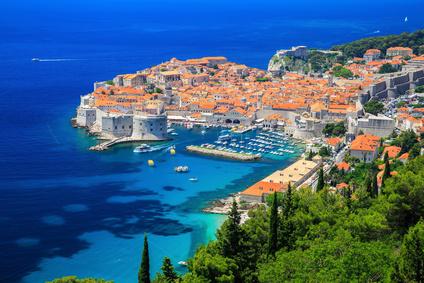
The “Pearl of the Adriatic,” a magnificent walled city that has become globally famous.
Attractions:The primary activity is walking the complete circuit of the ancient city walls, offering unparalleled views of orange-tiled roofs and the sea. Stroll down the polished limestone Stradun (main street), visit the Rector’s Palace, and take the cable car up to Mount Srđ for a breathtaking panorama.
Food & Drink:Savor fresh seafood, especially black risotto (crni rižot) and oysters from nearby Ston. Enjoy a glass of local wine from the Pelješac peninsula.
Crucial Tip:The city can be extremely crowded; visiting early in the morning or in the shoulder season (May, June, September) is highly recommended.
Chapter 5: Bosnia & Herzegovina – A Journey Through History
Mostar
The most iconic city of Bosnia, symbolizing both tragic division and hopeful reconciliation.
Attractions:The magnificent rebuilt Stari Most(Old Bridge) is the heart of the city. Watch daredevil divers leap from it into the Neretva River below. Explore the cobblestone streets of the old bazaar (Kujundžiluk) on either side of the bridge. The city still bears scars from the 1990s war, offering a sobering but important historical perspective.
>