A Comprehensive Walking Tour of Berlin’s Historic Core
This detailed guide outlines a classic and immersive one-day walking tour through the very heart of Berlin, Germany. The journey begins at the iconic Alexanderplatz, a sprawling square that epitomizes the city’s post-war GDR era, and winds its way through historic landmarks, regal boulevards, and cultural treasures, concluding with a return to the starting point. This route is designed to offer a profound understanding of Berlin’s layered history, from its Prussian kings and German Kaisers to the Cold War division and its vibrant modern reunification. Prepare for a day of exploration covering approximately 4-5 kilometers on foot, a distance best experienced slowly to absorb the immense historical weight and contemporary energy of this fascinating capital.
Starting Point: Alexanderplatz
Your journey begins at
Alexanderplatz, or “Alex” as the locals call it. This vast, open square is more than just a major transportation hub; it is a living monument to Berlin’s socialist past. During the Cold War, it was the centerpiece of East Berlin, and its architecture remains overwhelmingly utilitarian and monumental, a style characteristic of the German Democratic Republic (GDR).
The most dominant feature is the
Fernsehturm (Berlin TV Tower). Soaring 368 meters into the sky, it is the tallest structure in Germany. Built in the 1960s as a symbol of socialist technological prowess, it was nicknamed “Der Rache des Papstes” or “The Pope’s Revenge” by Berliners because of the cross-shaped reflection the sun often creates on its spherical dome. For a breathtaking 360-degree panoramic view of the entire city, a trip to the observation deck is highly recommended. Try to book tickets online in advance to avoid long queues.
Other notable structures on the square include the
World Time Clock, a popular meeting point that displays the time in various cities around the world, and the Fountain of International Friendship. The Rotes Rathaus (Red City Hall), which you will visit next, is visible from the square, providing a perfect visual link to your next destination.
Food & Drink: For an authentic taste of old East Berlin, seek out a Currywurst stand. This classic Berlin fast food consists of steamed then fried pork sausage cut into slices and seasoned with curry ketchup and a sprinkle of curry powder. It’s the perfect fuel to start your walk. Alternatively, the Alexa shopping mall adjacent to the square offers a food court with more variety.
Transport Tip: Alexanderplatz is served by S-Bahn lines (S3, S5, S7, S9), U-Bahn lines (U2, U5, U8), regional trains, and numerous trams and buses. It is arguably the most connected point in the city.
Cultural Insight: While today it’s a bustling commercial center, take a moment to imagine the square during GDR times, filled with people and state-organized parades. The atmosphere was strictly controlled, a stark contrast to the vibrant, chaotic freedom of today.
First Stop: Rotes Rathaus (Red City Hall)
A short two-minute walk south from Alexanderplatz brings you to the
Rotes Rathaus. Despite its name (“Red City Hall”), the color refers not to politics but to its distinctive red brick façade. This Renaissance-revival building, completed in 1869, serves as the seat of the Governing Mayor and the government of the state of Berlin.
The Rathaus has a complex history. Heavily damaged during World War II, it was reconstructed by the East German government. During the division of Berlin, while the city was officially under Four-Power control, the East Berlin magistrate operated from here, while West Berlin’s government was based in Schöneberg. Its current role as the central city hall for a unified Berlin makes it a powerful symbol of the city’s restored wholeness.
The interior is impressive, particularly the
Wappensaal (Coat of Arms Hall) and the grand staircase, but public access can be limited as it is a functioning government building. It’s always worth checking the official website for information on guided tours or open days.
What to See: Admire the terracotta frieze that wraps around the entire building, depicting scenes from Berlin’s history up until its construction. The square in front often hosts open-air exhibitions and markets.
Local Insight: Directly behind the Rathaus is the Neptunbrunnen (Neptune Fountain), a magnificent 19th-century fountain featuring the sea god Neptune surrounded by mythological figures representing four major Prussian rivers. It’s a beautiful spot often missed by hurried tourists.
The Grand Boulevard: Unter den Linden
From the Rotes Rathaus, walk west past the Neptune Fountain, and you will find yourself at the eastern end of Berlin’s most famous boulevard,
Unter den Linden (“Under the Lime Trees”). This tree-lined avenue stretches 1.5 kilometers from the Lustgarten to the Brandenburger Tor (Brandenburg Gate), though your tour will focus on its central section.
As you begin your stroll, you are walking in the footsteps of Prussian royalty, 19th-century intellectuals, and Nazi stormtroopers. This was the ceremonial heart of Prussian Berlin, and its buildings reflect this grand history. Key sights along this section include:
The Berlin State Opera: One of the oldest and most renowned opera houses in Germany.
Humboldt University: Founded in 1810, its alumni include Karl Marx, Albert Einstein, and the Brothers Grimm. The empty bookshelves of the Bebelplatz, just next to the university, serve as a haunting memorial to the Nazi book burnings of 1933.
Zeughaus (Old Arsenal): The oldest building on the boulevard, it now houses the German Historical Museum, an excellent resource for those wanting to delve deeper into the nation’s complex past.
The walk along Unter den Linden is an experience in itself. The wide sidewalks, the shade of the lime trees, and the steady stream of city life create a palpable sense of history and place.
Food & Drink: For a classic Berlin café experience, consider Opernpalais, located opposite the State Opera. It’s famous for its traditional German cakes and its sprawling outdoor terrace—a perfect spot for people-watching. For something quicker, there are numerous sausage and pretzel stands along the way.
Transport Tip: Unter den Linden is easily walkable. The U-Bahn station “Unter den Linden” (U5) is located at the eastern end, providing a convenient link if you wish to skip parts of the walk.
A Baroque Masterpiece: Berlin Cathedral
As you continue west on Unter den Linden, the magnificent dome of the
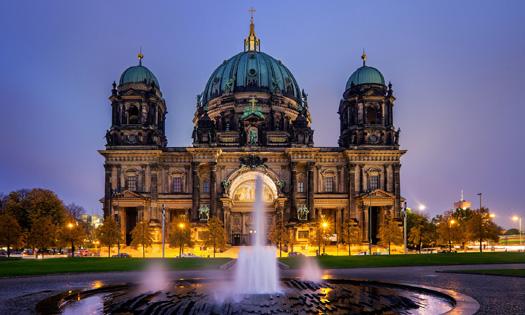
Berlin Cathedral (Berliner Dom) will loom into view on your left. Do not be fooled by the name; this is not a cathedral in the strict ecclesiastical sense but a Protestant church of monumental proportions. Built between 1894 and 1905 under Kaiser Wilhelm II, it was intended as a dynastic church for the Hohenzollern family and a Protestant counterweight to St. Peter’s Basilica in Rome.
The cathedral is a masterpiece of High Renaissance and Baroque revival architecture. Its opulent interior is breathtaking, featuring an incredibly ornate altar, a magnificent Sauer organ, and detailed mosaics on the dome’s ceiling. You can climb 270 steps to the dome’s outer walkway for another spectacular close-up view of Museum Island and central Berlin.
Beneath the church lies the
Hohenzollern Crypt, one of the most important dynastic sepulchres in Germany, containing nearly 100 sarcophagi from five centuries. The contrast between the lavish church above and the somber, historic crypt below is striking.
What to See: Don’t miss the baptismal and matrimonial chapel and the impressive painted dome. The cathedral often hosts organ concerts; check their schedule for an unforgettable auditory experience.
Practical Tip: There is an entrance fee to visit the cathedral (which includes access to the dome and crypt). Allow at least 60-90 minutes for a proper visit. Modest dress is recommended.
Cultural Insight: The cathedral was severely damaged during WWII and was left as a ruin by the East German government, which had no interest in restoring a symbol of imperial power. Reconstruction only began in earnest in the 1970s and was completed after reunification—a testament to Berlin’s commitment to restoring its historical fabric.
The Pulse of Modern Berlin: Friedrichstraße
After descending from the heights of the cathedral dome, walk south away from Unter den Linden and you will soon reach
Friedrichstraße. This north-south artery represents a completely different facet of Berlin: chic, modern, and commercial. Historically a street of luxury and culture, it was brutally severed by the Wall during the Cold War.
The most famous Cold War landmark here is
Checkpoint Charlie, located just a short walk south on Friedrichstraße. This was the best-known border crossing between East and West Berlin for foreigners and Allied personnel. Today, it’s a bustling tourist spot with a replica guardhouse and actors in period uniforms. While it can feel overly commercialized, its historical significance is immense.
Further north, Friedrichstraße transforms into a high-end shopping destination. Here you will find flagship stores for international luxury brands as well as architectural marvels like the
Galeries Lafayette, a French department store with a stunning conical glass vortex at its center.
Food & Drink: Friedrichstraße caters to all tastes and budgets. For a truly upscale experience, the rooftop restaurant at the Hotel de Rome (a short detour on Behrenstraße) offers stunning views. For a more casual but classic Berlin meal, find a traditional Kneipe (pub) on a side street off Friedrichstraße for hearty German fare like Eisbein (pork knuckle) or Schnitzel.
Shopping Tip: Even if luxury shopping isn’t your goal, step inside the Quartier 206 mall or Galeries Lafayette to admire their impressive interior architecture.
Historical Insight: Look for remnants of the Wall’s “death strip” near Checkpoint Charlie. The area surrounding it is now filled with new construction, but markers on the ground indicate where the Wall once stood—a powerful reminder of how recently this division defined daily life.
The Return Journey and Concluding Thoughts
From Friedrichstraße, your circular tour is nearly complete. You can easily return to your starting point at Alexanderplatz by walking east for about 15-20 minutes. Alternatively, you can hop on the U-Bahn at “Stadtmitte” (U2) or “Hausvogteiplatz” (U2) for a direct ride back to “Alexanderplatz” (U2/U5/U8). Walking back allows you to see the city transition once more from commercial glamour back to socialist-scale plazas.
As you return to Alexanderplatz, with its towering Fernsehturm glowing against the evening sky, take a moment to reflect on your journey. In just a few hours on foot, you have traversed centuries of German history: from Prussian imperialism at Unter den Linden and the Berlin Cathedral, through the devastating division symbolized by Checkpoint Charlie and Friedrichstraße’s rebirth, to the socialist ambition of Alexanderplatz and its enduring legacy in a now-unified, dynamic capital.
This tour provides a foundational understanding of Berlin’s complex identity. Each landmark tells a part of the story, but it is in walking between them that you truly feel Berlin’s resilience and its relentless drive to reinvent itself while never forgetting its past.
Practical Travel Tips for Your Berlin Walking Tour
Footwear is Key: This is a walking tour. Comfortable, broken-in shoes are non-negotiable.
Public Transport: Purchase a day pass for Berlin’s public transport (VBB zones AB). It will cover all your S-Bahn, U-Bahn, tram, and bus travel within the city center for 24 hours and offers excellent flexibility.
Museum Island Consideration: Your route passes directly by Museum Island. If you are an art or history enthusiast, consider dedicating an entire separate day to exploring its five world-class museums (Pergamonmuseum, Neues Museum, Altes Museum, Bode-Museum, Alte Nationalgalerie).
Cafe Culture: Germans love their coffee and cake (Kaffee und Kuchen). Embrace this tradition by taking a mid-afternoon break at one of the many cafés you’ll encounter.
Stay Hydrated: Carry a reusable water bottle. You can refill it at public fountains found in many squares.
The Berlin WelcomeCard: If you plan to visit many paid attractions (like the TV Tower or Berlin Cathedral) and use public transport extensively, this tourist card can offer significant savings.