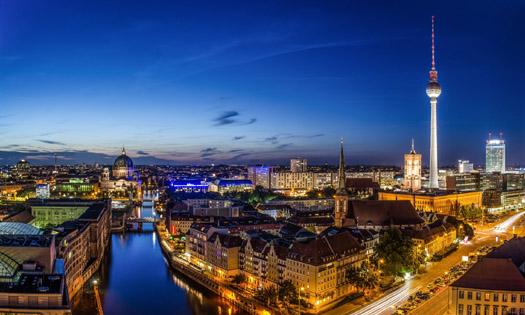
A Comprehensive Travel Guide: Exploring Berlin’s Historical Heart
This guide outlines a comprehensive one-day walking tour through the core of Berlin, Germany, connecting some of the city’s most significant historical and cultural landmarks. The route is designed to be logical and walkable, offering a profound journey from Prussian royalty and the Third Reich, through the Cold War division, to the vibrant, reunited capital of today. The itinerary starts from a central meeting point, proceeds through key sites, and concludes with suggestions for the evening.
Starting Point: Central Meeting Locations
Before embarking on the tour, it is practical to start from a central, easily accessible location. Two prime suggestions are:
Pariser Platz: This is the square directly facing the Brandenburg Gate. Starting here immediately immerses travelers in the historical significance of the city. The square itself is surrounded by embassies, the luxurious Hotel Adlon, and the Akademie der Künste (Academy of Arts).
Hauptbahnhof (Central Station): For those utilizing public transport, the Hauptbahnhof is Europe’s largest two-level train station and a major transportation hub. From here, it’s a short walk or a single S-Bahn stop to the Reichstag building or Brandenburg Gate.
1. Brandenburg Gate (Brandenburger Tor)
The Brandenburg Gate is arguably Berlin’s most iconic landmark. Built in the 18th century as a symbol of peace, it has since witnessed Napoleonic triumphs, Nazi parades, Cold War division, and the joyous celebrations of German reunification. Standing in the former “death strip” of no-man’s land between East and West Berlin, it now stands as a powerful symbol of European unity and peace.
Attraction Introduction
This neoclassical triumphal arch, modeled on the Propylaea of Athens’ Acropolis, features twelve Doric columns and the famous Quadriga statue—a chariot drawn by four horses driven by Victoria, the Roman goddess of victory. Visitors can walk through its five passages, which were closed off by the Berlin Wall from 1961 to 1989.
Cultural Insights
The Gate’s meaning has been reinvented with each era. Today, it is a focal point for national celebrations like New Year’s Eve and a venue for major public events. It represents not just German history, but a hope for a borderless world.
Transportation Information
U-Bahn: U55 to Brandenburger Tor. S-Bahn: S1, S2, S25, S26 to Brandenburger Tor. Numerous bus lines also stop nearby.
2. German Parliament Building (Reichstag Building)
A short walk north from the Brandenburg Gate brings you to the Reichstag Building, the seat of the German Bundestag (parliament). Its history is a mirror of Germany’s turbulent past: it was opened in 1894, burned mysteriously in 1933 (a key event used by the Nazis to consolidate power), severely damaged in WWII, partially restored in the Cold War, and finally completely renovated after reunification with its now-famous glass dome.
Attraction Introduction
The main attraction is the magnificent glass dome designed by architect Norman Foster. Visitors can walk up a spiraling ramp to the top for a 360-degree panoramic view of Berlin. The dome is a masterpiece of symbolism and engineering; its central funnel of mirrors reflects light into the parliamentary chamber below, representing the transparency of government (“the people above their politicians”).
Practical Information & Food
Visiting: Entry to the dome is free, but registration is mandatory. It is highly recommended to book online well in advance on the official Bundestag website. Walk-in registration is available at the service centre nearby, but slots are limited.
Food Recommendation: The rooftop restaurant, Kafer Dachgarten Restaurant, offers high-quality German and international cuisine with an unparalleled view. Reservations are essential. For a quicker, more casual meal, the canteen (Besucherrestaurant) inside is a good option.
3. Memorial to the Murdered Jews of Europe (Holocaust Memorial)
A somber and powerful five-minute walk south of the Brandenburg Gate lies this haunting memorial. Designed by architect Peter Eisenman, it was inaugurated in 2005 to honor the six million Jewish victims of the Holocaust.
Attraction Introduction
The above-ground “Field of Stelae” consists of 2,711 concrete slabs of varying heights arranged in a grid pattern on a sloping, undulating field. Walking among them creates a disorienting, isolating atmosphere meant to evoke the sense of fear and confusion experienced by the victims. Beneath the field is the
Place of Information, an underground museum that documents the victims through personal stories, letters, and diaries. This is an essential visit to contextualize the abstract memorial above.
Cultural Insights
The memorial’s abstract nature was intentionally chosen to allow for personal interpretation. It serves as a permanent, central place of remembrance and reflection in the heart of Berlin, forcing the nation to confront its past openly. Visitors are expected to behave respectfully; walking on the stelae or loud behavior is considered inappropriate.
4. Checkpoint Charlie
From the memorial, head southeast for about 15-20 minutes to reach Checkpoint Charlie, the most famous crossing point between East and West Berlin during the Cold War. It was used primarily by Allied personnel and foreigners.
Attraction Introduction
The current checkpoint is a replica of the original guardhouse. Actors dressed as American military police are often present for photo opportunities (for a tip). The surrounding area is filled with history: information panels detail dramatic escape attempts, and segments of the Wall are visible. The nearby
Checkpoint Charlie Museum (Mauermuseum) is a privately-run museum dedicated to the history of the Wall and stories of those who attempted to flee from East to West.
Cultural Insights & Food
Checkpoint Charlie today is a potent mix of heavy history and overt tourism. It highlights the absurdity and danger of a divided city. While it can feel commercialized, its historical significance is undeniable.
Food Recommendation: For a classic German currywurst experience, head to Curry & Chilli on Friedrichstraße. For a proper sit-down meal, Lutter & Wegner, a traditional German restaurant just a short walk away, is renowned for its Austrian and German cuisine and excellent wine selection.
5. Unter den Linden
From Checkpoint Charlie, walk north to reach the grand boulevard of Unter den Linden (“Under the Linden Trees”). This east-west artery was once the ceremonial route of Prussian kings and emperors, leading directly to the City Palace.
Attraction Introduction
Walking westwards back towards the Brandenburg Gate, you will pass numerous significant buildings:
Bebelplatz: Notorious as the site of the Nazi book burning in 1933. A memorial by Micha Ullman—a window set into the cobblestones showing empty bookshelves—is a powerful reminder.
State Opera (Staatsoper Unter den Linden): One of the leading opera houses in the world.
Humboldt University: One of Europe’s most prestigious universities, whose alumni include Einstein, Marx, and Engels.
Zeughaus: The old armory, now home to the German Historical Museum (Deutsches Historisches Museum).
Cultural Insights
Unter den Linden represents Berlin’s aspiration and imperial power. Its reconstruction after German reunification symbolized the effort to stitch the city’s historical center back together after decades of division.
6. Berlin Wall Memorial & East Side Gallery
While this itinerary is primarily walkable, visiting significant remnants of the Berlin Wall requires a short journey via public transport.
A. Berlin Wall Memorial (Gedenkstätte Berliner Mauer)
Location: Bernauer Strasse. Take the S-Bahn (S1, S2, S25, S26) from Brandenburger Tor or Unter den Linden to Nordbahnhof station.
This is the central memorial site of German division. It is a must-see for understanding the Wall’s mechanics and human cost. It preserves a 70-meter-long section of the border fortifications complete with the “death strip,” a watchtower, and excavation marks of escape tunnels. The open-air exhibition and documentation center provide harrowing accounts of escape attempts and the lives torn apart by the Wall.
B. East Side Gallery
Location: Mühlenstraße, near Ostbahnhof station. Take the S-Bahn from Friedrichstraße or other central stations to Ostbahnhof.
This is the longest remaining section of the Berlin Wall (1.3 km) and has been transformed into an international memorial for freedom. After the Wall fell, 118 artists from 21 countries painted murals on this segment. The most famous is Dmitri Vrubel’s “My God, Help Me to Survive This Deadly Love,” depicting the fraternal kiss between Brezhnev and Honecker. It is an iconic open-air gallery celebrating peace and the fall of oppression.
Return & Evening Conclusion
The tour concludes after exploring the Wall sites. From either location, it is easy to return to the city center via S-Bahn.
For Dinner: Consider heading to the adjacent neighborhoods of Mitte, Kreuzberg, or Prenzlauer Berg.
Mitte: For upscale dining, try Zur Letzten Instanz, Berlin’s oldest restaurant dating back to 1621.
Kreuzberg: For a vibrant, multicultural food scene, explore around Oranienstraße or Bergmannstraße for everything from Turkish cuisine to trendy vegan bistros.
For Accommodation:
Luxury: Hotel Adlon Kempinski (at Pariser Platz), The Ritz-Carlton.
Mid-Range: Motel One Berlin-Hauptbahnhof, AMANO Grand Central.
Budget/Boutique: The Circus Hotel, Michelberger Hotel (in Friedrichshain).
General Transportation Tips for Berlin
- The public transport system (BVG) is excellent, integrating U-Bahn (subway), S-Bahn (city train), trams, and buses.
- A Day Ticket (
Tageskarte) for zones AB is highly cost-effective for this itinerary and further exploration.
- Always validate your ticket in the red or yellow stamping machines before boarding trains. Failure to do so results in a fine.
- Walking and cycling are fantastic ways to explore the city center. Many bike rental shops are available.
Culinary Insights: What to Eat in Berlin
Berlin’s food scene is as diverse as its history.
Currywurst: Steamed then fried pork sausage sliced and topped with ketchup and curry powder. A true Berlin institution.
Döner Kebab: Invented by Turkish immigrants in Berlin, this is arguably the city’s most popular fast food.
Eisbein: A traditional dish of pickled ham hock, usually served with sauerkraut and mashed peas.
Berliner Pfannkuchen:A jelly-filled doughnut without a hole (known simply as “Berliner” in most of Germany).
Craft Beer: Berlin has a thriving craft beer scene beyond its classic Berliner Weisse (a tart wheat beer).
This walking tour through Berlin’s core offers more than just sightseeing; it is a journey through the layers of European history of the 20th and 21st centuries. It provides a deep understanding of resilience, memory, and the ongoing project of reconciliation and unity.