A Comprehensive Travel Guide: Southern Germany and Beyond
This itinerary explores the heart of Bavaria and ventures into the breathtaking landscapes of the Austrian Salzkammergut. It is a journey through fairy-tale castles, majestic Alpine peaks, picturesque villages, and rich cultural traditions, starting and ending in the vibrant metropolis of Munich.
Munich (München)
Munich, the capital of Bavaria, is a city that effortlessly blends traditional German culture with modern innovation. It serves as the perfect start and end point for this epic road trip.
Attractions
Marienplatz: The central square and heart of the city since 1158. Visitors gather to watch the Glockenspiel in the Neues Rathaus (New Town Hall) perform its charming dance at 11 am and 12 pm (also 5 pm in summer).
Frauenkirche (Cathedral of Our Blessed Lady): The iconic twin-domed church is a symbol of Munich. Its simple, Gothic interior offers a stark contrast to its imposing exterior.
English Garden (Englischer Garten): One of the world’s largest urban parks. It’s a place for relaxation, sunbathing, and watching surfers ride the standing wave at the Eisbach river.
Nymphenburg Palace: A magnificent Baroque palace, the summer residence of the Bavarian monarchs. The sprawling gardens and opulent interior, including the famous “Gallery of Beauties,” are not to be missed.
Deutsches Museum: One of the world’s oldest and largest museums of science and technology, offering interactive exhibits on everything from astronomy to mining.
Food & Drink
Weißwurst: A traditional Bavarian veal sausage, typically eaten before noon. Enjoy it with sweet mustard, a pretzel, and a wheat beer.
Schweinshaxe: A crispy, roasted pork knuckle, often served with dumplings and sauerkraut.
Beer Halls: Experience the quintessential Munich atmosphere at historic beer halls like the Hofbräuhaus, Augustiner-Keller, or Löwenbräukeller.
Biergarten: In warmer months, join the locals at a beer garden such as the one at the Chinese Tower (Chinesischer Turm) in the English Garden.
Transportation & Accommodation
Munich has an excellent public transportation system (MVV) comprising U-Bahn (subway), S-Bahn (suburban train), trams, and buses. The city center is very walkable. For accommodation, areas around the Hauptbahnhof (central station) offer convenience, while districts like Schwabing or Maxvorstadt provide a more local vibe.
Oberammergau & Surroundings
Leaving Munich and heading south, the landscape transforms into the rolling foothills of the Bavarian Alps.
Oberammergau
Famous worldwide for its Passion Play, which takes place every ten years (next in 2030), this charming village is also renowned for its Luftmalerei (air painting) – elaborate frescoes that adorn the facades of houses depicting biblical scenes, fairy tales, and local history.
Attractions: Stroll through the town to admire the painted houses. Visit a woodcarving workshop, a centuries-old tradition here.
Cultural Insight: The Passion Play tradition dates back to 1634 when townspeople vowed to perform the play if God spared them from the bubonic plague.
Linderhof Palace
A short drive from Oberammergau lies Linderhof Palace, the smallest but most intimate of King Ludwig II’s castles and the only one he saw completed. It is a rococo masterpiece set in a beautifully manicured park with fountains, terraces, and whimsical structures like the Venus Grotto—an artificial cave where the king had a shell-shaped boat.
Tips: Purchase tickets in advance online to avoid long queues. The interior can only be visited on a guided tour.
Neuschwanstein Castle & Füssen
The journey continues to the most famous castle in the world, the archetype of a fairy-tale fortress.
Neuschwanstein Castle
Commissioned by the “Fairytale King” Ludwig II as a homage to Richard Wagner’s operas and Germanic legends, Neuschwanstein is a 19th-century Romanesque Revival palace perched on a rugged hill. Its dramatic silhouette inspired Walt Disney’s Sleeping Beauty Castle.
Tickets & Access: Booking tickets online well in advance is absolutely essential. The ticket center is in Hohenschwangau village at the foot of the hill. From there, it’s a steep 30-40 minute walk, a shuttle bus (plus a short walk), or a horse-drawn carriage ride to the castle itself.
Marienbrucke (Mary’s Bridge): For the iconic postcard view of the castle, walk to this bridge which spans a gorge just above the castle.
Hohenschwangau Castle
Often overlooked in favor of its famous neighbor, this yellow castle is where King Ludwig II spent his childhood. It offers a more authentic glimpse into royal life and is well worth a visit.
Füssen
This charming old town, nestled at the end of the Romantic Road, is the main service hub for visitors to the castles. Its cobblestone streets, colorful buildings, and proximity to the Forggensee lake make it a pleasant place to stay overnight.
Accommodation: Staying in Füssen or nearby Schwangau allows for an early start to beat some of the crowds at Neuschwanstein.
Zugspitze & Garmisch-Partenkirchen
The route now heads east towards Germany’s highest peak.
Zugspitze
At 2,962 meters (9,718 feet), the Zugspitze offers panoramic views over Germany, Austria, Italy, and Switzerland. There are several ways to ascend:
Cogwheel Train & Cable Car: The Zugspitzbahn cogwheel train travels from Garmisch-Partenkirchen through a tunnel inside the mountain to the Glacier Garden station, where the Gletscherbahn cable car completes the journey to the summit.
Eibsee Cable Car: For a more dramatic aerial ride, take the Eibsee-Seilbahn from the beautiful Lake Eibsee, which offers stunning views directly to the top.
At the summit, you can walk on a platform overlooking a precipice, visit a chapel, and cross into Austria via a short path.
Garmisch-Partenkirchen
A world-renowned ski resort and spa town that hosted the 1936 Winter Olympics. The town has a distinct Alpine charm with its painted houses and wrought-iron balconies.
Attraction – Partnachklamm: A spectacular deep gorge with walkways carved into the rock walls alongside a roaring river. It’s a must-do hike (be sure to have waterproof clothing).
Food: Try hearty mountain fare like Kaiserschmarrn (shredded pancake) or Germknödel (yeast dough dumpling with plum filling).
Austrian Salzkammergut: Hallstatt & Bad Ischl
The journey now crosses the border into Austria, entering the stunning lake district of the Salzkammergut, a UNESCO World Heritage landscape.
Hallstatt
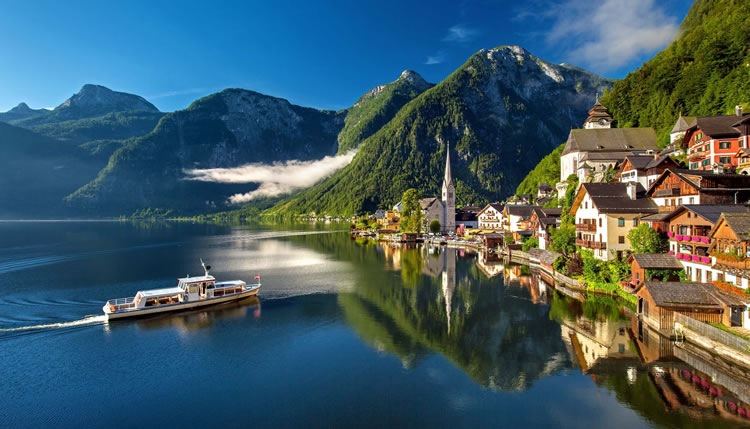
Often described as the “Pearl of the Salzkammergut,” Hallstatt is a picture-perfect village nestled between the towering Dachstein mountains and the serene Hallstätter See. Its history dates back thousands of years due to its salt mines.
Attractions:
Market Square (Marktplatz): The charming central square with its colorful houses.
World Heritage Viewpoint: The classic photo spot across the lake, accessible by a short walk or boat.
Salt Mine (Salzwelten Hallstatt): Take a funicular up the mountain to visit one of the world’s oldest salt mines, which includes a wooden slide and an underground salt lake.
Bone House (Beinhaus): Located next to the Catholic church, this small charnel house contains painted skulls—a unique local tradition due to limited burial space.
Cultural Insight: Hallstatt’s salt mining heritage is so significant that it gave its name to the early Iron Age “Hallstatt Culture.”
Transport Tip: Due to its popularity, parking is extremely limited. It is highly recommended to use the park-and-ride system from outside the village or arrive by train and ferry.
Bad Ischl
A historic spa town that was the summer retreat of Emperor Franz Joseph I and Empress Elisabeth (“Sisi”) of Austria. It was here, in 1914, that the Emperor signed the declaration of war against Serbia, triggering World War I.
Attractions:
Kaiservilla (Imperial Villa): The former summer residence of the Habsburgs, set in a beautiful park. The guided tour offers a fascinating glimpse into imperial life.
Café-Konditorei Zauner: A world-famous pastry shop established in 1832, beloved by the imperial family. Trying their pastries is an essential cultural experience.
Food: Indulge in a slice of Ischler Torte, a delicious hazelnut and chocolate layered cake, with a coffee.
The Return to Munich
The drive back from Bad Ischl to Munich takes you through more beautiful Austrian and Bavarian countryside. Consider stopping at one of the many smaller lakes or villages along the way for a final taste of Alpine serenity before returning to the urban energy of Munich.
Practical Trip Information
Best Time to Visit
Spring (May-June) & Autumn (September-October): Ideal for pleasant weather, fewer crowds, and beautiful foliage in autumn.
Summer (July-August): Peak season with warm weather and long days, but also the largest crowds. Essential to book everything far in advance.
Winter (December-March): A magical time with Christmas markets and snow-covered landscapes, perfect for winter sports around Garmisch. Some attractions may have reduced hours.
Transportation: The Road Trip
The most flexible way to do this itinerary is by car (rented from Munich). The German Autobahn and Austrian motorways are efficient. Be aware that Austrian motorways require a Vignette (toll sticker), available at border gas stations. Alternatively, this trip can be done by a combination of trains and regional buses (e.g., Bayern-Ticket in Germany for regional travel), though it requires more planning and time.
Accommodation Strategy
A mix of bases works well for this loop. Spend multiple nights in Munich at the start/end. For the Alpine section, consider staying 1-2 nights in Füssen/Schwangau to explore the castles and 1-2 nights in Garmisch-Partenkirchen for Zugspitze and Partnachklamm. An overnight stay in Hallstatt or Bad Ischl is highly recommended to experience Hallstatt after the day-trippers have left.
Cuisine Summary
The culinary journey reflects the regions: robust Bavarian meat dishes and beer in Germany; lighter Austrian fare like Wiener Schnitzel, freshwater fish from the lakes, and exquisite pastries in Austria. Always be sure to try local specialties in each town.
Cultural Etiquette
- A simple “Guten Tag” (Good day) or “Grüß Gott” (a common Bavarian/Austrian greeting) goes a long way.
- In beer halls and gardens, it is customary to share tables when they are crowded.
- Tipping is common; round up the bill or leave 5-10% for good service.
- Cash (Euros) is still king in many smaller restaurants and shops, especially in rural areas.