Grand European Tour: Paris to Rome via the Alps
An unforgettable journey through the heart of Western Europe, blending art, history, alpine landscapes, and Mediterranean charm.
Introduction to the Journey
This extensive itinerary connects three of Europe’s most beloved countries: France, Switzerland, and Italy. It is designed to showcase a diverse range of experiences, from the cosmopolitan grandeur of Paris and Rome to the storybook villages of Alsace, the breathtaking majesty of the Swiss Alps, the romantic canals of Venice, and the rolling hills of Tuscany. Travel is primarily by Europe’s efficient rail network, offering scenic and comfortable journeys between destinations.
The route is logical and geographically sequential, minimizing travel time and maximizing immersion. It is recommended to dedicate a minimum of two to three weeks to fully appreciate the depth and variety of this tour.
France: Art and Alsatian Charm
Paris
The journey begins in the French capital, a global center for art, fashion, gastronomy, and culture. Paris is a city of immense scale and history, where every arrondissement (district) offers a unique character.
Key Attractions:
Eiffel Tower: The iconic symbol of Paris. Advance booking for lifts is essential to avoid long queues. Consider the stairs for a less crowded and more affordable option up to the second floor.
Louvre Museum: Home to thousands of works of art, including the Mona Lisa and the Venus de Milo. Purchase tickets online in advance. It’s vast, so prioritize what you want to see.
Notre-Dame Cathedral: While the interior remains closed for restoration after the 2019 fire, the exterior is still a masterpiece of French Gothic architecture and the Île de la Cité is worth exploring.
Arc de Triomphe & Champs-Élysées: Climb the Arc for one of the best panoramic views of Paris, looking down the twelve radiating avenues.
Montmartre & Sacré-Cœur: A historic artistic neighborhood on a hill, crowned by the dazzling white Basilica of Sacré-Cœur. Enjoy street artists and charming cafés.
Practical Information:
Getting In: Served by two major international airports: Charles de Gaulle (CDG) and Orly (ORY).
Getting Around: The Paris Métro is extensive and efficient. A carnet (pack of 10 tickets) is cost-effective. Walking is the best way to discover the city’s hidden gems.
Stay: Neighborhoods like Le Marais (trendy), Saint-Germain-des-Prés (literary), and the Latin Quarter (bohemian) are central and full of character.
Strasbourg
A high-speed train (TGV) east from Paris brings you to Strasbourg, the capital of the Alsace region and the official seat of the European Parliament. The city beautifully blends French and German influences.
Key Attractions:
Strasbourg Cathedral (Cathédrale Notre-Dame): A stunning example of Rayonnant Gothic architecture. Don’t miss the astronomical clock inside and the view from the platform.
La Petite France: The city’s most picturesque quarter, with half-timbered houses, cobblestone streets, and canals crisscrossed by charming bridges.
Palais Rohan: A former princely residence housing three excellent museums: Archaeological, Decorative Arts, and Fine Arts.
European Quarter: Take a guided tour of the European Parliament to understand the workings of the EU.
Practical Information:
Getting There: Approx. 2-hour TGV ride from Paris Gare de l’Est.
Getting Around: The city center is very walkable. A tram system covers longer distances.
Food Specialties: Choucroute (sauerkraut with meats), Flammekueche (Alsatian pizza), and Riesling wine.
Colmar
A short train ride south from Strasbourg lies Colmar, often considered the capital of the Alsatian wine region. It is even more fairy-tale-like than Strasbourg, with its perfectly preserved old town.
Key Attractions:
Little Venice (Quartier de la Krutenau): A tranquil canal district where colorful half-timbered houses reflect in the water. A boat tour is highly recommended.
Old Town (Vieux Colmar): A labyrinth of cobbled lanes, medieval churches, and beautifully decorated buildings like the Maison Pfister and Koïfhus (Old Custom House).
Unterlinden Museum: Housed in a 13th-century Dominican convent, its star exhibit is the Isenheim Altarpiece, a masterwork of German Renaissance art.
Alsace Wine Route: Colmar is a perfect base for exploring the nearby vineyards and picturesque villages like Eguisheim and Riquewihr.
Practical Information:
Getting There: Approx. 30-minute regional train from Strasbourg.
Getting Around: The town is entirely walkable. Rent a bike or a car to explore the surrounding wine route.
Switzerland: Alpine Lakes and Peaks
Zurich
A train journey from Colmar (often with a change in Basel) takes you into Switzerland and to its largest city, Zurich. A global banking hub, Zurich also boasts a beautifully preserved old town and a vibrant cultural scene.
Key Attractions:
Old Town (Altstadt): Straddling both sides of the Limmat River, it’s a delight to explore with its guild houses, churches, and boutique shops.
Bahnhofstrasse: One of the world’s most exclusive shopping avenues, running from the main train station to Lake Zurich.
Lake Zurich (Zürichsee): Take a boat cruise to enjoy stunning views of the city and the distant Alps from the water.
Grossmünster & Fraumünster: Two iconic churches; the former with its twin towers offering great views, the latter famous for its stained-glass windows by Marc Chagall.
Practical Information:
Getting There: Approx. 2-2.5 hours by train from Colmar.
Swiss Travel Pass: Highly recommended for this leg of the journey. It offers unlimited travel on trains, buses, and boats, and discounts on many mountain railways.
Lucerne (Luzern)
A short train ride from Zurich brings you to Lucerne, a postcard-perfect city nestled beside a lake and surrounded by mountains. It is the gateway to central Switzerland.
Key Attractions:
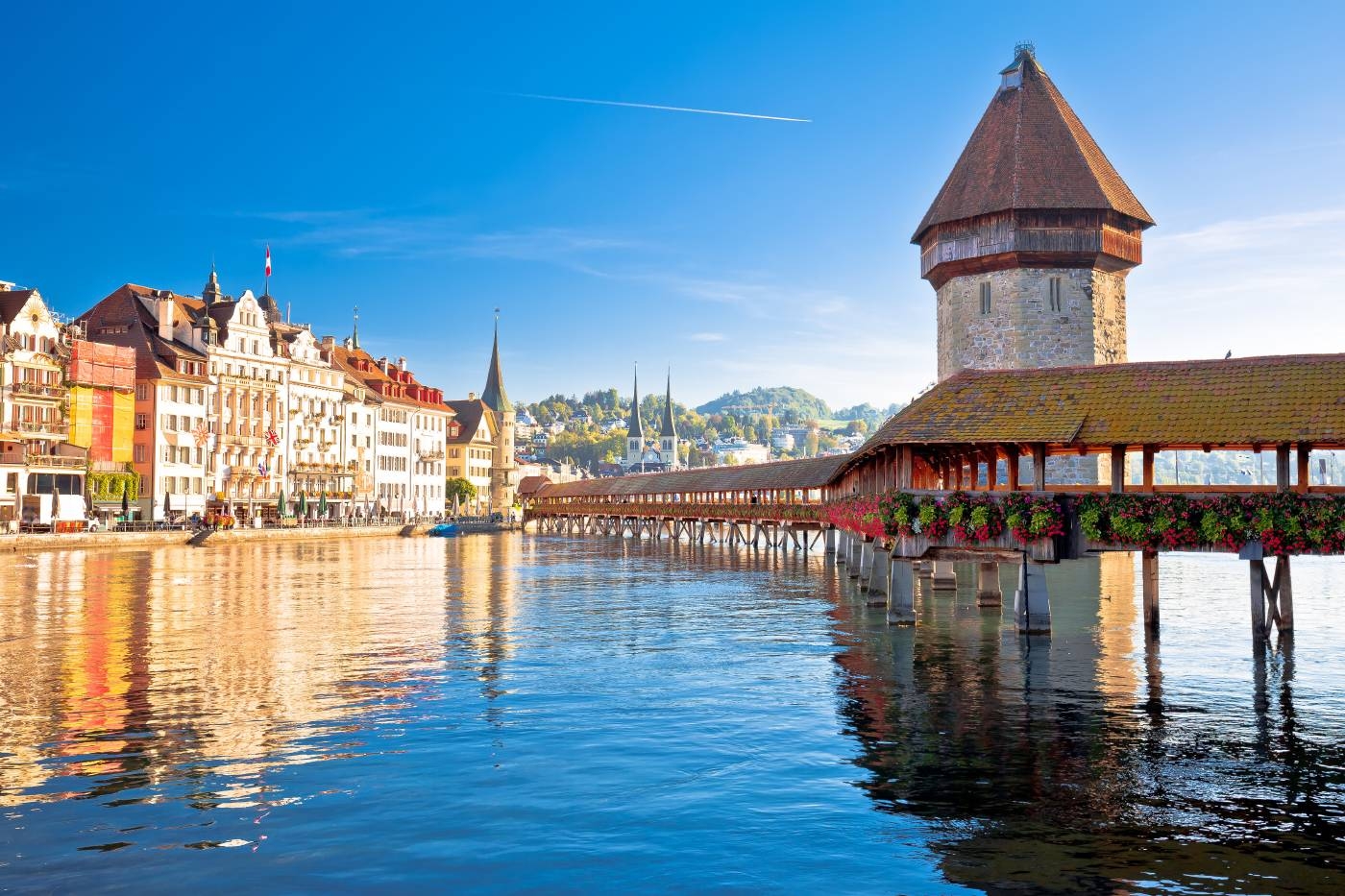
Chapel Bridge (Kapellbrücke): A 14th-century wooden footbridge, the oldest in Europe, adorned with interior paintings depicting Lucerne’s history.
Old Town: A compact area filled with frescoed buildings, cobblestone squares, and the Musegg Wall, a well-preserved section of the city’s fortifications.
Lake Lucerne (Vierwaldstättersee): Embark on a scenic boat cruise to explore the various arms of the lake and admire the mountain scenery.
Lion Monument (Löwendenkmal): A poignant sculpture of a dying lion carved into a rock face, commemorating Swiss Guards who died during the French Revolution.
Practical Information:
Getting There: Approx. 45-60 minutes by direct train from Zurich.
Base for Excursions: An ideal base for trips to Mount Pilatus and Mount Rigi.
Lungern (Lungerer See)
Not a major city but an unmissable scenic stop on the Brunig Pass line between Lucerne and Interlaken. The village of Lungern sits above an emerald-green lake of the same name, offering one of Switzerland’s most iconic alpine views from the train window.
Key Attractions:
The Viewpoint: As the train descends from the pass towards Lungern, sit on the right-hand side for a breathtaking panoramic view of the lake and village below.
Lungern Village: A peaceful stop to walk around the lake, breathe the fresh mountain air, and experience a quieter side of Switzerland.
Practical Information:
Getting There: The train from Lucerne to Interlaken Ost stops here. Consider getting off for an hour or two before continuing your journey.
Interlaken
Situated between Lake Thun and Lake Brienz, Interlaken is a world-famous resort town and the adventure sports capital of the Bernese Oberland. It’s the primary gateway for exploring the Jungfrau region.
Key Attractions & Activities:
Harder Kulm: Take the funicular up to this viewpoint for a spectacular panoramic outlook over Interlaken, its two lakes, and the towering Jungfrau massif.
Adventure Sports: Paragliding, skydiving, canyon jumping, and hiking are all popular activities in the area.
Boat Trips: Scenic cruises on either Lake Thun or Lake Brienz offer serene views of the surrounding mountains and castles.
Base for Excursions: Interlaken is the starting point for journeys to Grindelwald, Lauterbrunnen, and Jungfraujoch.
Practical Information:
Getting There: Approx. 2-hour scenic train ride from Lucerne.
Stay: Consider staying in surrounding villages like Wilderswil or Unterseen for a quieter experience.
Jungfraujoch – Top of Europe
A full-day excursion from Interlaken, this journey takes you to the highest railway station in Europe at 3,454 meters (11,332 ft). It is an engineering marvel and offers a once-in-a-lifetime high-alpine experience.
Key Attractions at the Top:
Sphinx Observatory: The main viewing terrace provides uninterrupted 360-degree views of the Aletsch Glacier (the longest in the Alps), and surrounding peaks.
Aletsch Glacier: Walk through the ice tunnel onto the plateau to stand on the glacier itself.
Ice Palace: A labyrinth of rooms and corridors carved deep into the glacier, featuring beautiful ice sculptures.
The Journey Itself:The train ride from Interlaken to Kleine Scheidegg and then the final cogwheel ascent through the Eiger tunnel is spectacular.