A Journey Through Germany’s Southwest: Frankfurt, Heidelberg, Stuttgart & Metzingen
This travel guide details a classic circular route through the heart of southwestern Germany, a region renowned for its stunning landscapes, profound history, world-class automotive innovation, and exceptional shopping opportunities. The journey from Frankfurt, through the romantic city of Heidelberg, to the industrial powerhouse of Stuttgart, and finally to the shopper’s paradise of Metzingen, offers a rich and varied experience of German culture.
Part 1: Frankfurt am Main – The Gateway to Germany
Frankfurt is often the first point of contact for international travelers, thanks to its massive airport. While it serves as Germany’s financial capital, with a stunning skyline of skyscrapers affectionately nicknamed “Mainhattan,” it also possesses a charming, historic core that reveals its deep-rooted past.
Attractions & Culture
Römerberg: This is the historic heart of Frankfurt. The square is lined with beautifully reconstructed half-timbered houses that were painstakingly rebuilt after World War II. The Römer itself is Frankfurt’s city hall, a complex of three Gothic buildings with a distinctive stepped-gable facade. It’s a perfect starting point to immerse yourself in the city’s atmosphere.
St. Bartholomew’s Cathedral (Kaiserdom): A majestic red sandstone Gothic cathedral, it was the election and coronation site for Holy Roman Emperors for centuries. Climbing the tower is a must for a breathtaking panoramic view of the city center and the modern skyline beyond.
Museumsufer (Museum Embankment): On the south bank of the River Main, you’ll find one of Europe’s most dense concentrations of museums. Highlights include the Städel Museum, with its superb collection of European art from the Middle Ages to the present, and the German Film Museum.
The Modern Skyline: Don’t miss the opportunity to view the city from across the River Main, especially at dusk when the banks are illuminated. For an even closer look, visit the observation deck of the Main Tower, one of the few skyscrapers open to the public.
Food & Drink
Frankfurt’s culinary scene is a blend of traditional Hessian specialities and international flair.
Grüne Soße (Green Sauce): A Frankfurt classic, this cold herb sauce made from seven specific herbs (parsley, chives, chervil, borage, sorrel, garden cress, and salad burnet) is typically served with boiled potatoes and hard-boiled eggs or beef.
Apfelwein (Ebbelwoi): This tart, fermented apple cider is the city’s signature drink. Visit a traditional Apfelweinwirtschaft (cider tavern) in the Sachsenhausen district, where the drink is served in a patterned glass jug called a “Bembel.”
Frankfurter Würstchen: The original Frankfurter is a thin, smoked pork sausage. Enjoy it with bread and mustard for an authentic local snack.
Transportation & Practical Tips
- Frankfurt Airport (FRA) is seamlessly connected to the city center by S-Bahn (commuter train) lines S8 and S9, taking about 15 minutes.
- The city has an excellent public transportation system (RMV), including U-Bahn (subway), trams, and buses. A day pass (Tageskarte) is cost-effective for extensive exploration.
Local Insight: While the banking district is impressive, the true charm of Frankfurt lies in its surrounding neighborhoods like Nordend and Bornheim, filled with cozy cafes and independent shops.
Part 2: Heidelberg – The Romantic City on the Neckar
A short journey south from Frankfurt brings you to Heidelberg, a city that seems plucked from a fairy tale. Nestled in the Neckar river valley and surrounded by forested hills, Heidelberg is world-famous for its romantic ambiance, majestic castle ruins, and Germany’s oldest university.
Attractions & Culture
Heidelberg Castle (Heidelberger Schloss): This magnificent red sandstone ruin dominates the city skyline. Take the funicular railway up the hill to explore the sprawling courtyards and gardens. Don’t miss the Heidelberg Tun, an enormous wine vat with a capacity of over 220,000 liters.
The Old Town (Altstadt): Stroll along the Hauptstrasse, one of Europe’s longest pedestrian streets, lined with Baroque buildings, shops, and cafes. The atmosphere is particularly enchanting in the evening.
The Old Bridge (Karl-Theodor-Brücke): This beautiful stone bridge, guarded by a medieval gate tower, offers iconic views of the castle and old town. Cross the bridge for a different perspective and a path leading up to the Philosophers’ Walk.
Philosophers’ Walk (Philosophenweg): This path on the sunny side of the Neckar river provides arguably the best views of Heidelberg. It’s a peaceful, leafy walk that was favored by university professors and philosophers for contemplation.
Food & Drink
Heidelberger Studentenkuss: A local chocolate praline, the “Heidelberg Student Kiss,” was originally created as a discreet way for students to send messages to young ladies from the convent school.
Regional Wines: The hills surrounding Heidelberg are part of the Baden wine region. Sample local Riesling or Spätburgunder (Pinot Noir) in one of the many traditional wine taverns, known as “Weinstuben.”
Heidelberger Frühstück: A hearty breakfast platter often found in local cafes, featuring cold cuts, cheese, bread, and a boiled egg.
Transportation & Practical Tips
- Heidelberg is easily reached from Frankfurt by frequent direct trains (ICE or regional), taking approximately 1 hour.
- The city is very walkable. A funicular runs from Kornmarkt up to the castle and continues to the summit of the Königstuhl mountain.
Local Insight: To avoid the largest crowds, visit the castle early in the morning or later in the afternoon. For a unique experience, attend a classical concert or theater performance held within the castle grounds during the summer months.
Part 3: Stuttgart – The Cradle of the Automobile
Continuing south, you arrive in Stuttgart, the capital of Baden-Württemberg. This dynamic city is set in a series of lush hills and valleys and is globally synonymous with automotive engineering, being the home of Mercedes-Benz and Porsche. However, it also boasts a vibrant cultural scene and beautiful green spaces.
Attractions & Culture
Mercedes-Benz Museum: An architectural marvel in itself, this museum takes you on a journey through over 130 years of automotive history. The spiral design guides you from the top floor (the invention of the car) down through time, showcasing over 160 vehicles. It’s an essential visit even for those not deeply interested in cars.
Porsche Museum: Located in Zuffenhausen, this sleek, modern museum focuses on the history and engineering excellence of Porsche. The collection features iconic sports cars from throughout the company’s history.
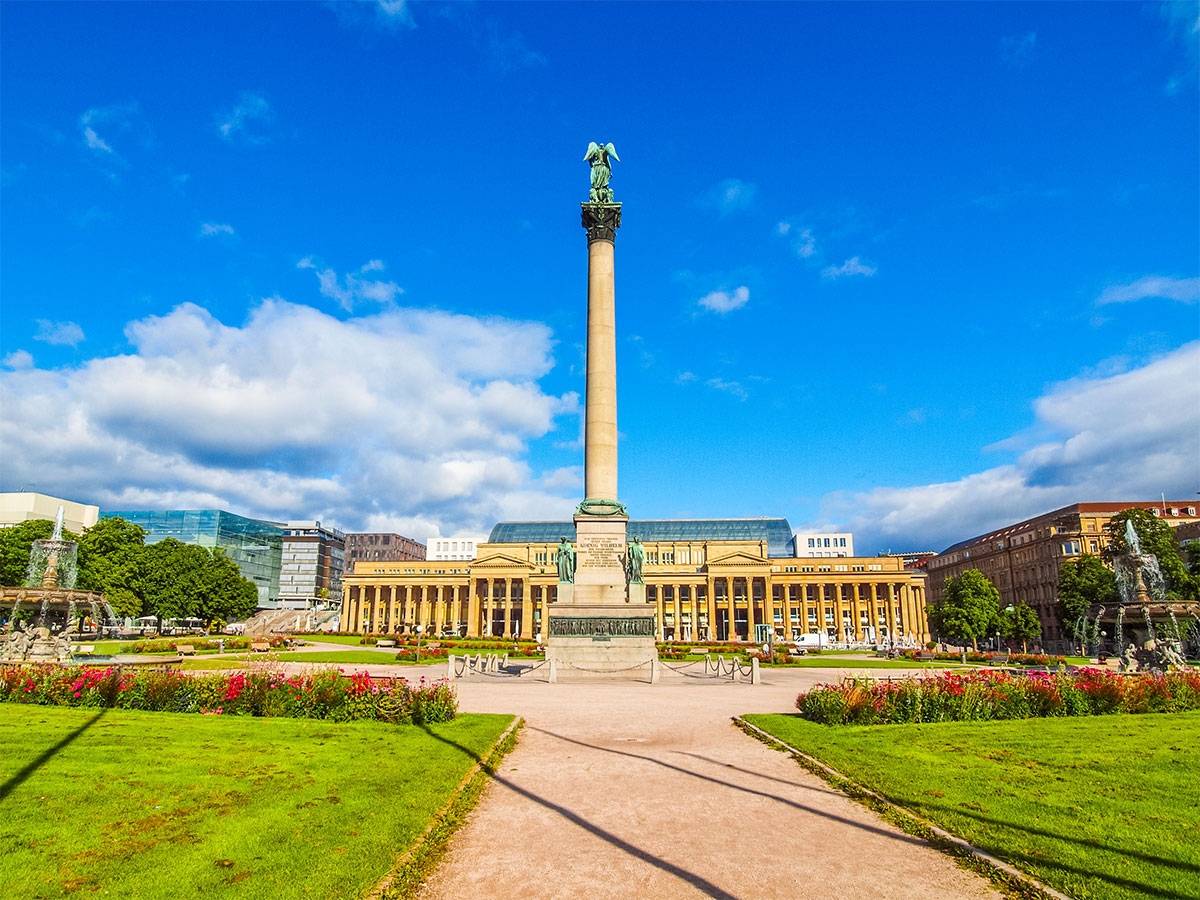
The Palace Square (Schlossplatz): Stuttgart’s central square is a large, beautiful public space flanked by the New Palace (Neues Schloss) and the Old Castle (Altes Schloss). It’s a perfect spot for people-watching and relaxing.
Staatsgalerie Stuttgart: This outstanding art museum houses a significant collection ranging from Old Masters (like Rembrandt and Monet) to modern classics (Picasso, Dalí) and contemporary art.
Food & Drink
Maultaschen: A Swabian specialty often described as a large pasta pocket filled with meat, spinach, onions, and herbs. They can be served in broth, pan-fried with onions, or sliced in a salad.
Spätzle: These soft egg noodles are a staple of the region. They are often served as a side dish, baked with cheese (Käsespätzle), or topped with lentils and sausages.
Swabian Wines: Stuttgart is surrounded by one of Germany’s largest contiguous wine regions. Sample Trollinger (a light red wine) or Riesling in one of the many “Besen” or “Straussenwirtschaften,” temporary wine taverns run by local vintners.
Transportation & Practical Tips
- The train from Heidelberg to Stuttgart takes about 40 minutes on an ICE train.
- Stuttgart has an integrated public transport system (VVS) including U-Bahn and S-Bahn lines. Consider purchasing a “Stuttgart Card” for unlimited travel and discounts on attractions.
Local Insight: For a break from the urban environment, visit Wilhelma, a stunning zoological-botanical garden set in a historic Moorish-style palace complex. It’s one of the most visited zoos in Germany.
Part 4: Metzingen – A Shopper’s Paradise
A short train ride south of Stuttgart lies Metzingen, a small town that has been transformed into a world-renowned outlet shopping destination. What began with a single Hugo Boss factory store has exploded into a village dedicated to discounted luxury and high-street fashion.
The Shopping Experience
The Outlet City: Metzingen is home to over 60 designer and brand stores offering significant discounts year-round. Major brands include Hugo Boss (the flagship store is massive), Prada, Gucci, Burberry, Jimmy Choo, Michael Kors, Nike, and Adidas.
Deals and Discounts: While prices are already reduced, look out for additional seasonal sales and special promotions. It’s advisable to check the official Outletcity Metzingen website for current offers before you go.
The Environment: Unlike some outlet malls, Metzingen is integrated into the town’s streets, making for a pleasant open-air shopping experience. The architecture is modern and well-designed.
Practical Tips for Metzingen
Getting There: Regular regional trains (RE) run from Stuttgart Hauptbahnhof to Metzingen (Bahnhof), taking approximately 25-30 minutes. The outlet stores are a short 5-minute walk from the train station.
Timing Your Visit: Weekdays are significantly less crowded than weekends. Arrive early to avoid the biggest crowds and have the best selection of items.
Amenities: The outlet has several cafes and restaurants to refuel. There are also luggage storage facilities at the train station and information centers where you can get a map.
Local Insight: Don’t forget about VAT refunds for non-EU residents. Ask for a “Tax-Free” form at participating stores when you make your purchase and get it stamped at customs upon your departure from the EU.
The Return Journey: Metzingen to Frankfurt Airport
The most efficient way to conclude your trip is to return from Metzingen to Frankfurt Airport. The journey involves taking a regional train back to Stuttgart Hauptbahnhof and then transferring to a high-speed ICE train directly to Frankfurt Airport (Flughafen Fernbahnhof). The total travel time is typically around 1 hour and 45 minutes. Be sure to check the train schedule in advance and allow ample time for your flight.
Overall Travel Advice & Cultural Notes
The German Rail System: The Deutsche Bahn (DB) network is efficient and reliable. Booking train tickets in advance online can save money, especially for ICE long-distance trains. The DB Navigator app is an indispensable tool for schedules, platform information, and mobile tickets.
Cash vs. Card: While card payments are becoming more common, Germany still has a strong preference for cash (Barzahlung). It’s wise to always have some euros on hand, particularly in smaller shops, cafes, and markets.
Culinary Courage: Embrace the regional specialties in each location. Each area has its own distinct culinary traditions that are a core part of its identity.
Sustainability: This itinerary is perfectly suited for train travel, which is a sustainable and scenic way to explore Germany. All cities mentioned have excellent public transport, making it easy to explore without a car.
This journey from Frankfurt through Heidelberg and Stuttgart to Metzingen offers a captivating blend of history, romance, industrial prowess, and modern consumer culture—a comprehensive taste of what makes southwestern Germany such a compelling destination.