A Grand Parisian Promenade: From Place de la Concorde to the Champs-Élysées
This travel guide details one of the most iconic and walkable routes in Paris, a journey through history, art, and luxury. Stretching from the monumental Place de la Concorde to the Arc de Triomphe, this axis is the very heart of the City of Light. Visitors can experience the evolution of Parisian power, from royal gardens and revolutionary squares to the opulence of the Belle Époque and the modern allure of high fashion. This comprehensive guide will navigate you through each landmark, offering practical advice to enrich your exploration.
Chapter 1: Place de la Concorde – A Square of Turbulent History
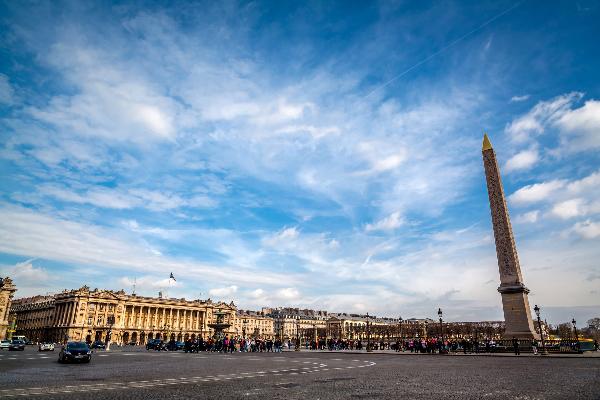
Place de la Concorde is not just a square; it is a vast historical stage. Designed in 1755 and originally named Place Louis XV, it was the site of the grisly executions of King Louis XVI, Queen Marie Antoinette, and over 1,300 others during the French Revolution’s Reign of Terror. Its current name, meaning “Square of Harmony,” was adopted in 1795 in a hopeful move to reconcile the nation’s deep divisions.
The square’s most dominant feature is the
Luxor Obelisk, a 3,300-year-old Egyptian monument gifted to France in the 19th century. Flanked by two majestic fountains, the Fountain of River Commerce and Navigation and the Fountain of the Seas, the obelisk stands as a silent witness to centuries of change. At each corner of the octagonal square, you will find statues representing eight French cities: Lille, Strasbourg, Lyon, Marseille, Bordeaux, Nantes, Brest, and Rouen.
Cultural Insight: The square’s design offers a perfect example of “controlled vista” in urban planning. From the center, one can see the Arc de Triomphe to the west, the Tuileries Garden and Louvre to the east, the Madeleine Church to the north, and the National Assembly across the Seine to the south. This was an intentional design to showcase the power and order of the French state.
Transportation: The easiest way to reach Place de la Concorde is via Metro lines 1, 8, or 12, stopping at the “Concorde” station. Multiple bus lines also serve the area. It is a major hub for both metro and bus transfers.
Chapter 2: Jardin des Tuileries – The Royal Garden
Adjacent to Place de la Concorde lies the Jardin des Tuileries (Tuileries Garden), a formal French garden stretching between the square and the Louvre Museum. Created by André Le Nôtre, the landscape architect of Versailles, in the 17th century, it was once the garden of the Tuileries Palace, which was burned down during the Paris Commune of 1871.
Today, it is a public park beloved by Parisians and tourists alike. Visitors can stroll along tree-lined promenades, relax in iconic green metal chairs around ornamental ponds, and admire an impressive collection of sculptures by artists like Aristide Maillol and Auguste Rodin. The garden also hosts two museums within its grounds: the Galerie Nationale du Jeu de Paume, dedicated to modern and contemporary art and photography, and the Musée de l’Orangerie, which houses Claude Monet’s breathtaking
Water Lilies murals.
Food Recommendation: Scattered throughout the garden are several charming cafés and kiosks. For a classic Parisian experience, stop at one of them for a coffee or a glass of wine. For a more substantial meal, the Café des Marronniers offers a lovely terrace setting. Alternatively, grab a baguette sandwich, some pastries from a nearby boulangerie, and have a picnic on the lawn (where permitted).
Chapter 3: Crossing the Seine – Pont de la Concorde & Pont Alexandre III
To continue this grand tour, one must cross the River Seine. Two bridges in close proximity offer very different experiences.
Pont de la Concorde (Concorde Bridge)
This bridge directly connects Place de la Concorde with the Palais Bourbon, home of the French National Assembly. Built between 1787-1791, it is said that much of its stone came from the rubble of the Bastille prison after it was stormed. It is a robust, elegant, but relatively austere bridge compared to its neighbor, serving as a vital traffic link.
Pont Alexandre III
A short walk east from Place de la Concorde brings you to what is widely considered the most ornate and beautiful bridge in Paris. The Pont Alexandre III is a masterpiece of Beaux-Arts style, inaugurated for the 1900 World’s Fair. It is adorned with spectacular gilt-bronze sculptures, including winged horses, cherubs, and nymphs at each end. The single-span steel arch bridge was designed to not obstruct the view of the Champs-Élysées or the Invalides. Crossing it feels like stepping into a gilded age of unparalleled optimism and artistry.
Cultural Insight: The bridge’s construction was a symbol of the Franco-Russian Alliance. It is named after Tsar Alexander III of Russia, and its first foundation stone was laid by his son, Tsar Nicholas II. The sculptures representing the “Nymphs of the Seine” face the “Nymphs of the Neva” (the river of St. Petersburg), reinforcing this diplomatic friendship.
Chapter 4: The Grand Palais and Petit Palais – Beaux-Arts Marvels
As you step off the Pont Alexandre III on the Left Bank (Rive Gauche), you are immediately greeted by two magnificent palaces built for the 1900 Exposition Universelle (World’s Fair).
Grand Palais (Grand Palace)
Recognizable by its vast glass barrel-vaulted roof and grand ionic colonnade, the Grand Palais was declared a “monument dedicated by the Republic to the glory of French art.” Today, it hosts major temporary art exhibitions, fashion shows (such as Chanel’s renowned sets), and other prestigious events. Its nave is an architectural wonder in itself. Part of the complex also houses the Palais de la Découverte, a science museum.
Petit Palais (Small Palace)
Facing the Grand Palais, the Petit Palais is home to the Musée des Beaux-Arts de la Ville de Paris (City of Paris Museum of Fine Arts). Its collections are permanent and free to enter, spanning from antiquity through the Renaissance and into the 19th century, with works by artists such as Rembrandt, Delacroix, and Courbet. The building itself is stunning, with a beautiful interior courtyard garden café that provides a peaceful oasis.
Transportation: The closest Metro stations are “Champs-Élysées – Clemenceau” (Lines 1 & 13) and “Invalides” (Lines 8 & 13).
Chapter 5: The Élysée Palace – The Seat of Power
A short walk up Rue du Faubourg Saint-Honoré from the vicinity of the Grand Palais brings you to one of Paris’s most secure and discreet landmarks: the Palais de l’Élysée (Élysée Palace). This is the official residence and workplace of the President of the French Republic. While it is not open to the public for tours, its imposing gates and guarded entrance are a sight to behold for those interested in politics and power.
Cultural Insight: The palace’s history is as rich as its current function. Built in 1718 for Louis Henri de La Tour d’Auvergne, it was later owned by Madame de Pompadour, King Louis XV’s influential mistress. It became the presidential palace in 1848. The term “Élysée” is derived from Elysian Fields, the paradise for heroes in Greek mythology.
Chapter 6: Avenue des Champs-Élysées – The World’s Most Beautiful Avenue
From Place de la Concorde begins the legendary Avenue des Champs-Élysées, a 1.9-kilometer stretch often called “
la plus belle avenue du monde” (“the world’s most beautiful avenue”). The avenue is divided into two distinct parts: the lower part, which runs through the Jardins des Champs-Élysées with gardens, theatres (like the Théâtre Marigny), and pavilions; and the upper part, from Rond-Point des Champs-Élysées to the Arc de Triomphe, which is a global center for commerce, luxury, and entertainment.
This upper part is lined with flagship stores for brands like Louis Vuitton, Cartier, and Mercedes-Benz; major banks; car showrooms; cinemas; and countless cafés and restaurants. It is a place for people-watching par excellence. Key landmarks along the avenue include the Grand Palais and Petit Palais (on Winston Churchill Avenue) and the iconic
Arc de Triomphe standing proudly at its western terminus.
Food Recommendation: While many restaurants on the Champs-Élysées are tourist-oriented chains, there are gems to be found. Ladurée on the Champs-Élysées is famous for being the birthplace of the double-decker macaron and offers a truly Parisian salon de thé experience. For a more classic brasserie meal in a historic setting, Fouquet’s is an institution. For a better value and more authentic experience, venture onto the side streets like Rue de Berri or Rue du Colisée.
Accommodation Tips: Staying near the Champs-Élysées offers unparalleled convenience and luxury but comes with a premium price tag. Hotels like Le Bristol, Hotel Plaza Athénée, and Hotel George V are among the most luxurious in the world. For more moderate options, look at hotels in the surrounding 8th arrondissement or across the river in the 7th arrondissement, which are still within walking distance but offer slightly better value.
Chapter 7: Galeries Lafayette Champs-Élysées – A New Temple of Fashion
While the original Galeries Lafayette on Boulevard Haussmann is a historic department store known for its stunning stained-glass dome, its newer sibling on the Champs-Élysées represents a modern vision of retail. Located at number 60, this store is a destination in itself, focusing on contemporary fashion, beauty, and lifestyle.
The architecture is sleek and innovative, featuring a dynamic “moving room” elevator and art installations. It houses a curated selection of international designers alongside established luxury brands. The store also includes a concept grocery store, a bookstore, and several trendy eateries. It’s less about old-world opulence and more about discovering what’s next in fashion and design.
Shopping Tip: Unlike its main branch, this Galeries Lafayette Champs-Élysées does not have a dedicated tax-free refund desk on-site. However, you can still get a VAT refund on eligible purchases; ensure you ask for a tax-free form at checkout and have it validated at the airport before you leave the EU.
Practical Travel Information
Suggested Itinerary
Morning (3-4 hours): Start at Place de la Concorde. Explore its history and take photos with the Obelisk and fountains. Then, enter the Tuileries Garden. Visit the Musée de l’Orangerie to see Monet’s Water Lilies if you have time. Relax by the main pond.
Lunch (1 hour): Have lunch at a café within the Tuileries or grab a picnic to enjoy on the grass.
Afternoon (4-5 hours): Walk to Pont Alexandre III for photos. Cross over to see the Grand Palais and Petit Palais (you may choose to visit an exhibition or just admire the architecture). Begin your walk up the Champs-Élysées. Do some window-shopping, stop for a coffee or hot chocolate at Ladurée, and explore Galeries Lafayette Champs-Élysées.
Evening (2-3 hours): Continue your stroll up the avenue as it lights up at dusk. Consider climbing the Arc de Triomphe for a breathtaking panoramic view of Paris, with the Champs-Élysées leading directly to the Louvre in one direction and La Défense in the other. Have dinner at a brasserie on or near the avenue.
Getting Around
On Foot: This entire route is best experienced on foot. The total walking distance from Place de la Concorde to the Arc de Triomphe is about 2.2 km (1.4 miles), not including detours to bridges and palaces.
By Metro: The Metro is efficient for hopping between districts if you get tired. Key stations: Concorde (start), Champs-Élysées – Clemenceau (for palaces), Franklin D. Roosevelt (mid-way on avenue), George V (for luxury shopping), Charles de Gaulle – Étoile (for Arc de Triomphe).
By Bike/Scooter: Paris’s Vélib’ bike-sharing system or electric scooters are a fun way to cover more ground while still being outdoors.
Cultural Etiquette
Greetings: Always begin interactions in shops and cafés with “Bonjour Madame/Monsieur.” A simple greeting goes a long way.
Dining: Meals are often leisurely affairs. To ask for the bill, you must request it (“L’addition, s’il vous plaît”), as it is considered rude for waitstaff to bring it unasked.
Shopping: In luxury boutiques on Avenue Montaigne (just off Champs-Élysées), dressing smartly can sometimes affect your reception.
Public Spaces: The gardens are cherished public spaces. Do not walk on flower beds and dispose of trash properly.
A journey along this historic axis is more than just sightseeing; it is an immersion into the soul of Paris. It’s a walk through layers of time—from royal absolutism and revolutionary fervor to Belle Époque splendor and contemporary chic—all seamlessly woven into one magnificent urban tapestry.