A Comprehensive Travel Guide to Schönbrunn Palace, Vienna
Schönbrunn Palace (German: Schloss Schönbrunn), a UNESCO World Heritage Site since 1996, stands as one of Austria’s most significant cultural monuments and a cornerstone of Viennese identity. This magnificent Baroque complex, with its 1,441 rooms, vast gardens, and storied history, was the former summer residence of the Habsburg monarchs. For any traveler to Vienna, a visit to Schönbrunn is not merely a stop on an itinerary; it is an immersive journey into the heart of the Austrian Empire, its art, architecture, and the lives of its most famous rulers, including Empress Maria Theresa and Emperor Franz Joseph I.
An Introduction to Schönbrunn Palace
The history of Schönbrunn and its buildings spans over 300 years. The name “Schönbrunn” (meaning “beautiful spring”) originates from a water source discovered on the grounds, which supplied the court. The estate came into Habsburg possession in 1569, but the palace as it is known today was constructed and remodeled under the patronage of Empress Maria Theresa in the mid-18th century. It was she who transformed the hunting lodge into a vibrant, sprawling center of court and political life. The palace’s distinctive “Schönbrunn Yellow” became the official color for Habsburg buildings across the empire.
The palace’s architecture and interiors are a testament to changing tastes and eras, predominantly reflecting the Rococo style. Walking through its halls, visitors are transported back to the age of empires, witnessing the opulence and power of one of Europe’s most influential dynasties. Beyond the palace walls, the gardens are a masterpiece of landscape design, offering everything from formal French-style parterres to wooded areas, fountains, and architectural follies.
Key Attractions Within the Palace and Gardens
The Palace Interior Tours
Visitors can explore the palace’s opulent state rooms and private apartments through two main tours. It is highly recommended to book tickets online in advance to avoid long queues, especially during peak season.
Imperial Tour (22 Rooms): This tour provides a fantastic overview of the palace’s highlights. It includes the reception rooms and private apartments of Emperor Franz Joseph and Empress Elisabeth (Sisi). Key rooms on this route are the Walnut Room, the stunning Great Gallery used for grand balls and receptions, and the Millions Room, a precious cabinet decorated with rare rosewood and miniatures from India and Persia.
Grand Tour (40 Rooms): For a more in-depth experience, the Grand Tour includes all rooms from the Imperial Tour and extends into the 18th-century state apartments from the time of Empress Maria Theresa. Visitors can see the exquisite Bergl Rooms, painted with exotic landscapes, the Chinese Cabinets used for secret political negotiations, and the Napoleon Room, where the French emperor once resided.
The Palace Gardens (Schlosspark)
The gardens of Schönbrunn are free to enter for the public and are a destination in their own right. They exemplify Baroque landscape architecture, with symmetrical designs, meticulously maintained hedges, and grand vistas.
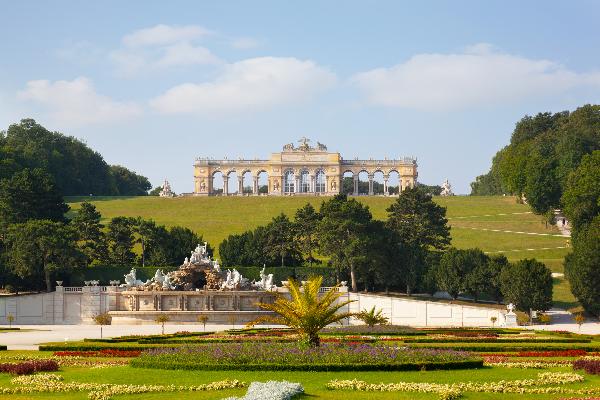
Neptune Fountain: Located at the foot of the hill behind the palace, this monumental fountain depicts the sea god Neptune. It serves as a spectacular visual endpoint to the main garden axis.
The Gloriette: Perched atop the hill, the Gloriette is a magnificent arcade structure dedicated to the Just War. Climbing the hill is rewarded with the best panoramic view of the palace and the Vienna skyline. The structure itself now houses a café where one can enjoy the view with a coffee.
Maze and Labyrinth: A recreation of the palace’s original Baroque maze, this area offers fun for all ages with its hedge maze, labyrinth, and a series of puzzles and games in the playground.
Roman Ruins (Römische Ruine): Also known as the Ruin of Carthage, this structure is a classic example of a “fake ruin” popular in Romantic landscape gardens, designed to evoke thoughts of transience and the past.
Tiergarten Schönbrunn (Vienna Zoo)
Founded in 1752, Tiergarten Schönbrunn is the oldest continuously operating zoo in the world. Located on the palace grounds, it is renowned for its species-appropriate enclosures and successful breeding programs, particularly for pandas. It’s an excellent addition to a family visit to Schönbrunn.
Palm House (Palmenhaus)
This immense Art Nouveau glasshouse is one of the largest of its kind in Europe. It houses three climatic zones with Mediterranean, tropical, and subtropical plants, including ancient palm trees and a fascinating collection of butterflies.
Culinary Delights: Food and Drink Recommendations
Experiencing Viennese coffee house culture and local cuisine is an integral part of any visit to Schönbrunn.
Within the Palace Grounds
Café Gloriette: Located within the Gloriette structure, this café offers arguably the most spectacular setting for a coffee and cake in all of Vienna. Enjoy a traditional Melange (a Viennese coffee specialty) and a slice of Sachertorte or Apfelstrudel while overlooking the palace.
Residenz Café: Situated in the former court bakery next to the palace exit, this café offers a wide selection of pastries, sandwiches, and meals in a historic setting.
Landtmann’s Jausen Station: For a more rustic Austrian experience, this traditional garden restaurant located in the western part of the park offers classic cold platters (Jause), beers, and refreshments.
In the Surrounding Neighborhood (Hietzing)
The Hietzing district around Schönbrunn has numerous authentic restaurants and
Heurigen (traditional Viennese wine taverns).
Gasthaus Kopp: A short walk from the palace, this traditional inn serves classic Viennese fare like Wiener Schnitzel and Tafelspitz (boiled beef) in a cozy atmosphere.
Café Dommayer: A historic coffee house where Johann Strauss II once performed. It’s perfect for experiencing classic Viennese coffee house ambiance.
Heuriger: Venture into the streets behind the palace (like Winzerstraße) to find family-run Heurigen where you can drink young wine from the vineyards on the outskirts of Vienna and enjoy a self-service buffet of cold cuts, cheeses, and spreads.
Practical Transportation Information
Schönbrunn Palace is very well-connected by Vienna’s efficient public transport network (Wiener Linien).
By U-Bahn (Subway): The U4 line is the most direct route. Alight at the “Schönbrunn” station. From there, it is a 5-minute walk to the main palace entrance.
By Tram: Tram lines 10 and 60 stop at the “Schönbrunn” station, which is also conveniently located near the entrance.
By Bus: Bus line 10A stops at “Schönbrunn” as well.
By Car: Driving is not recommended for tourists due to limited and expensive parking. If necessary, there is a paid parking garage at Schönbrunn (“Parking Schönbrunn”).
A valid public transport ticket (such as a 24-hour, 48-hour, or weekly pass) is required for all these options. The palace is located in Vienna’s 13th district, Hietzing.
Accommodation Tips Near Schönbrunn
Staying near Schönbrunn offers a more relaxed, residential feel compared to the city center, while still being well-connected.
Luxury: The Hotel Schönbrunn is located directly opposite the palace gates and offers classic elegance with modern amenities. It provides unparalleled convenience for early morning or late evening strolls in the gardens.
Mid-Range: The Hietzing district has several charming boutique hotels and guesthouses. Look for options like Pension Kraml or Pension Museum for a comfortable and authentic stay.
Budget-Friendly: There are hostels and budget hotels within a 15-20 minute walk or a short tram ride from the palace. The area is generally safe and quiet at night.
City Center vs. Schönbrunn: For first-time visitors who wish to be close to other major attractions like St. Stephen’s Cathedral and the State Opera, staying in the Innere Stadt (District 1) may be preferable. However, with the U4 line providing a direct connection (about 15-20 minutes), staying near Schönbrunn is an excellent alternative.
Cultural Insights and Etiquette
A visit to Schönbrunn is more meaningful with an understanding of its cultural context.
The Habsburg Legacy
The palace is intrinsically linked to Empress Maria Theresa, a powerful female ruler who centralized power and bore 16 children, using them as pawns in strategic marriages across Europe. It was also the primary residence of Emperor Franz Joseph I (1830-1916), who embodied duty and simplicity, and his wife Empress Elisabeth (“Sisi”), who is celebrated for her beauty, non-conformity, and tragic life. Understanding their stories adds profound depth to seeing their living quarters.
The Viennese Coffee House Culture
The coffee houses around Schönbrunn are part of a UNESCO-intangible cultural heritage. They are considered extensions of one’s living room—a place to read the newspaper, meet friends, or simply linger for hours over a single coffee. When visiting, embrace this slow pace. It is customary for waiters to bring a glass of water with your coffee.
Visitor Etiquette
Photography: Photography for personal use is usually permitted in the gardens and outside structures but is strictly prohibited inside most of the palace rooms. Always check for signs.
Queuing: Austrians value order. Please wait your turn in lines for tickets and entry.
Quiet Respect: The palace is a historic monument. Maintain a respectful volume when speaking inside.
The Gardens: While the gardens are for public enjoyment, visitors are expected to stay on paths and not walk on the flower beds or lawns in the formal areas.
A Sample One-Day Itinerary at Schönbrunn
Morning (9:00 AM): Arrive early to beat the crowds. Start with the Grand Tour of the palace interior to immerse yourself in Habsburg history.
Late Morning (11:30 AM): Exit into the gardens. Walk up the main axis towards the Neptune Fountain and begin the climb up the hill to the Gloriette.
Lunch (12:30 PM): Enjoy lunch with a view at Café Gloriette or a more substantial meal at a restaurant in Hietzing.
Afternoon (1:30 PM): Explore other garden attractions based on your interest: get lost in the Maze, visit the tranquil Roman Ruins, or explore the vast Palm House and its butterfly house.
Late Afternoon (3:30 PM): Visit Tiergarten Schönbrunn (the zoo) if time and interest allow, or simply find a bench in a quiet part of the garden to relax.
Evening (6:00 PM): Conclude your day like a local by finding a nearby Heuriger for a glass of Austrian wine and a casual dinner.
A trip to Schönbrunn Palace is a journey through time, art, and nature. By planning ahead and immersing oneself in its history and surroundings, a visitor can truly capture the imperial spirit that continues to define Vienna.