Romantic Germany Travel Guide
Frankfurt – Heidelberg – Rüdesheim – Rhine River – Assmannshausen – Würzburg – Rothenburg
Introduction
This travel guide covers a classic German itinerary through the heart of the country’s most romantic and historically rich regions. The journey encompasses the modern financial hub of Frankfurt, the romantic university town of Heidelberg, the world-renowned Rhine Valley with its vineyards and castles, and the beautifully preserved medieval towns of the Romantic Road. This route offers a comprehensive experience of German culture, history, architecture, and natural beauty, perfectly blending urban exploration with scenic landscapes.
The estimated total distance of this circular route is approximately 600-700 kilometers, making it ideal for a 7 to 10-day trip by car or train. The guide provides objective descriptions and practical information to help you plan your journey effectively.
Itinerary Overview
| Day | Route Segment | Key Attractions | Approx. Travel Time |
|---|---|---|---|
| 1-2 | Frankfurt | Römerberg, Museumsufer, Main Tower | – |
| 3 | Frankfurt → Heidelberg | Heidelberg Castle, Old Bridge, Philosophers’ Walk | 1 hour (train/car) |
| 4 | Heidelberg → Rüdesheim (via Rhine) | Rhine River Cruise, Vineyards | 2-3 hours (train + cruise) |
| 5 | Rüdesheim & Assmannshausen | Drosselgasse, Niederwald Monument, Hiking | – |
| 6 | Rüdesheim → Frankfurt → Würzburg | Würzburg Residence, Marienberg Fortress | 2.5 hours (train) |
| 7 | Würzburg → Rothenburg ob der Tauber | Medieval Old Town, Town Walls, Plönlein | 1 hour (train) |
| 8 | Rothenburg → Frankfurt | Return journey, optional stops | 2.5 hours (train) |
Frankfurt am Main
Frankfurt am Main, often simply called Frankfurt, is a global hub for commerce, culture, education, and tourism. It is known for its futuristic skyline, earning it the nickname “Mainhattan,” but also boasts a well-preserved historical old town.
Main Attractions
Römerberg: The historic heart of Frankfurt, featuring the Römer city hall complex with its characteristic stepped-gable facades. The square is surrounded by reconstructed medieval buildings and is the site of the Christmas market.
St. Bartholomew’s Cathedral (Kaiserdom): A 14th-15th century Gothic cathedral that was the election and coronation church for Holy Roman Emperors. Visitors can climb the tower for panoramic city views.
Museumsufer (Museum Embankment): A unique concentration of museums on both sides of the River Main. Key institutions include the Städel Museum (European art), the German Film Museum, and the Liebieghaus (sculpture).
Main Tower: The only skyscraper in Frankfurt with a public viewing platform. The 200-meter-high platform offers unparalleled 360-degree views of the city and the surrounding region.
Palmengarten: One of Germany’s largest botanical gardens, featuring greenhouses with diverse climate zones and extensive outdoor gardens.
Practical Information: Frankfurt
Getting There: Frankfurt Airport (FRA) is one of Europe’s busiest hubs. The central train station (Hauptbahnhof) has excellent national and international connections.
Getting Around: The city has an efficient public transport system (RMV), including U-Bahn (subway), S-Bahn (commuter rail), trams, and buses. A day ticket (“Tageskarte”) is cost-effective for extensive exploration.
Accommodation: Options range from luxury hotels in the banking district to mid-range and budget hotels near the central station and in the city center.
Cuisine: Try local specialties like “Grüne Soße” (green sauce with herbs) with boiled eggs and potatoes, “Frankfurter Würstchen” (small sausages), and Apfelwein (hard apple cider) in a traditional Sachsenhausen pub.
Heidelberg
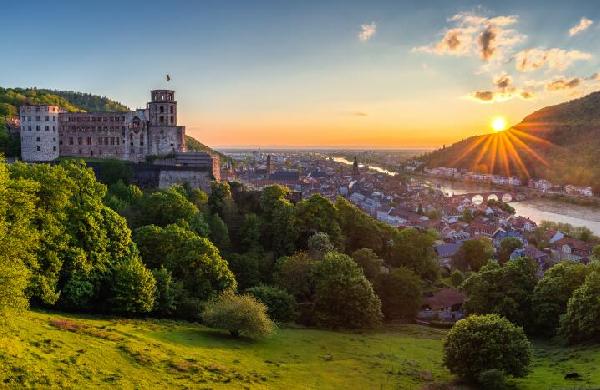
Heidelberg is renowned for its romantic setting, picturesque old town, and Germany’s oldest university. Nestled in the Neckar river valley, its combination of intellectual history and stunning scenery has inspired poets and artists for centuries.
Main Attractions
Heidelberg Castle: A magnificent ruin dominating the city skyline. The castle is a mix of architectural styles due to its construction and destruction over centuries. Highlights include the Grosses Fass (the world’s largest wine barrel) and the scenic castle gardens.
Old Town (Altstadt): Stretching along the Neckar River, it features the Hauptstrasse, one of Europe’s longest pedestrian streets, lined with shops, cafes, and historical buildings.
Old Bridge (Karl-Theodor-Brücke): A beautiful stone bridge across the Neckar, offering iconic views of the castle and old town. The bridge gate is a notable landmark.
Philosophers’ Walk (Philosophenweg): A path on the northern side of the Neckar River, offering spectacular views of the castle and old town. It was traditionally a place for academics to walk and reflect.
Student Prison (Studentenkarzer): Part of the university where misbehaving students were incarcerated from 1778 to 1914. The walls are covered in their graffiti and drawings.
Practical Information: Heidelberg
Getting There: Direct train connections from Frankfurt Hauptbahnhof take about 1 hour. By car, it’s approximately 90 minutes via the A5 motorway.
Getting Around:The old town is very walkable. To reach the castle, you can walk up the steep path or take the Bergbahn (funicular railway).
Cuisine:Heidelberg has a vibrant food scene. Enjoy a meal in a traditional student pub (“Kneipe”) or a café on the Hauptstrasse.