Ultimate Balkan & Eastern Europe Travel Guide: Croatia, Bulgaria, Serbia, Hungary, Bosnia & Herzegovina
This comprehensive travel guide details a grand loop through the heart of the Balkans and Eastern Europe, a region rich with dramatic history, stunning natural beauty, and vibrant cultures. The itinerary connects iconic capitals, charming medieval towns, breathtaking national parks, and stunning Adriatic coastlines, offering a deep and diverse travel experience.
Introduction to the Route
The proposed route is a circular journey starting and ending in Budapest, Hungary. It ventures through the Romanian cities of Timișoara, Sibiu, Brașov, and Bucharest, down into the Bulgarian heartland of Veliko Tărnovo and Plovdiv, across to the Serbian hubs of Niš and Belgrade, before returning to Budapest. From there, it heads south into Croatia, exploring its capital, world-famous Plitvice Lakes, coastal gems like Zadar and Split, and the jewel of the Adriatic, Dubrovnik. Finally, it delves into Bosnia and Herzegovina, visiting Mostar and Sarajevo, before looping back through Croatia and Hungary to conclude. This guide breaks down the journey into manageable chapters.
Chapter 1: The Hungarian Start – Budapest
Budapest, the “Pearl of the Danube,” is a fitting start and end point for this adventure. The city is majestically split by the Danube River into Buda and Pest.
Main Attractions: Buda Castle Hill, including the Royal Palace and Matthias Church; the iconic Parliament Building; Fisherman’s Bastion for panoramic views; the poignant Shoes on the Danube Bank memorial; and the relaxing Széchenyi Thermal Baths.
Food & Drink: Indulge in a bowl of hearty Goulash. Try Lángos (fried dough with toppings), and sample Tokaji wine. For a unique experience, visit a “ruin pub” in the Jewish Quarter.
Transportation: Budapest has an efficient metro, tram, and bus system. A Budapest Card can offer good value for unlimited travel and museum entries. The city is a major regional transport hub with excellent train and bus connections.
Accommodation Tip: Stay in Pest for vibrant nightlife and easier access to restaurants, or in Buda for a more tranquil, historic atmosphere.
Chapter 2: The Romanian Leg (Timișoara – Sibiu – Brașov – Sinaia – Bucharest)
This segment traverses the diverse landscapes of Transylvania and Wallachia in Romania.
Timișoara
Known as the “City of Roses” and the birthplace of the 1989 Romanian Revolution. Its elegant squares—Piața Victoriei, Piața Libertății, and Piața Unirii—are filled with beautiful Secessionist architecture.
Sibiu
A stunning medieval Saxon town in Transylvania. The Great Square and Little Square are connected by the iconic Liars’ Bridge. Don’t miss the ASTRA National Museum Complex, an impressive open-air folk museum.
Brașov & Sinaia
Brașov is a gateway to Transylvania’s legends. Explore the charming Council Square and the Black Church. A short trip away is Bran Castle, often associated with the Dracula myth. En route from Brașov to Bucharest lies Sinaia, home to the breathtaking Peleș Castle, a masterpiece of German Renaissance architecture.
Bucharest
Romania’s bustling capital, known as “Little Paris.” The colossal Palace of the Parliament is the world’s second-largest administrative building. Wander through the historic Lipscani district for its vibrant nightlife and cafes.
Food & Drink: Savor Sarmale (cabbage rolls), Mămăligă (polenta), and Mititei (grilled sausages). Try Țuică, a strong plum brandy.
Transportation: Trains are a scenic way to travel between these Romanian cities. Bucharest has a extensive metro system. Inter-city buses are also efficient and often cheaper.
Cultural Insight: Romania is a land of folklore and myth, deeply connected to its Dacian, Roman, and Saxon heritage. The Romanian Orthodox Church plays a central role in daily life.
Chapter 3: The Bulgarian Heartland (Veliko Tărnovo – Plovdiv – Sofia)
Bulgaria offers a rich tapestry of history, from medieval empires to Ottoman influence.
Veliko Tărnovo
The historic capital of the Second Bulgarian Empire, dramatically set on hills above the Yantra River. The Tsarevets Fortress is the main attraction, offering spectacular sound and light shows.
Plovdiv
One of Europe’s oldest continuously inhabited cities. Explore the charming Old Town with its colorful National Revival architecture and the ancient Roman Theatre, still used for performances today.
Sofia
Bulgaria’s capital sits at the foot of Vitosha Mountain. Key sites are concentrated: the Alexander Nevsky Cathedral, the Roman Serdica ruins, Saint George Rotunda, and the beautiful Boyana Church (a UNESCO site located on the city’s outskirts).
Food & Drink: Enjoy Shopska Salad, Tarator (cold cucumber soup), and Banitsa (cheese-filled pastry). Sample Rakia (fruit brandy) and local wines.
Transportation: Trains and buses connect these cities. Sofia has a good metro system that links the main bus and train stations to the city center.
Accommodation Tip: In Veliko Tărnovo, stay in a guesthouse in the old town for authentic charm. In Plovdiv, the Kapana creative district offers trendy stays.
Chapter 4: The Serbian Crossroads (Niš – Belgrade)
This leg delves into Serbia’s turbulent history and vibrant modern energy.
Niš
One of the oldest cities in the Balkans and the birthplace of Emperor Constantine. Visit the sobering Skull Tower (Ćele Kula) and Niš Fortress.
Belgrade
The Serbian capital, meaning “White City,” is located at the confluence of the Danube and Sava rivers. Explore the massive Kalemegdan Fortress, stroll through Skadarlija (the bohemian quarter), and see the stunning Saint Sava Temple.
Food & Drink: Feast on Ćevapi (grilled minced meat), Pljeskavica (Balkan burger), and Kajmak (dairy spread). Experience Belgrade’s famous splavovi (floating river clubs).
Transportation: Buses are often faster and more frequent than trains in Serbia. Belgrade has an extensive bus and tram network.
Cultural Insight: Serbians are known for their fiery spirit and hospitality (gostoprimstvo). Coffee culture is central to social life, often involving long hours spent in kafanas (traditional taverns).
Chapter 5: The Croatian Adriatic & Inland Wonders (Zagreb – Plitvice Lakes – Zadar – Split – Dubrovnik)
Croatia’s diverse offerings range from a charming capital to a legendary coastline.
Zagreb
The capital is divided into the historic Upper Town (Gornji Grad) and the bustling Lower Town (Donji Grad). Don’t miss St. Mark’s Church, the Museum of Broken Relationships, and Dolac Market.
Plitvice Lakes National Park
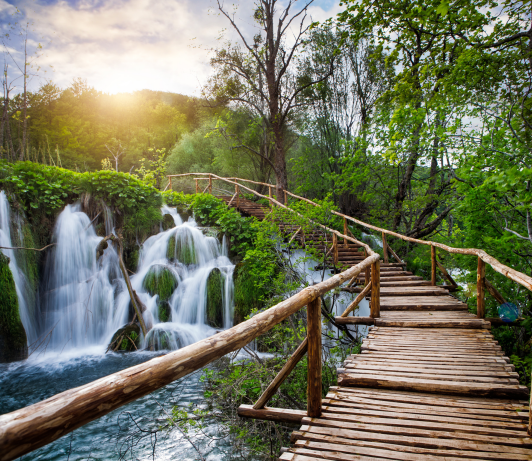
A UNESCO World Heritage site and Croatia’s most famous natural attraction. A series of 16 terraced lakes, connected by waterfalls and set in deep woodland, offer some of Europe’s most stunning scenery. Walk the wooden pathways and take a boat across Kozjak Lake.
Zadar
A historic coastal city known for its unique modern installations: the Sea Organ, which creates music from wave action, and the Sun Salutation, a light display powered by the sun.
Split
Built around the monumental Diocletian’s Palace, a living Roman palace where people still live, work, and shop within its ancient walls. Climb Marjan Hill for breathtaking views.
Dubrovnik
The “Pearl of the Adriatic.” Walk the magnificent city walls for unparalleled views of terracotta roofs and the sea. Explore Stradun, the main street, and take the cable car to Mount Srđ.
Food & Drink: Enjoy fresh seafood, especially grilled fish and black risotto. Try Dalmatian Pršut (prosciutto) and Paški Sir (cheese from Pag island). Sample Travarica (herbal brandy) and local wines like Plavac Mali.
Transportation: Croatia’s coast is best traveled by bus or catamaran. Booking bus tickets in advance during peak season is essential. The Pelješac Bridge now provides a direct route to Dubrovnik without passing through Bosnia.
Accommodation Tip: For a unique experience in Split, stay in a room within Diocletian’s Palace. In Dubrovnik, consider staying in nearby Babin Kuk for slightly better value.
Chapter 6: Bosnia & Herzegovina’s Soul (Mostar – Sarajevo)
A journey into a country marked by its complex history and profound resilience.
Mostar
Famous for its iconic Stari Most (Old Bridge), rebuilt after its destruction in the 1990s war. Watch divers leap from the bridge and wander through the cobblestone streets of the old bazaar.
Sarajevo
The capital where East meets West. Explore Baščaršija, the old Ottoman bazaar; visit the Latin Bridge, site of Franz Ferdinand’s assassination; and learn about the Siege of Sarajevo at the Tunnel Museum. The surrounding hills are dotted with “Sarajevo Roses.”
Food & Drink: Don’t leave without trying Ćevapi in Somun bread from Sarajevo or Mostar. Enjoy Burek (meat or cheese pie) and Baklava. Bosnian coffee is a strong, integral part of the culture.
Transportation: Buses are the primary mode of transport between cities. The train from Mostar to Sarajevo is one of Europe’s most scenic rail journeys.
Cultural Insight: Bosnia is a mosaic of Bosniaks, Serbs, and Croats, with corresponding Muslim, Orthodox, and Catholic influences. This blend is visible in its architecture, food, and daily life. The recent war is a sensitive but important part of the national narrative.
Chapter 7: The Return Journey (Vinkovci – Pécs – Budapest)
The final stretch heads back through eastern Croatia and southern Hungary.
Vinkovci, Croatia
A transit hub in eastern Croatia’s Slavonia region, known for its Roman history (as Cibalae) and traditional folklore events.
Pécs, Hungary
A beautiful cultural city in Hungary, famous for its early Christian burial chambers (a UNESCO site), Ottoman-era mosques, and vibrant Zsolnay ceramic art.
General Travel Tips for the Region
Best Time to Visit: Late spring (May-June) and early autumn (September-October) offer pleasant weather and fewer crowds. July-August is hot and very busy on the coast.
Currency: Hungary uses Hungarian Forint (HUF), Romania uses Romanian Leu (RON), Bulgaria uses Bulgarian Lev (BGN), Serbia uses Serbian Dinar (RSD), Croatia uses Euro (EUR), Bosnia uses Convertible Mark (BAM). Always have some local cash on hand.
Visa Requirements: Check visa requirements based on your nationality. Croatia is in the EU and Schengen Area; other countries are at various stages of EU integration but generally offer visa-free travel for short stays to many passport holders.
Souvenirs: Look for local handicrafts like Bulgarian pottery, Serbian filigree jewelry, Bosnian copperware, Hungarian paprika, and Croatian lavender products.
Sensitivity: Be mindful of recent history, especially regarding the wars of the 1990s in Croatia and Bosnia. Approach topics with respect when discussing them with locals.
This epic journey through six countries provides an unforgettable immersion into a complex and captivating corner of Europe. From imperial capitals to Adriatic shores and rugged mountain landscapes, this route promises a travel experience rich in history, culture, and natural splendor.