Comprehensive Travel Guide: Italy & Malta Grand Tour
This guide details a classic itinerary covering the artistic heart of Italy and the historic islands of Malta, from Rome’s ancient wonders to the medieval streets of Mdina and the stunning coastal scenery of the Cinque Terre and the Blue Grotto.
Part 1: Italy Mainland Itinerary
Rome: The Eternal City
Rome, Italy’s capital, is a sprawling, cosmopolitan city with nearly 3,000 years of globally influential art, architecture, and culture on display. Ancient ruins like the Forum and the Colosseum stand as a testament to the power of the Roman Empire.
Key Attractions:
The Colosseum: The iconic Roman amphitheater, once host to gladiatorial contests and public spectacles. Booking a skip-the-line ticket is highly recommended.
Roman Forum: The political, religious, and commercial heart of ancient Rome, now a sprawling complex of ruins.
Pantheon: A remarkably preserved Roman temple, now a church, with the world’s largest unreinforced concrete dome.
Trevi Fountain: A magnificent Baroque fountain. Tradition says throwing a coin over your shoulder ensures your return to Rome.
Vatican City: An independent city-state and the center of the Catholic Church. Must-sees include St. Peter’s Basilica, the Vatican Museums, and the Sistine Chapel with Michelangelo’s ceiling.
Practical Information:
Getting Around: Rome has a comprehensive metro, bus, and tram system. The historic center is best explored on foot.
Accommodation: Stay in central areas like Trastevere, Monti, or near Termini Station for convenience.
Food Tip: Try classic Roman pasta dishes like Cacio e Pepe and Carbonara.
Civita di Bagnoregio: The “Dying City” / “Sky City”
Perched atop a crumbling tufa hill in Lazio, Civita di Bagnoregio is a stunningly picturesque village often called “The Dying City” due to erosion. Its dramatic, isolated location has also earned it the nickname “Sky City.”
Key Attractions:
The Footbridge: The only access to the town is a long, steep pedestrian bridge from Bagnoregio, offering breathtaking views.
Medieval Architecture: Wander the silent, narrow lanes lined with ancient stone houses and visit the central St. Donato Church.
Panoramic Views: The edges of the town provide incredible vistas of the surrounding “badlands” valleys.
Practical Information:
Getting There: Accessible by bus from Viterbo or Orvieto. You must park in Bagnoregio and walk across the bridge.
Best Time to Visit: Early morning or late afternoon to avoid day-trip crowds.
Note: The town has a very small permanent population. Facilities are limited.
Siena: The Gothic Jewel of Tuscany
A UNESCO World Heritage site, Siena is renowned for its medieval brick buildings, the magnificent central Piazza del Campo, and its fierce Palio horse race.
Key Attractions:
Piazza del Campo: One of Europe’s greatest medieval squares, famous for its shell shape and the Fonte Gaia fountain.
Siena Cathedral (Duomo): A stunning example of Italian Romanesque-Gothic architecture, featuring a striped bell tower, intricate marble floor, and works by Pisano, Donatello, and Michelangelo.
Palazzo Pubblico: The city’s Gothic town hall, housing the Civic Museum and offering access to the Torre del Mangia, a tall tower with panoramic city views.
Practical Information:
Getting There: Well-connected by train and bus from Florence. The train station is downhill from the city; take a bus up.
Special Event: The Palio horse race is held twice yearly (July 2 and August 16) in Piazza del Campo.
Florence: Cradle of the Renaissance
The capital of Italy’s Tuscany region, Florence is home to many masterpieces of Renaissance art and architecture. Its compact historic center is a walkable open-air museum.
Key Attractions:
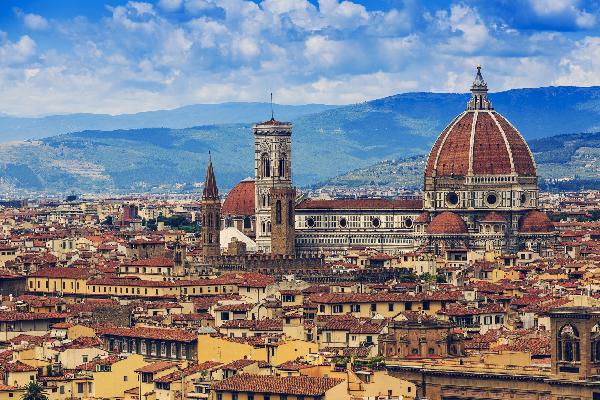
Florence Cathedral (Duomo): Dominating the skyline with its iconic red-tiled dome engineered by Brunelleschi. Climb to the top for a spectacular view.
Uffizi Gallery: One of the world’s top art museums, housing works by Botticelli, Leonardo da Vinci, Michelangelo, and Raphael.
Accademia Gallery: Home to Michelangelo’s monumental statue of David.
Ponte Vecchio: A medieval stone bridge spanning the Arno River, famous for its shops built along it, traditionally occupied by jewellers.
Piazzale Michelangelo: A square across the river offering the most famous panoramic view of Florence.
Practical Information:
Museum Reservations: Book tickets for the Uffizi and Accademia weeks in advance to avoid extremely long queues.
Getting Around: The historic center is entirely walkable. City buses are useful for reaching Piazzale Michelangelo.
Pisa: More Than Just a Tower
While famous for its Leaning Tower, Pisa offers a beautiful historic center and a prestigious university atmosphere.
Key Attractions:
Piazza dei Miracoli (Field of Miracles): A UNESCO site containing the Leaning Tower (Campanile), the Cathedral (Duomo), the Baptistery, and the Camposanto Monumentale (cemetery).
The Leaning Tower: Climb the 294-step spiral staircase to the top for a unique leaning experience and a great view. Book tickets in advance.
Pisa Cathedral: A magnificent example of Pisan Romanesque architecture. Entry is included with a ticket to any other monument in the square.
Practical Information:
Getting There: An easy day trip from Florence by train (about 1 hour). The Field of Miracles is a 20-30 minute walk from Pisa Centrale station.
Time Needed: A half-day is sufficient to see the main sights in the Piazza dei Miracoli.
Cinque Terre: The Five Lands
A string of five centuries-old seaside villages on the rugged Italian Riviera coastline. The villages are colorfully built into steep terraces and are part of a national park.
The Five Villages (from south to north):
Riomaggiore:The first village for many, with a picturesque harbor and colorful houses stacked on a cliff.
Manarola:Famous for its postcard-perfect view from the seaside path. Great for sunset.
Corniglia:The only village not directly on the sea, perched high on a cliff. It requires climbing ~380 steps from the station.
Vernazza:Often considered the most beautiful, with a natural harbor, a small beach, and a castle ruin overlooking the town.
Monterosso al Mare:The largest village, with a more traditional beach resort feel and a long sandy beach.
Practical Information:
Getting Around:The Cinque Terre Train Card is essential. It provides unlimited travel on the regional trains between the villages and access to hiking paths. The trains are frequent and fast.
Hiking:The famous coastal trail, Sentiero Azzurro, connects the villages. Check which sections are open before you go, as landslides can cause closures.
Boat Trips:A fantastic way to see the villages from the water.
Milan: Italy’s Fashion & Design Capital
A global capital of fashion and design, Milan is a modern, wealthy metropolis that also boasts a rich artistic and cultural heritage.
Key Attractions:
Milan Cathedral (Duomo):A breathtaking Gothic masterpiece. You can walk on the roof among its spires and statues for an up-close view.
Galleria Vittorio Emanuele II:A magnificent 19th-century shopping arcade, known as “Milan’s drawing room.”
La Scala Opera House:One of the world’s most famous opera houses. Take a tour or see a performance.
“The Last Supper”:Leonardo da Vinci’s iconic mural, located in the refectory of the Convent of Santa Maria delle Grazie. Reservations must be made months in advance.
Practical Information:
Getting Around:Milan has an excellent metro system (Metropolitana) that is easy to navigate.
Shopping:The Quadrilatero della Moda is the high-fashion district surrounding Via Montenapoleone.
Sirmione: Pearl of Lake Garda
A stunning resort town on a narrow peninsula jutting into Lake Garda, famous for its thermal spas and dramatic castle.
Key Attractions:
Scaliger Castle (Rocca Scaligera):A formidable 13th-century castle with a moat and panoramic views from its towers.
Grottoes of Catullus (Grotte di Catullo):The ruins of a vast Roman villa at the tip of the peninsula, set in an archaeological park with olive trees and stunning lake views.
Spa Treatments:Sirmione’s natural thermal springs feed numerous spa centers offering therapeutic treatments.