The Ultimate Iceland Ring Road Itinerary: Reykjavik to the Ring Road and Back
This comprehensive travel guide outlines one of the world’s most spectacular road trips: a journey around Iceland’s Ring Road (Route 1). This itinerary takes you from the vibrant capital of Reykjavik, through the famous Golden Circle, along the dramatic South Coast, into the remote Eastfjords, across the powerful North, and through the enchanting Snaefellsnes Peninsula before returning to the capital. It’s a journey through a land of fire and ice, where glaciers meet volcanoes, and waterfalls cascade over every cliff.
Part 1: Starting in Reykjavik & The Golden Circle
Your Icelandic adventure begins in
Reykjavik, the world’s northernmost capital. A city that perfectly blends colorful urban charm with raw, natural beauty. Spend a day exploring its key sites.
Hallgrímskirkja Church: This iconic expressionist church, inspired by Iceland’s basalt landscapes, dominates the city skyline. Take the elevator up the tower for a panoramic view of the city’s colorful rooftops and the sea beyond.
Harpa Concert Hall: A architectural masterpiece with a geometric glass facade that reflects the sky and harbor. Even if you don’t see a show, wandering its interior is a visual treat.
The Sun Voyager (Sólfar): A stunning steel sculpture of a Viking ship-dream boat, located by the seaside. It’s a perfect spot for photos, especially at sunset.
Laugavegur Street: The main shopping street, filled with boutiques, cafes, restaurants, and bars. It’s the heart of the city’s social life.
Food & Culture in Reykjavik: Don’t leave without trying a hot dog from Bæjarins Beztu Pylsur, a legendary stand. For a more upscale taste of Iceland, sample fermented shark (hákarl) for the brave, or enjoy fresh seafood like Arctic char or langoustine. The city’s coffee culture is also thriving—find a cozy cafe to warm up in.
Transportation Tip: Most travelers pick up their rental car at Keflavik International Airport (KEF) upon arrival. A 4×4 vehicle is highly recommended for this entire itinerary for better comfort, safety, and access to some highland and F-road detours.
The Golden Circle & Kerið Crater
The Golden Circle is a classic introductory route to Iceland’s geological wonders, easily accessible from Reykjavik.
Þingvellir National Park: A site of profound historical and geological significance. This is where the North American and Eurasian tectonic plates are pulling apart, creating a vast rift valley. It was also the original site of Iceland’s parliament, the Alþingi, established in 930 AD. Walk through the Almannagjá gorge for a tangible sense of the continental drift.
Geysir Geothermal Area: Home to the original Great Geysir, after which all others are named. While Geysir itself is mostly dormant, its neighbor, Strokkur, erupts reliably every 5-10 minutes, shooting a column of boiling water up to 40 meters (130 feet) into the air.
Gullfoss Waterfall: The “Golden Falls” is a massive, two-tiered waterfall where the river Hvítá plunges 32 meters into a deep canyon. The power and spray are immense, often creating stunning rainbows on sunny days.
Kerið Volcanic Crater: A striking addition to the classic route, Kerið is a 3,000-year-old volcanic crater lake. Its steep red and black slopes are contrasted by an astonishingly blue-green lake at the bottom. You can walk the entire rim and even descend to the water’s edge.
Practical Tip: The Golden Circle can be done as a long day trip from Reykjavik, but consider staying in the countryside afterwards (e.g., in Flúðir or Selfoss) to break up the driving and experience rural Iceland.
Part 2: The Dramatic South Coast to Vík
The drive along Iceland’s South Coast is arguably one of the most scenic in the world, showcasing an incredible density of natural wonders.
Reynisfjara (Black Sand Beach): Near the village of Vík, this is arguably Iceland’s most famous black sand beach. Its dramatic basalt sea stacks, the Reynisdrangar, rise from the ocean, and its enormous cave, Hálsanefshellir, is a marvel. CRITICAL SAFETY WARNING: This beach is known for “sneaker waves”—sudden, powerful waves that can drag people out to sea. Never turn your back on the ocean and always keep a safe distance.
The DC-3 Plane Wreck (Sólheimasandur): The skeletal remains of a US Navy DC-3 plane that crash-landed in 1973 sit isolated on a vast black sand plain. Reaching it requires a flat, ~4 km (2.5 mile) walk (one-way) from the parking lot. The stark, desolate landscape makes for powerful, otherworldly photography.
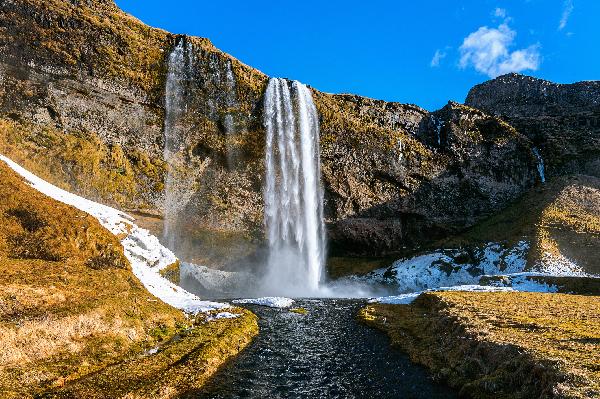
Seljalandsfoss Waterfall: A graceful and unique waterfall where you can walk on a path that goes completely behind the cascading water. You will get wet, so wear a waterproof jacket and pants. Just to the left (when facing it) is the hidden Gljúfrabúi waterfall, partially concealed within a canyon.
Skógafoss Waterfall: A mighty, broad waterfall that tumbles 60 meters down a cliff. On sunny days, a double rainbow is often visible at its base. A steep staircase runs alongside it, leading to a viewing platform at the top and the start of the famous Fimmvörðuháls hiking trail.
Accommodation & Food: The village of Vík is a key stopover. It has hotels, guesthouses, and a well-stocked supermarket. For dinner, try the restaurant at the Hotel Katla for modern Icelandic cuisine or the Sudur-Vík for pizza and burgers in a cozy setting.
Part 3: Vatnajökull National Park & The Eastfjords
Continuing east from Vík, the landscape becomes even more dominated by the vast Vatnajökull ice cap, Europe’s largest glacier.
Jökulsárlón Glacier Lagoon: A breathtaking lagoon filled with icebergs that have calved from the Breiðamerkurjökull glacier. The icebergs, in shades of blue and white, float serenely towards the Atlantic Ocean. Take an amphibious boat or zodiac tour to get up close to the ice.
Diamond Beach: Just across the road from Jökulsárlón, where icebergs wash up on the black sand shore. The contrast of the glittering ice crystals against the dark sand creates one of Iceland’s most photogenic scenes.
Skaftafell Nature Reserve: Part of Vatnajökull National Park, this area is a hiker’s paradise. A popular and relatively easy hike leads to Svartifoss (Black Fall), a unique waterfall framed by dark basalt columns.
The Eastfjords (Austfirðir): Leaving the glacier behind, Route 1 winds through the remote and serene Eastfjords. This region is characterized by deep, U-shaped valleys, towering mountains, and tiny fishing villages clinging to the fjords. It’s less touristy and offers a sense of tranquil isolation. Stop in towns like Djúpivogur or Borgarfjörður Eystri, known for its puffin colony in summer.
Egilsstaðir is the main service town for the east, a practical stop for fuel, supplies, and accommodation. From here, a detour is highly recommended.
Detifoss Waterfall Detour: Heading north from Egilsstaðir on Route 1, you’ll enter a vast, empty highland region. A rugged road (Route 864 on the east bank or 862 on the west) leads to Dettifoss, Europe’s most powerful waterfall by volume. The raw power as the Jökulsá á Fjöllum river plunges 45 meters into Jökulsárgljúfur canyon is humbling. Upstream is the graceful horseshoe-shaped Selfoss, and downstream is the majestic Ásbyrgi canyon, a horseshoe-shaped cliff formation believed to be Sleipnir’s hoofprint in Norse mythology.
Part 4: The North & Lake Mývatn
The Lake Mývatn area is a geothermal wonderland, often called a smaller, more accessible version of the Yellowstone Caldera.
Lake Mývatn: A shallow lake teeming with birdlife. The surrounding landscape is surreal, formed by volcanic eruptions.
Námaskarð Pass (Hverir): A barren, Martian-like landscape of bubbling mud pots, hissing fumaroles, and steaming sulfur vents. The smell of sulfur is strong, but the sight is unforgettable.
Krafla Volcano & Viti Crater: Visit the Krafla caldera and its explosion crater, Viti (“Hell”). Viti now holds an astonishingly blue-green lake.
Mývatn Nature Baths: The North’s answer to the Blue Lagoon. These geothermally heated milky-blue waters are perfect for a relaxing soak at a fraction of the cost and crowd level of its southern counterpart.
Goðafoss (Waterfall of the Gods): Located right on the Ring Road. This stunning semicircular waterfall is steeped in history; it’s said that after Iceland’s lawmaker Þorgeir Ljósvetningagoði made Christianity the official religion in 1000 AD, he threw his statues of the Norse gods into these falls.
Accommodation: Stay in the Mývatn area itself (e.g., at Skútustaðir or Reykjahlíð) to fully explore this unique region.
Akrureyri & The West
Akrureyri, Iceland’s “Capital of the North,” is a charming city on the Eyjarfjörður fjord. It boasts beautiful botanical gardens, a striking modernist church (Akrureyrarkirkja), and a vibrant cultural scene. It’s an excellent place to restock and explore urban life.
Travelling West: From Akureyri, you’ll head west through scenic valleys. A worthwhile historical stop is Reykholt, one of Iceland’s most important medieval literary and historical centers. It was the home of Snorri Sturluson, the poet and historian who wrote the Prose Edda.
The Magical Snaefellsnes Peninsula
Often called “Iceland in Miniature,” this peninsula packs glaciers, volcanoes, lava fields, black sand beaches, and charming fishing villages into one compact area.
Snaefellsjökull National Park: Dominated by the glacier-capped stratovolcano Snaefellsjökull, famous as the entrance to Jules Verne’s “Journey to the Center of the Earth.”
Kirkjufell Mountain: Arguably Iceland’s most photographed mountain. Its distinct arrowhead shape, often reflected in the nearby Kirkjufellsfoss waterfalls, is iconic.
Arnarstapi & Hellnar: Picturesque coastal villages connected by a beautiful coastal hiking path featuring dramatic cliffs and rock arches like Gatklettur.
Londrangar Basalt Cliffs: Remnants of an ancient volcanic crater that now stand as towering pinnacles off the coast.
Djúpalónssandur Black Pebble Beach: A hauntingly beautiful cove with black pebbles and the rusted remains of a shipwreck. Test your strength with the historic lifting stones that fishermen once used.
The Final Leg: Back to Reykjavik
The drive from Snaefellsnes back to Reykjavik is straightforward. Once back in the capital, you can reflect on an epic journey that has circled the entire island. Consider visiting the Blue Lagoon or the newer Sky Lagoon for a final relaxing soak before your flight home.
Crucial Practical Travel Tips for Your Ring Road Adventure
Best Time to Go: Summer (June-August) offers 24-hour daylight (Midnight Sun), accessible roads, and lush landscapes. However, it’s peak season. Shoulder seasons (May & September) offer fewer crowds, northern lights potential, but some services may be limited. Winter is challenging due to limited daylight and potentially dangerous road conditions.
Driving: Check road.is and safetravel.is daily for road conditions and weather alerts. Icelandic weather is notoriously volatile. Never drive off-road—it’s illegal and damages fragile ecosystems. Be aware of single-lane bridges.
Budget: Iceland is expensive. Save money by booking accommodation well in advance, buying groceries from Bonus or Kronan supermarkets for picnics and lunches, and using shared bathroom facilities in guesthouses.
What to Pack: Layers are key! Waterproof and windproof outer shell (jacket and pants), warm mid-layers (fleece/wool), thermal base layers, sturdy waterproof hiking boots, swimsuit and towel for hot pots, and a camera with extra memory cards.
Respect Nature: Always stay on marked paths. The environment is fragile and volcanic rock can be sharp and unstable. Your safety depends on respecting the power of nature—never underestimate waves, weather, or glaciers.
This Ring Road itinerary offers a profound journey into the heart of Iceland’s elemental beauty. It’s a trip that will leave you with memories of landscapes so powerful and unique they will feel almost otherworldly.