Central European Grand Tour: From the Alps to the Adriatic
An itinerary covering Munich, Ljubljana, Postojna, Split, Dubrovnik, Zadar, Plitvice Lakes, Zagreb, Salzburg, and Hallstatt.
Trip Overview
This comprehensive journey takes you through the heart of Central Europe, from the beer halls of Bavaria to the sun-drenched shores of the Dalmatian Coast. You will experience a remarkable diversity of landscapes, cultures, and history, traversing four distinct countries: Germany, Austria, Slovenia, and Croatia. The route is designed as a circular tour starting and ending in Munich, Germany, making it efficient for flight bookings.
Countries Covered: Germany, Austria, Croatia, Slovenia
Major Cities & Stops: Munich (Start/End), Ljubljana, Postojna, Split, Dubrovnik, Zadar, Plitvice Lakes National Park, Zagreb, Salzburg, Hallstatt.
Recommended Duration: 14-21 days.
Primary Themes: Imperial History, Alpine & Karst Landscapes, Coastal Beauty, Medieval Architecture, Cultural Heritage.
Detailed Itinerary
Munich, Germany
The capital of Bavaria serves as the gateway to this grand tour. Munich seamlessly blends traditional German culture with modern urban life.
Key Attractions:
Marienplatz: The central square, home to the New Town Hall (Neues Rathaus) and its famous Glockenspiel.
Hofbräuhaus: The world’s most famous beer hall, offering a quintessential Bavarian experience.
English Garden: One of the world’s largest urban public parks, perfect for a stroll or to see surfers on the Eisbach river.
Nymphenburg Palace: A magnificent Baroque palace and its expansive gardens, the summer residence of the Bavarian monarchs.
Deutsches Museum: One of the oldest and largest science and technology museums in the world.
Practical Tips:
Getting Around: Munich has an excellent public transportation system (MVV) including U-Bahn (subway), S-Bahn (suburban train), trams, and buses. A day pass is cost-effective.
Accommodation: Stay near the Hauptbahnhof (main train station) or in the Altstadt (Old Town) for easy access to sights.
Ljubljana, Slovenia
A charming, green capital dominated by a medieval castle and adorned with beautiful Baroque and Art Nouveau architecture, largely designed by architect Jože Plečnik.
Key Attractions:
Ljubljana Castle: Take the funicular to this hilltop fortress for panoramic views of the city and the Julian Alps.
Tromostovje (Triple Bridge): The iconic triple bridge spanning the Ljubljanica River in the heart of the city.
Prešeren Square: The central square dedicated to Slovenia’s greatest poet, France Prešeren.
Dragon Bridge: A famous Art Nouveau bridge guarded by four dragon statues, the symbol of Ljubljana.
Tivoli Park: The largest park in the city, ideal for a relaxing walk.
Practical Tips:
Getting There from Munich: Direct train or bus (approx. 5-6 hours). Driving takes about 4.5 hours.
Getting Around: The city center is compact and largely pedestrianized, easily explored on foot or by bicycle.
Postojna Cave, Slovenia
A short trip from Ljubljana lies one of the world’s most spectacular karst cave systems. A unique underground world of stalactites, stalagmites, and halls.
Key Attractions:
Cave Train Ride: A miniature train takes you deep into the cave system, a unique experience in itself.
Stalactite Formations: Witness breathtaking formations like the Brilliant, a brilliant white stalagmite, and the “Spaghetti Hall”.
Predjama Castle: Often visited in combination with the cave, this Renaissance castle is built dramatically into the mouth of a cave cliff.
The Human Fish (Proteus): See the olm, a rare blind amphibian that lives in the cave’s underground rivers.
Practical Tips:
Getting There: Easily accessible by car or bus from Ljubljana (approx. 45-60 minutes).
Tickets: Book online in advance during peak season to avoid long queues. The cave temperature is a constant 10°C (50°F), so bring a jacket.
Split, Croatia
The vibrant heart of Dalmatia, built around the monumental Roman Palace of Emperor Diocletian. It’s a living city where ancient history blends with a modern Mediterranean lifestyle.
Dubrovnik, Croatia
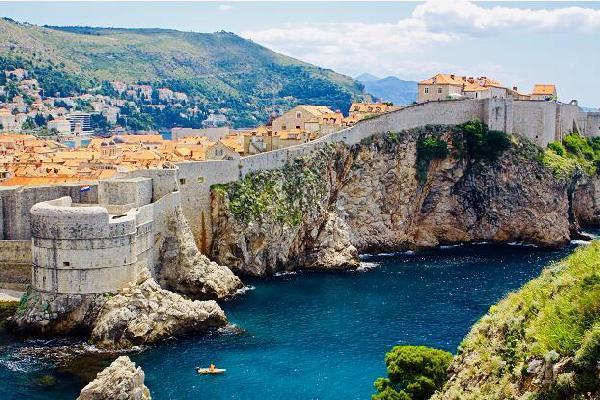
The “Pearl of the Adriatic,” a stunning medieval walled city on the Dalmatian Coast. Its well-preserved Old Town is a UNESCO World Heritage site.
Zadar, Croatia
A historic city known for its Roman and Venetian ruins, but most famous for its unique modern installations: the Sea Organ and the Sun Salutation.
Plitvice Lakes National Park, Croatia
A UNESCO World Heritage site and Croatia’s most famous natural attraction. A breathtaking system of 16 terraced lakes, joined by waterfalls and set in deep woodland.
Zagreb, Croatia
Croatia’s lively capital, offering a mix of Austro-Hungarian architecture, vibrant street life, and numerous museums.
Salzburg, Austria
The birthplace of Mozart and the setting for “The Sound of Music,” this Baroque city is nestled amidst alpine peaks and is home to a magnificent fortress.
Hallstatt, Austria
A picture-perfect village on the shore of Lake Hallstatt, surrounded by towering mountains. A UNESCO World Heritage site known for its salt mine history.
Return to Munich
The final leg from Hallstatt to Munich completes the circuit. The drive offers beautiful alpine scenery. Upon return to Munich, you can depart or extend your stay.
Practical Information
Transportation
Flights: Start and end at Munich Airport (MUC).
Car Rental: Highly recommended for flexibility, especially for reaching places like Plitvice and Hallstatt. Pick up and drop off in Munich. Ensure your rental agreement allows cross-border travel.
Trains & Buses: An excellent alternative. Germany, Austria, and Slovenia have efficient rail networks (Deutsche Bahn, ÖBB). Croatia is best covered by bus (e.g., FlixBus) for this itinerary. Book longer journeys in advance for better prices.
Ferries: Essential for Croatian island hopping. Jadrolinija is the main state-run ferry company. Book car ferries in advance during summer.
Accommodation
Types: A wide range is available: hotels, guesthouses (pensions), private apartments (very common in Croatia), and hostels.
Booking: Book well in advance for peak season (June-August), especially in popular coastal towns like Dubrovnik and Split and in small villages like Hallstatt.
Location: In cities, staying in or near the Old Town is ideal for walkability but can be noisier. For coastal towns, consider locations with beach access.
Money & Costs
Currencies:
- Germany & Austria: Euro (€)
- Slovenia: Euro (€)
- Croatia: Euro (€) – adopted in 2023.
Cost Overview: Germany and Austria are generally more expensive than Slovenia and Croatia. Coastal Croatia can be pricey during peak season. Overall, a mid-range budget is recommended.
Payment: Credit/debit cards are widely accepted in cities and tourist areas. However, always carry some cash for small shops, markets, and rural areas.
Visas & Entry
All four countries are part of the Schengen Area (Croatia joined in 2023). This means a single Schengen visa allows travel between them. For US, UK, Canadian, Australian, etc., passport holders, visa-free travel for up to 90 days within a 180-day period applies. Always check the latest entry requirements based on your nationality before travel.
Best Time to Travel
Late Spring (May-June) & Early Autumn (September): Ideal. Pleasant weather, fewer crowds, and lower prices than peak summer. The sea is warm enough for swimming in September.
Summer (July-August): Peak season. Hot weather, crowded coastal destinations, and highest prices. Book everything far in advance.
Winter (Nov-Mar): Cold, with some attractions (especially coastal) having reduced hours. However, Christmas markets in Munich and Salzburg are magical. Hallstatt is beautiful under snow.