Ultimate Travel Guide: 法兰克福-苏黎世-卢塞恩-列支敦士登-慕尼黑-德奥边境小镇-维也纳-布达佩斯-布拉格-德累斯顿-柏林-法兰克福 in 德国,瑞士,德国,奥地利,匈牙利,捷克


This comprehensive travel guide details a classic Central European itinerary, connecting the historic and cultural hubs of Germany, Switzerland, Austria, Hungary, and the Czech Republic. The journey is a loop, starting and ending in Frankfurt, Germany, and is ideally suited for a multi-week trip by train or car. The route offers a rich tapestry of experiences, from Alpine landscapes and medieval old towns to imperial palaces and vibrant modern cities.


The route is as follows: Frankfurt am Main (Germany) → Zurich (Switzerland) → Lucerne (Switzerland) → Liechtenstein → Munich (Germany) → German-Austrian Border Town (e.g., Salzburg or Berchtesgaden) → Vienna (Austria) → Budapest (Hungary) → Prague (Czech Republic) → Dresden (Germany) → Berlin (Germany) → Frankfurt am Main (Germany). This guide provides objective descriptions and practical information for each destination.


Frankfurt am Main, Germany

Frankfurt is a city of contrasts, famously known as “Mainhattan” due to its impressive skyline of skyscrapers that house the headquarters of many European banks and financial institutions. Despite its modern facade, Frankfurt boasts a well-preserved Altstadt (Old Town) centered around the Römerberg square. The city is a major transportation hub, making it an ideal start and end point for this journey. Key sights include the Römer (the city hall), the reconstructed half-timbered houses, the Goethe House (birthplace of the famous writer Johann Wolfgang von Goethe), and the Museumsufer (Museum Embankment) with a high density of museums lining the Main River.

Spring (April-May) and Autumn (September-October) for mild weather.
Frankfurt Airport (FRA) is one of Europe’s busiest. The Hauptbahnhof (main train station) is a central hub for national and international rail travel. The city has an excellent public transport system (U-Bahn, S-Bahn, trams). Areas around the Hauptbahnhof offer convenience but can be less scenic. The city center (Innenstadt) and Sachsenhausen (famous for its apple wine taverns) are popular choices.

Römerberg Square, St. Bartholomew’s Cathedral, Goethe House, Main Tower for panoramic views, Museumsufer.


Zurich, Switzerland

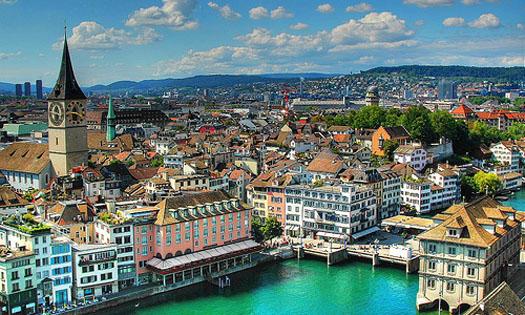
Zurich is Switzerland’s largest city, a global center for banking and finance set on the pristine shores of Lake Zurich and at the foot of the Alps. It seamlessly combines a modern, cosmopolitan atmosphere with a beautifully preserved medieval old town (Altstadt). The Limmat River flows through the city center, flanked by historic guild houses and churches. Zurich is known for its high quality of life, luxury shopping along the Bahnhofstrasse, and a vibrant cultural scene. The view of the snow-capped Alps from the lake on a clear day is breathtaking.

June to September for warm weather and lake activities; December for the famous Christmas markets.
Zurich Airport (ZRH) is well-connected. The Hauptbahnhof is a major European rail terminus. Zurich is very walkable, with an efficient tram and bus network. The Old Town (Altstadt) for history, Kreis 4/5 (Zurich West) for a trendy, industrial vibe, and areas near the lake for scenic views.

Bahnhofstrasse, Lake Zurich boat cruise, Grossmünster and Fraumünster churches, Lindenhof park for views, Swiss National Museum.


Lucerne, Switzerland

Lucerne is a picture-postcard city nestled amid stunning mountain scenery on the shores of Lake Lucerne. Its well-preserved medieval architecture, iconic wooden bridges, and beautiful waterfront make it one of Switzerland’s most popular destinations. The Chapel Bridge (Kapellbrücke), a covered wooden footbridge from the 14th century with interior paintings, is the city’s most famous landmark. The nearby Water Tower and the poignant Lion Monument are other key attractions. Lucerne serves as a perfect gateway for excursions to nearby mountains like Pilatus and Titlis.

April to October for pleasant weather; summer is ideal for lake cruises.
Lucerne is easily reached by train from Zurich (approx. 50 minutes). The city center is compact and best explored on foot. The Old Town area offers the most charm and proximity to major sights.

Chapel Bridge (Kapellbrücke), Lion Monument (Löwendenkmal), Musegg Wall, Old Town squares, Lake Lucerne cruise.


Liechtenstein

The Principality of Liechtenstein is a microstate nestled between Switzerland and Austria. It is one of the smallest countries in the world, known for its dramatic Alpine landscape, medieval castles, and status as a financial center. The capital, Vaduz, is more of a small town than a bustling city, dominated by the stunning Vaduz Castle perched on a hill overlooking the Rhine Valley. While small, it offers a unique opportunity to visit a sovereign principality. The Postmuseum, showcasing the country’s famous postage stamps, and the Kunstmuseum Liechtenstein, featuring modern art, are key points of interest.

May to October for hiking and clear views of the Alps.
Accessed by bus from Sargans or Buchs in Switzerland (both are train stations). There is no airport. The country can be traversed by bus or car in a short time. Limited options in Vaduz; many visitors stay in nearby Swiss or Austrian towns.

Vaduz Castle (exterior views only as it’s the royal residence), Vaduz city center, Liechtenstein National Museum.


Munich, Germany

Munich, the capital of Bavaria, is a city that effortlessly blends traditional German culture with modern innovation. It is world-famous for its annual Oktoberfest celebration, but its appeal extends far beyond beer halls. Munich boasts magnificent architecture, from the grand Frauenkirche and the neo-Gothic Neues Rathaus (New Town Hall) on Marienplatz to the baroque Nymphenburg Palace. The city is home to prestigious art museums, beautiful English Garden parks larger than Central Park, and a high-tech industry. The atmosphere is generally relaxed and prosperous.

Late spring, summer, and early autumn (May-September). September-October for Oktoberfest (book far in advance).
Munich Airport (MUC) is a major hub. The Hauptbahnhof is centrally located. An excellent U-Bahn and S-Bahn system covers the city. Altstadt-Lehel for proximity to main sights, Schwabing for a trendy university vibe, Maxvorstadt for museums.

Marienplatz and the Glockenspiel, Englischer Garten, Hofbräuhaus beer hall, Nymphenburg Palace, Deutsches Museum.


German-Austrian Border Town (e.g., Salzburg or Berchtesgaden)

This part of the itinerary allows for flexibility. A highly recommended stop is Salzburg, Austria. Just across the German border, Salzburg is the birthplace of Mozart and the setting for “The Sound of Music.” Its stunning Baroque architecture is dominated by the Hohensalzburg Fortress overlooking the Altstadt. Alternatively, one could visit Berchtesgaden in Germany, famous for the Kehlsteinhaus (Eagle’s Nest) with its dramatic Alpine views and the serene Königssee lake. Both locations offer unparalleled access to the Eastern Alps’ natural beauty.

April to October for optimal sightseeing and mountain access.
Salzburg is easily reached by train from Munich (~1.5 hours). Berchtesgaden requires a train to Freilassing and then a bus. Having a car provides more flexibility in this region. In Salzburg: Old Town for history; in Berchtesgaden: the town center or near Königssee.

Salzburg: Hohensalzburg Fortress, Mirabell Palace and Gardens, Getreidegasse (Mozart’s Birthplace). Berchtesgaden: Königssee boat trip, Eagle’s Nest Documentation Center.


Vienna, Austria

Vienna, the capital of Austria, is a city steeped in imperial history, classical music, and grand architecture. For centuries the center of the Habsburg Empire, its legacy is visible in magnificent palaces like Schönbrunn and the Hofburg. The city’s historic center is a UNESCO World Heritage Site. Vienna is synonymous with composers like Mozart, Beethoven, and Strauss, and offers world-class opera and concert experiences. Coffee house culture is an integral part of Viennese life, inviting visitors to slow down and savor a slice of Sachertorte.

Spring (April-May) and Autumn (September-October) for mild weather and fewer crowds.
Vienna International Airport (VIE). The city has an outstanding U-Bahn system that is easy to navigate. The Hauptbahnhof is the main train station. Innere Stadt (1st District) for luxury and history; Leopoldstadt (2nd District) for a more local feel; Mariahilf (6th District) for shopping and value.

Schönbrunn Palace, Hofburg Palace, St. Stephen’s Cathedral, Belvedere Palace (home to Klimt’s “The Kiss”), Vienna State Opera.


Budapest, Hungary

Budapest, Hungary’s capital, is often called the “Queen of the Danube.” It was formed in 1873 by merging the hilly Buda with the flat Pest. The city is famed for its stunning architecture, particularly the Hungarian Parliament Building on the Pest side and Buda Castle on the opposite bank. Budapest is renowned for its thermal bath culture, with historic spas like Széchenyi and Gellért. The city has a vibrant nightlife centered on “ruin bars” set up in abandoned buildings. The view from Gellért Hill at night, with the illuminated Chain Bridge and Parliament, is unforgettable.

May-June and September-October for pleasant temperatures.
Budapest Ferenc Liszt International Airport (BUD). The city has a good metro, tram, and bus network. Keleti and Nyugati stations are the main international rail hubs. Pest side (District V, VI, VII) for nightlife and central sights; Buda side for a quieter, more residential feel.

Buda Castle & Fisherman’s Bastion, Hungarian Parliament Building, Széchenyi Thermal Bath, St. Stephen’s Basilica, Great Market Hall.


Prague, Czech Republic

Prague, the “City of a Hundred Spires,” is one of Europe’s most beautiful and well-preserved cities. Its historic center, a UNESCO World Heritage Site, escaped major damage during WWII. The city’s skyline is dominated by the sprawling Prague Castle complex on one side of the Vltava River and the Old Town with its famous Astronomical Clock on the other. The Charles Bridge, a 14th-century stone bridge lined with statues, connects the two. Prague offers a magical atmosphere with its Gothic churches, Baroque palaces, cobblestone streets, and vibrant beer culture.

Spring and early autumn to avoid peak summer crowds.
Václav Havel Airport Prague (PRG). The city is very walkable but also has an efficient metro and tram system. Hlavní nádraží is the main train station. Old Town (Staré Město) for being in the heart of everything; Lesser Town (Malá Strana) for a quieter, romantic setting; Vinohrady for a local neighborhood vibe.

Prague Castle & St. Vitus Cathedral Charles Bridge Old Town Square & Astronomical Clock Jewish Quarter (Josefov) Wenceslas Square
Dresden GermanyDresden the capital of Saxony is known as the “Florence on the Elbe” due to its magnificent Baroque and Rococo architecture built under Augustus the Strong in the 18th century Heavily damaged by bombing in World War II the city has been painstakingly rebuilt The reconstructed Frauenkirche is a powerful symbol of reconciliation The city’s treasures are concentrated in the Altstadt along the Elbe River including the Zwinger Palace Semperoper opera house and the Procession of Princes mural Dresden also has a vibrant alternative culture scene in the Neustadt district

May to October for comfortable sightseeing especially to enjoy the Elbe riversideDresden Airport (DRS) has limited connections The Hauptbahnhof is well-connected by rail The city center is walkable with trams providing additional coverageAltstadt for proximity to major landmarks; Neustadt for nightlife trendy cafes and a bohemian atmosphereFrauenkirche Zwinger Palace Semperoper Procession of Princes mural Brühl’s Terrace “The Balcony of Europe” Green Vault museumBerlin GermanyBerlin Germany’s capital and largest city is a vibrant hub of history culture and creativity It is a city forever marked by its 20th-century history particularly the Cold War division symbolized by the Berlin Wall Today it is known for its tolerant liberal atmosphere world-class museums cutting-edge architecture and legendary nightlife Reminders of its past are everywhere from the Brandenburg Gate and Reichstag Building to the Holocaust Memorial and East Side Gallery Berlin is not a conventionally beautiful city but one that is endlessly fascinating dynamic and thought-provoking

Late spring summer and early autumn (May-September)Berlin Brandenburg Airport (BER) serves the city Berlin has an extensive and efficient public transport system (U-Bahn S-Bahn trams buses) The Hauptbahnhof is a central rail hubMitte for central location and major sights; KreuzbergFriedrichshain for nightlife and alternative culture; Prenzlauer Berg for a trendy family-friendly vibeBrandenburg Gate Reichstag Building & dome Museum Island East Side Gallery Holocaust Memorial Checkpoint Charlie Topography of TerrorThe Euro () is used in Germany Austria France Netherlands Belgium Luxembourg Slovenia Slovakia Estonia Latvia Lithuania Croatia Montenegro Kosovo Andorra Monaco San Marino Vatican City Liechtenstein Switzerland uses the Swiss Franc (CHF) Hungary uses the Hungarian Forint (HUF) Czech Republic uses the Czech Koruna (CZK)German is spoken in Germany Austria Switzerland Liechtenstein Hungarian in Hungary Czech in the Czech Republic English is widely spoken in tourist areas hotels and restaurants but learning a few basic phrases in the local language is always appreciatedThis itinerary is perfectly suited for train travel Europe’s rail network is efficient comfortable and connects all these cities Eurail Interrail passes or point-to-point tickets can be purchased Driving offers flexibility especially for visiting smaller towns and countryside regions but consider parking costs and environmental zones in citiesThe Schengen Area allows for border-free travel between most European countries on this itinerary Check visa requirements based on your nationality as you will be entering the Schengen Zone Travel between Germany Austria Switzerland Liechtenstein Czech Republic Hungary is generally without border controlsThis Central European loop offers an unparalleled journey through the heart of the continent From Frankfurt’s financial power to Zurich’s pristine lakes from Vienna’s imperial splendor to Budapest’s romantic thermal baths from Prague’s fairy-tale spires to Berlin’s gritty history this trip encapsulates diverse cultures languages histories and landscapes It is a demanding but immensely rewarding itinerary that provides a deep understanding of Europe’s past present and future

Leave a Reply

Your email address will not be published. Required fields are marked *