A Scenic German Journey: Frankfurt, Würzburg, Heidelberg, Rüdesheim, Koblenz & Cologne
This comprehensive travel guide details a classic circular route through the heart of Western Germany, a journey that encapsulates the very essence of the country’s rich history, vibrant culture, and stunning natural beauty. The itinerary takes you from the modern financial hub of Frankfurt, through the romantic valleys of the Rhine and Main rivers, past medieval castles and world-renowned vineyards, to the magnificent Gothic cathedral of Cologne. It’s a trip that seamlessly blends urban exploration with enchanting small-town experiences.
Route Overview and Practical Tips
This journey is best experienced over a period of 7 to 10 days, allowing for a comfortable pace to absorb the unique character of each destination. The primary mode of transport for this route is Germany’s efficient and reliable train system, operated by Deutsche Bahn (DB). The
Rhein-Main-Ticket or Schönes-Wochenende-Ticket can offer significant savings for regional travel if you are in a small group. For the most scenic leg of the trip—the Rhine Gorge between Rüdesheim and Koblenz—a river cruise is highly recommended.
Best Time to Visit: Late spring (May-June) and early autumn (September-October) offer pleasant weather, fewer crowds, and, in autumn, the beautiful spectacle of harvest season in the wine regions.
Accommodation: Book well in advance, especially for smaller towns like Rüdesheim and during popular festivals. Consider staying in a traditional guesthouse (Gasthaus) for a more authentic experience.
Cuisine: Be prepared for hearty, regional specialties. Each area has its own culinary highlights, from apple wine in Frankfurt to Riesling in the Rhine Valley.
Language: While English is widely spoken in tourist areas, learning a few basic German phrases like “Guten Tag” (Good day) and “Danke” (Thank you) is always appreciated.
Frankfurt: The Gateway
Often dubbed “Mainhattan” due to its impressive skyline of skyscrapers on the banks of the Main River, Frankfurt am Main is a city of fascinating contrasts, where centuries-old history coexists with a dynamic, modern economy.
Attractions & Experiences
Römerberg: This is the historic heart of Frankfurt, a picturesque square lined with beautifully reconstructed half-timbered houses. The Römer itself is the city hall and an iconic symbol of Frankfurt.
St. Bartholomew’s Cathedral (Kaiserdom): A grand Gothic cathedral that was the election and coronation site for Holy Roman Emperors. Climb the tower for a breathtaking panoramic view of the city.
Museumsufer (Museum Embankment): Located along the south bank of the Main River, this is one of Europe’s most concentrated museum landscapes. Highlights include the Städel Museum (fine arts), the German Film Museum, and the Communications Museum.
Main Tower: For the best view of the famous skyline, head to the public viewing platform of this skyscraper. It’s particularly stunning at sunset.
Food & Drink
Frankfurt’s culinary scene is diverse, but its traditional specialties are a must-try.
Grüne Soße (Green Sauce): A cold herb sauce made with seven fresh herbs, sour cream, and yogurt, typically served with boiled potatoes and eggs. It’s a local obsession.
Frankfurter Würstchen: The original Frankfurter is a thin, smoked pork sausage. Enjoy it with bread, mustard, and a glass of Apfelwein.
Apfelwein (Ebbelwoi): Frankfurt’s traditional alcoholic beverage is a tart, fermented apple wine. Experience it in the traditional apple wine pubs (Apfelweinwirtschaften) in the Sachsenhausen district, served in a ribbed glass jug called a Bembel.
Transportation & Local Insight
Frankfurt Airport (FRA) is a major international hub. The city center is easily accessible via S-Bahn trains (lines S8 or S9). Within the city, an excellent public transport network (RMV) of U-Bahn, trams, and buses makes getting around simple. Purchase a day pass (
Tageskarte) for unlimited travel. A local insight: avoid the area around the central station (Hauptbahnhof) late at night, as it can be seedy.
Würzburg: The Baroque Pearl
A short train ride northeast from Frankfurt brings you to Würzburg, a city graciously nestled in vineyards and renowned for its magnificent Prince-Bishops’ Residence, a UNESCO World Heritage site.
Attractions & Experiences
Würzburg Residence (Würzburger Residenz): This monumental palace is a masterpiece of Baroque architecture. The grand staircase, crowned by Giovanni Battista Tiepolo’s vast fresco—the largest in the world—is simply awe-inspiring. The guided tour of the opulent rooms is essential.
Marienberg Fortress (Festung Marienberg): perched high above the Main River, this fortress offers stunning views over the city. You can walk up through the vineyard or take a bus. The fortress houses two interesting museums on regional history.
Alte Mainbrücke (Old Main Bridge): A charming pedestrian bridge adorned with statues of saints. It’s a local tradition to stop here with a glass of Franconian wine (Bocksbeutel) and watch the world go by, much like on Prague’s Charles Bridge.
Market Square & St. Mary’s Chapel: The vibrant market square is the city’s bustling center, with the intricately decorated red sandstone St. Mary’s Chapel as its centerpiece.
Food & Drink
Würzburg is the capital of the Franconian wine region, known for its dry, crisp white wines like Silvaner and Müller-Thurgau.
Franconian Wine: Look for the distinctive round-bellied Bocksbeutel bottle. Enjoy a tasting at one of the many wine bars (Weinstuben) in the city.
Franconian Sausages: Sample local sausages like Bratwurst or Blutwurst, often served with sauerkraut and bread.
Transportation & Local Insight
Würzburg is easily reached from Frankfurt by frequent IC (InterCity) or ICE (InterCity Express) trains in about 1 hour. The city center is compact and best explored on foot. A local insight: visit the
Hofkeller, the historic court cellar under the Residence, for a memorable wine tasting in a regal atmosphere.
Heidelberg: Romanticism & Academia
Traveling south from Würzburg, you arrive in Heidelberg, Germany’s oldest university town and the very embodiment of Romanticism. Its ruined castle overlooking the river and the charming old town has inspired poets and artists for centuries.
Attractions & Experiences
Heidelberg Castle (Heidelberger Schloss): Take the funicular railway up to this magnificent red sandstone ruin. The view of the old town and the Neckar River from the castle terrace is iconic. Don’t miss the world’s largest wine barrel (Großes Fass) in the castle cellar.
Old Town (Altstadt): Stroll along the Hauptstraße, one of Europe’s longest pedestrian streets, lined with shops, cafes, and historical buildings.
Old Bridge (Karl-Theodor-Brücke): Cross this beautiful stone bridge for a classic photo opportunity back towards the castle and old town. Be sure to touch the brass monkey statue for good luck!
Philosophers’ Walk (Philosophenweg): On the north side of the river, this path winds up the hill, offering arguably the best views of Heidelberg. It’s a peaceful escape favored by philosophers and students.
Food & Drink
The student population ensures a lively and affordable food scene alongside traditional restaurants.
Heidelberger Studentenkuss: A local chocolate praline, the “Heidelberg Student’s Kiss,” created as a discreet way for students to send messages to young ladies.
Regional Dishes: Try hearty fare like Sauerbraten (pot roast) or Schweinshaxe (pork knuckle) in a traditional beer garden.
Transportation & Local Insight
The train from Würzburg to Heidelberg takes approximately 1 hour on an ICE train. Heidelberg’s main station is a short tram ride from the old town. A local insight: visit one of the historic student prison cells (
Studentenkarzer) at the university, where misbehaving students were incarcerated and left their mark with graffiti and drawings on the walls.
The Rhine Valley: Rüdesheim & Koblenz
The journey now enters its most scenic phase—the Upper Middle Rhine Valley, a UNESCO World Heritage site between Bingen/Rüdesheim and Koblenz. This is a land of legend, with castles perched on nearly every hilltop and steep vineyards terraced along the riverbanks.
Rüdesheim am Rhein
A classic Rhine Valley wine town, Rüdesheim is charming, touristy, and full of life.
Drosselgasse: This narrow, cobblestone lane is world-famous. Just 144 meters long, it’s packed with wine taverns, restaurants, and live music. It’s a vibrant, if crowded, experience.
Siegfried’s Mechanical Music Cabinet (Musikkabinett): A fascinating museum housing a unique collection of self-playing musical instruments from three centuries.
Niederwalddenkmal: Take a cable car (Sesselbahn) up to this monumental statue commemorating the unification of Germany in 1871. The views over the Rhine Gorge are spectacular.
Cruise the Rhine: This is the highlight. Board a KD Rhine Cruise or a similar vessel for the journey downstream to Koblenz. You’ll glide past Loreley Rock, the legendary cliff where a siren’s song was said to lure sailors to their doom, and countless castles like Pfalzgrafenstein, Rheinfels, and Marksburg.
Cuisine of the Rhine Valley
Riesling Wine: This is Riesling paradise. The region produces some of the world’s finest Rieslings, ranging from bone-dry (Trocken) to lusciously sweet (Spätlese, Auslese). Visit a local winery (Weingut) for a tasting.
Rheinischer Sauerbraten:A regional specialty, this pot roast is marinated for days in a vinegar and spice mixture before being slow-cooked. It’s typically served with red cabbage and potato dumplings.
Cruise & Koblenz Arrival
The river cruise from Rüdesheim to Koblenz takes approximately 2-3 hours, depending on the boat and stops. It’s an unmissable experience that brings the romance of the Rhine to life. Upon arrival in Koblenz, you disembark at the heart of the city.
Koblenz: Where Rivers Meet
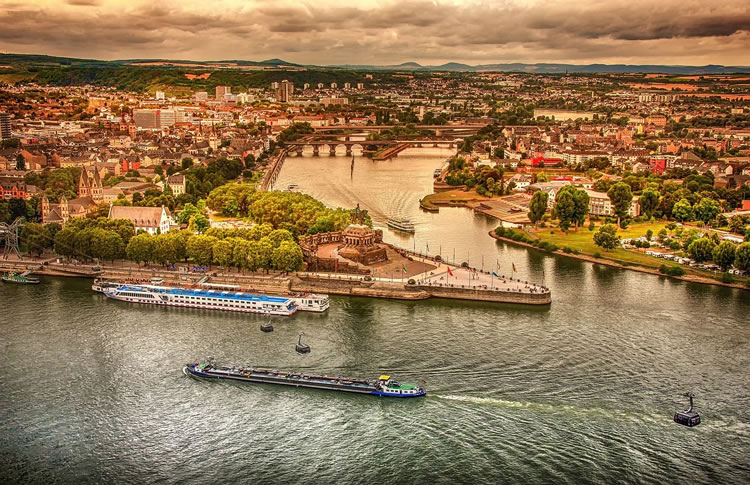
Situated at the dramatic confluence of the Rhine and Moselle rivers (
Deutsches Eck or “German Corner”), Koblenz is a city with over 2,000 years of history.
Deutsches Eck: This headland is dominated by a giant equestrian statue of Emperor Wilhelm I. It’s a powerful national monument and offers superb views of the two rivers merging.
Ehrenbreitstein Fortress (Festung Ehrenbreitstein): One of Europe’s largest preserved fortresses, it looms high above the Rhine opposite Deutsches Eck. Reach it via a scenic cable car ride over the river. The views from the fortress grounds are breathtaking.
Historic Old Town: Explore the charming squares like Jesuitenplatz, with its pretty fountain and pastel-colored buildings.
Transportation & Local Insight
The train journey from Heidelberg to Rüdesheim requires a change in Mainz and takes about 1.5 hours. From Koblenz to Cologne, frequent trains take just under an hour. A local insight for Koblenz: during summer, the riverside promenades come alive with beer gardens and cafes—a perfect spot for an evening drink while watching the river traffic.
Cologne: The Metropolitan Cathedral City
The final major stop on this journey is Cologne (Köln), a vibrant, sprawling metropolis with a rich Roman heritage and a famously open-minded and festive culture.
Attractions & Experiences
Cologne Cathedral (Kölner Dom):A UNESCO World Heritage site and Germany’s most visited landmark. This Gothic masterpiece is staggering in its scale and detail. Climb the 533 steps to the top of the south tower for an incredible view. The Shrine of the Three Kings inside is a major pilgrimage site.
Old Town (Altstadt):The reconstructed old town, nestled between the cathedral and the Rhine, is home to colorful buildings, traditional breweries (Brauhäuser), and the picturesque Fischmarkt (Fish Market) square.
Hohenzollern Bridge:The railway bridge next to the cathedral is famous for its “love locks.” Couples attach padlocks to the fence and throw the key into the Rhine as a symbol of their everlasting love.
Museum Ludwig:Situated near the cathedral, this museum boasts one of Europe’s most important collections of modern art, including a superb Pop Art section and many works by Picasso.
Chocolate Museum (Schokoladenmuseum):A delightful museum located on the Rheinau peninsula that tells the story of chocolate from bean to bar, complete with a chocolate fountain.
Cuisine & The Famous Kölsch
Cologne has its own unique beer culture centered around
Kölsch.
Kölsch Beer:A light, crisp, top-fermented beer that is served in tall, thin 0.2-liter glasses called Stangen. Waiters known as Köbes (in blue aprons) will continuously replace your empty glass with a fresh one until you place your coaster on top of the glass to indicate you’ve had enough.
Cologne Dishes:The local cuisine is hearty. Try Himmel un Ääd(“Heaven and Earth”—black pudding with apple sauce and mashed potatoes) or Cologne is world-famous for its Carnival ( The final leg from Cologne back to Frankfurt is a swift and comfortable journey aboard an ICE train, taking just over one hour. As you travel back to your starting point, you can reflect on a journey that has taken you through a remarkable cross-section of German culture—from financial power and Baroque grandeur to romantic ruins, mythical river landscapes, and Gothic splendor. This circular route through Western Germany offers an unforgettable tapestry of experiences that will leave you with a deep appreciation for this diverse and captivating country.
Carnival Insight & Transportation
The Return to Frankfurt & Final Thoughts