A Journey Through Southern Germany: From Frankfurt to Munich
This travel guide outlines a classic route through the heart of Southern Germany, blending modern finance, romantic old towns, automotive passion, sobering history, and Bavarian charm. The journey from Frankfurt to Munich takes you through a diverse landscape of culture, history, and gastronomy, offering a profound and memorable experience.
Route Overview
The itinerary covers a logical and scenic progression through the states of Hesse and Baden-Württemberg, culminating in Bavaria. The suggested route is:
Frankfurt → Heidelberg → Stuttgart → Metzingen (Shopping Outlet) → Dachau Concentration Camp Memorial Site → Munich. This path is best navigated by Germany’s efficient rail system (Deutsche Bahn) or by rental car for maximum flexibility.
1. Frankfurt am Main: The Gateway
Often called “Mainhattan” due to its impressive skyline of skyscrapers lining the River Main, Frankfurt is Germany’s financial powerhouse. However, look beyond the glass and steel to discover a city with a charming, reconstructed old town and a vibrant cultural scene.
Attractions & Experiences
Römerberg: This is the historic heart of Frankfurt. The square is lined with beautifully reconstructed half-timbered houses, including the Römer city hall. It’s a picturesque spot that feels like stepping back in time, especially during the Christmas market.
St. Bartholomew’s Cathedral (Frankfurter Dom): A red sandstone Gothic church that was the election and coronation site for Holy Roman Emperors. Climb the tower for a panoramic view of the city center.
Museumsufer (Museum Embankment): On both sides of the River Main, you’ll find a dense collection of over a dozen museums. Highlights include the Städel Museum for European art, the German Film Museum, and the Communications Museum.
Main Tower: For the best view of the skyline, head to the viewing platform of this skyscraper. It’s particularly stunning at sunset.
Food & Drink
Apfelwein (Ebbelwoi): Frankfurt’s traditional beverage is a tart, alcoholic cider. Experience it in the cobbled streets of the Sachsenhausen district in a traditional apple wine pub.
Grüne Soße (Green Sauce): A cold herb sauce made with seven specific herbs, sour cream, and yogurt. It’s typically served with boiled potatoes and hard-boiled eggs or schnitzel.
Frankfurter Würstchen: The original Frankfurter is a thin, smoked pork sausage. Enjoy it with bread and mustard.
Transportation & Tips
- Frankfurt Airport (FRA) is one of Europe’s major hubs, making it a convenient starting point.
- The city center is very walkable, and an excellent public transport network (U-Bahn, S-Bahn, trams) covers all areas.
Local Insight: While the banking district is impressive, spend your time in Alt-Sachsenhausen and the Römerberg to capture the city’s soul.
2. Heidelberg: The Romantic City
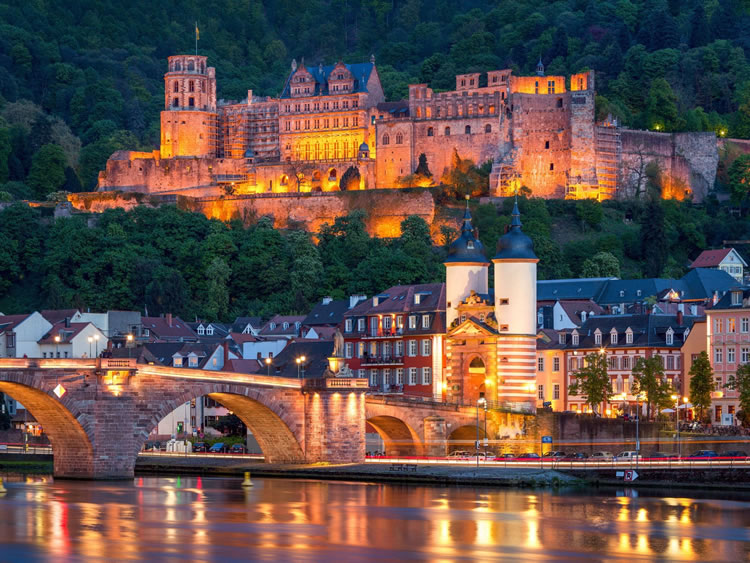
A short train ride south brings you to Heidelberg, the epitome of German Romanticism. Nestled in the Neckar river valley and dominated by its magnificent ruined castle, the city has inspired poets and artists for centuries.
Attractions & Experiences
Heidelberg Castle: Take the funicular railway or walk up the steep paths to this iconic red sandstone ruin. The view over the old town and river is breathtaking. Don’t miss the world’s largest wine barrel in the castle cellar.
Altstadt (Old Town): Stroll along the Hauptstraße, one of Europe’s longest pedestrian streets, lined with Baroque buildings, shops, and cafes.
Old Bridge (Karl-Theodor-Brücke): Cross this beautiful stone bridge for classic postcard views of the castle and old town. Be sure to spot the Bridge Monkey statue.
Philosophers’ Walk (Philosophenweg): On the north side of the river, this path offers the opposite, equally stunning, perspective of the castle and city. It’s a peaceful escape.
Food & Drink
Heidelberger Studentenkuss: A local chocolate praline, the “Heidelberg Student’s Kiss,” was originally a discreet way for students to send messages to young ladies.
- Heidelberg has its own brewery,
Heidelberger Brauerei, where you can sample traditional German beers.
- The region is known for its wine, particularly from the Baden wine-growing area. Try a local Riesling or Spätburgunder (Pinot Noir).
Transportation & Tips
- Heidelberg is easily reached from Frankfurt by train in about 1 hour.
- The city is best explored on foot. The funicular to the castle is included in the castle entrance ticket.
Local Insight: Visit the castle in the late afternoon for softer light and fewer crowds. For a unique experience, attend one of the castle illumination and firework displays held a few times a year.
3. Stuttgart: Cradle of the Automobile
Stuttgart is the capital of Baden-Württemberg and a powerhouse of industry, home to Mercedes-Benz and Porsche. It’s a city set within rolling hills and vineyards, offering a unique blend of technology and nature.
Attractions & Experiences
Mercedes-Benz Museum: An architectural marvel that takes you on a journey through the entire history of the automobile, from the very first car to futuristic concepts. It’s a must-visit even for non-car enthusiasts.
Porsche Museum: Located in Zuffenhausen, this sleek museum focuses on the iconic sports cars of Ferdinand Porsche. The exhibits are stunning and immersive.
Stuttgart Library (Stadtbibliothek): A stunningly modern cube-shaped library with a minimalist white interior centered around a monumental staircase. A paradise for architecture lovers.
Schlossplatz: The city’s central square, surrounded by the New Palace and the Old Castle, is a perfect spot for people-watching and relaxing.
Food & Drink
Maultaschen: A Swabian specialty – large pasta pockets filled with meat, spinach, or herbs. They can be served in broth, fried, or sliced in a salad.
Spätzle: The iconic German egg noodle, often served as a side dish or as Kässpätzle (with cheese and fried onions).
Weindorf: If your visit coincides with one of Stuttgart’s famous wine festivals (like the Stuttgart Wine Village), it’s a fantastic opportunity to sample local wines from the region’s many vineyards directly within the city.
Transportation & Tips
- The train from Heidelberg to Stuttgart takes approximately 40 minutes.
- Stuttgart has a comprehensive S-Bahn and U-Bahn network. The museums are slightly outside the city center but are easily reachable by public transport.
Local Insight: For a break from the urban environment, take a short trip to the nearby Wilhelma Zoo and Botanical Gardens or hike through the vineyards that surround the city.
4. Metzingen: Outlet Shopping Paradise
A short detour from Stuttgart brings you to Metzingen, a small town that has become one of Germany’s premier shopping destinations. It began with the Hugo Boss factory outlet and has since expanded into a vast outlet city.
Attractions & Experiences
Shopping: This is the main and only attraction. You’ll find outlets for high-end and premium brands like Hugo Boss (the flagship store), Bally, Bogner, Escada, Michael Kors, Puma, and many more, with discounts often ranging from 30% to 70% off retail prices.
Food & Drink
- The outlet center has several cafes and restaurants catering to shoppers. For a more local experience, walk into the town center of Metzingen itself to find traditional German restaurants.
Transportation & Tips
- Metzingen is easily reached from Stuttgart by regional train (approx. 25-30 minutes). The outlet city is a short walk from the train station.
Local Insight: Visit on a weekday to avoid massive weekend crowds. Check the website for special sales events before you go. Come with a list and a budget, as it’s easy to get carried away.
5. Dachau Concentration Camp Memorial Site: A Sobering Lesson
A crucial note: This is not an “attraction” in the traditional sense but a memorial and a place of education and remembrance. Visitors should approach it with respect and solemnity.
On the way from Stuttgart to Munich, it is possible to stop at Dachau, a suburb of Munich. This was the first Nazi concentration camp, opened in 1933, and served as a model for all others.
Attractions & Experiences
The Memorial Site: The grounds include the former administration building (now a museum with extensive historical exhibitions), the reconstructed barracks, the bunker (prison within the prison), and the crematorium area. It is a harrowing but essential visit to understand the depths of human cruelty and the importance of vigilance and remembrance.
Food & Drink
- There is a small cafeteria on site, but due to the nature of the visit, most people choose not to eat on the premises. It is more appropriate to have a meal before or after your visit in Munich or another location.
Transportation & Tips
- From Stuttgart, take a train to Munich Hauptbahnhof. From there, take the S-Bahn (S2) towards Dachau/Petershausen. Get off at Dachau station. From there, take bus 726 (direction: Saubachsiedlung) to the “KZ-Gedenkstätte” stop.
Local Insight: Allow at least 3-4 hours for a respectful visit. The audio guide is highly recommended as it provides detailed context and personal stories. Be prepared for an emotionally draining experience. Silence and respectful behavior are expected throughout the site.
6. Munich (München): The Capital of Bavaria
The final destination is Munich, a city that masterfully blends traditional Bavarian culture with a modern, cosmopolitan vibe. Known for its beer halls, beautiful architecture, and world-class museums, Munich has something for everyone.
Attractions & Experiences
Marienplatz: The central square and heart of the city. Watch the Glockenspiel performance in the New Town Hall at 11 am and 12 pm (and 5 pm in summer).
Hofbräuhaus: The world’s most famous beer hall. Even if you don’t stay for a full meal, it’s worth stepping inside to experience the bustling atmosphere, oompah music, and massive beer steins.
English Garden (Englischer Garten): One of the world’s largest urban parks. You can stroll, bike, or watch surfers ride the standing wave in the Eisbach river.
Nymphenburg Palace: A breathtaking Baroque palace with stunning gardens. The “Gallery of Beauties” commissioned by King Ludwig I is a highlight.
Deutsches Museum: Located on an island in the Isar river, this is one of the world’s largest and oldest museums of science and technology.
Viktualienmarkt: A daily food market near Marienplatz offering fresh produce, cheeses, meats, flowers, and more. It’s a great place to grab a bite to eat.
Food & Drink
Weißwurst: A traditional Bavarian veal sausage, typically eaten before noon. Remember to remove the skin before eating!
Schweinshaxe:A roasted pork knuckle with crispy crackling, usually served with dumplings and sauerkraut.
Brezen (Pretzel):The large, soft Bavarian pretzel is a staple snack, often enjoyed with Obatzda (a spicy cheese-butter spread) and a beer.
Beer: Munich is synonymous with beer. Visit during Oktoberfest for the ultimate experience, or enjoy it year-round in any of the city’s countless beer gardens (like the one at the Chinese Tower in the English Garden) and halls.
Transportation & Tips
- Munich has an excellent U-Bahn (subway) and S-Bahn (suburban train) system that connects the entire city and surrounding areas.
- The city center is very walkable, with most major sights located within a reasonable distance from Marienplatz.
Local Insight: To experience a true local beer garden, bring your own food if you wish (this is allowed in traditional ones) but always buy your drinks from the self-service counters. A simple “Prost!” (cheers) while making eye contact is customary. For a less touristy alternative to Hofbräuhaus, try Augustiner Bräustuben or Löwenbräukeller.
A Note on Transportation Between Cities
The entire journey is perfectly suited for travel by train using Deutsche Bahn (DB). Consider purchasing a
“Bayernticket” (Bavaria Ticket) for your travel within Bavaria (e.g., from Stuttgart to Munich and around Munich), which offers unlimited travel on regional trains for one day at a very low group rate. For cross-state travel (e.g., Frankfurt to Heidelberg), standard DB tickets or savings fares (Sparpreis) booked in advance are your best options.
A journey through Southern Germany offers an incredible diversity of experiences—from skyscrapers to castle ruins, from automotive innovation to historical reflection, and from quiet old towns to bustling beer halls. It’s a trip that engages all senses and leaves a lasting impression.
*Please check official websites for current opening hours, ticket prices, and booking requirements before your visit, as details can change.*