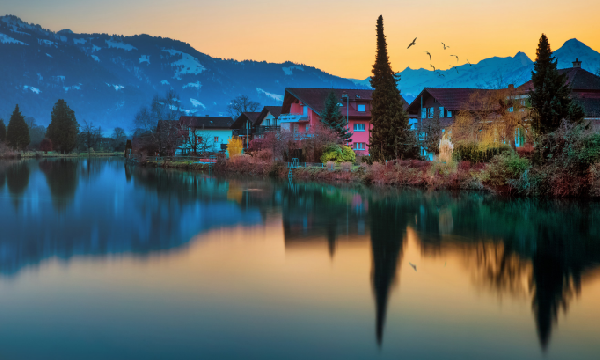
A Grand Tour: From Frankfurt to the Swiss Alps
This journey takes you from the economic heart of Germany into the very soul of Switzerland, traversing vibrant cities, serene lakes, and the majestic Alps. It’s a carefully curated route that blends urban culture with unparalleled natural beauty, offering a profound and diverse European travel experience.
Part 1: The German Start – Frankfurt & Stuttgart
Frankfurt am Main: The Manhattan of Germany
Often the first point of entry for international travelers, Frankfurt is a city of fascinating contrasts. Its soaring skyscrapers, which form one of Europe’s most impressive skylines, house the continent’s financial powerhouses. Yet, nestled at their feet is a charming, reconstructed Altstadt (Old Town) that tells a story of a much older Germany.
Key Attractions:
Römerberg: The historic heart of Frankfurt, this picturesque square is lined with beautifully reconstructed half-timbered houses. The Römer itself is the city’s town hall and an iconic symbol.
St. Bartholomew’s Cathedral (Frankfurter Dom): A stunning Gothic cathedral where Holy Roman Emperors were once elected and crowned. Climb the tower for a breathtaking panoramic view of the city.
Museumsufer (Museum Embankment): A unique concentration of museums on both banks of the River Main. Highlights include the Städel Museum for art lovers and the German Film Museum.
Main Tower: The only skyscraper with a public viewing platform. The ascent offers the definitive view of Frankfurt’s impressive skyline.
Culinary Delights:
Frankfurt’s culinary scene is robust. You must try
Grüne Soße (Green Sauce), a cold herb sauce typically served with boiled potatoes and eggs. Pair it with a glass of Apfelwein (apple wine), the region’s signature tart alcoholic beverage, best enjoyed in the traditional apple wine pubs of the Sachsenhausen district.
Transport & Tips:
- Frankfurt Airport (FRA) is a major international hub, seamlessly connected to the city by S-Bahn trains.
- The city center is very walkable, and an excellent public transport network (RMV) covers all areas.
Local Insight: For a true local experience, skip the fancy bars and head to an Apfelweinwirtschaft in Sachsenhausen for a convivial evening.
Stuttgart: Cradle of the Automobile
A short train ride south leads to Stuttgart, a city set in a lush basin of hills and vineyards. It’s the proud home of Mercedes-Benz and Porsche, but also a center for sophisticated culture and green spaces.
Key Attractions:
Mercedes-Benz Museum: An architectural marvel that takes you on a journey through the entire history of the automobile, from the very first car to futuristic concepts.
Porsche Museum: A sleek, contemporary museum dedicated to the iconic sports car brand, showcasing its engineering excellence and racing heritage.
Stuttgart Library (Stadtbibliothek): A stunningly modern cube-shaped library with a minimalist white interior that is a paradise for architecture photographers.
Wilhelma Zoo and Botanical Garden: One of Europe’s most beautiful zoos, located on the grounds of a former royal palace.
Culinary Delights:
Stuttgart is the capital of the Swabian region, known for its hearty cuisine. Sample
Maultaschen (large pasta pockets filled with meat, spinach, and herbs) and Spätzle (soft egg noodles, often topped with cheese). The city is also surrounded by vineyards, so tasting local Trollinger or Riesling wine is a must.
Transport & Tips:
- The train from Frankfurt to Stuttgart takes about 1 hour 15 minutes on the high-speed ICE train.
- Stuttgart has a comprehensive network of S-Bahn, U-Bahn, and trams (operated by VVS).
Local Insight: Visit one of the many Weinstuben (wine bars) in the historic Bohnenviertel district for an authentic taste of local wine and food in a cozy setting.
Part 2: Into the Heart of Switzerland
Zurich: Global City on a Lake
The train journey from Stuttgart to Zurich is a scenic prelude to Switzerland. Zurich is a global banking center that effortlessly combines efficiency with a high quality of life. Its pristine lake and river, flanked by elegant boulevards and a well-preserved medieval old town, create a stunning urban landscape.
Key Attractions:
Old Town (Altstadt): A labyrinth of narrow, cobblestone streets on both sides of the Limmat River. Explore Grossmünster and Fraumünster churches, the latter famous for its stained-glass windows by Marc Chagall.
Bahnhofstrasse: One of the world’s most exclusive shopping avenues, running from the main train station to Lake Zurich.
Lake Zurich (Zürichsee): Take a boat cruise to appreciate the city from the water, with views of the Alps in the distance. Swimming in the clean lake during summer is a popular local activity.
Lindenhof: A tranquil hilltop park offering the best panoramic views over the Old Town’s rooftops and the Limmat River.
Swiss National Museum (Landesmuseum): Housed in a fairytale-like castle, it provides a comprehensive overview of Swiss cultural history.
Culinary Delights:
Zurich is famous for
Zürcher Geschnetzeltes – sliced veal in a creamy white wine and mushroom sauce, typically served with Rösti (Swiss-style hash browns). Don’t forget to indulge in Swiss chocolate at legendary confiseries like Sprüngli.
Transport & Tips:
- Zurich Airport (ZRH) is a major hub. The train from Stuttgart takes about 3 hours.
- The Zurich Card offers unlimited public transport and museum entries.
Local Insight: For a unique experience, join the locals for a swim in the Limmat River at Oberer Letten or take a dip in one of the public river baths (Flussbad).
The Swiss Village Experience: A Taste of Alpine Serenity
The true magic of Switzerland lies not just in its cities but in its countless picturesque villages. While your itinerary mentions “Swiss小镇” (Swiss town) twice, this allows for flexibility. Consider villages like:
Grindelwald: A dramatic valley village directly beneath the mighty north face of the Eiger.
Wengen or Mürren: Idyllic, car-free villages perched on a mountain terrace high above the Lauterbrunnen Valley, offering jaw-dropping views.
Spiez: A stunning town on the shore of Lake Thun with a beautiful castle and vineyards.
The experience here is about immersion: waking up to the sound of cowbells, breathing the crisp mountain air, hiking through flower-strewn meadows, and simply absorbing the peaceful atmosphere.
Bern: The Charming Federal Capital
A short train ride from Zurich brings you to Bern, the de facto capital of Switzerland. Its UNESCO-listed Old Town, built on a steep peninsula encircled by the Aare River, is a masterpiece of medieval planning and sandstone architecture.
Key Attractions:
Old Town (Altstadt): Characterized by nearly four miles of arcades (Lauben) – covered walkways lining the streets, sheltering charming shops and cafes.
Zytglogge: The iconic medieval clock tower. Watch its animated figures put on a show just before the hour strikes.
Federal Palace (Bundeshaus): The seat of the Swiss government and parliament. Free tours are available when parliament is not in session.
Bear Park (BärenPark): Bern’s heraldic animals are kept in a modern, spacious enclosure by the river. A visit is a city tradition.
Rose Garden (Rosengarten): A beautiful park across the river offering the classic postcard view of Bern’s Old Town.
Culinary Delights:
Bern is known for its hearty Berner Platte, a platter featuring an assortment of smoked meats, sausages, sauerkraut, and beans. Also, try Berner Mandelbärli, almond bear-shaped cookies that make for a perfect souvenir.
Transport & Tips:
- The train from Zurich to Bern takes just under 1 hour.
- The Old Town is best explored on foot. The public transport system (BernMobil) is excellent for longer distances.
Local Insight: In summer, join the locals for a swim in the turquoise waters of the Aare River. They float from the outskirts right into the heart of the city – an unforgettable experience (for strong swimmers only!).
The Swiss Riviera: Lausanne & Montreux
Travelling southwest from Bern, you reach Lake Geneva (Lac Léman) and the region often called the Swiss Riviera, blessed with a remarkably mild climate.
Lausanne: The Olympic City
A vibrant city built on three hills, Lausanne is home to the International Olympic Committee and has a dynamic, youthful energy thanks to its university.
Olympic Museum: A world-class, interactive museum celebrating the history and spirit of the Olympic Games, with stunning gardens and lake views.
Cathédrale de Notre-Dame: A magnificent Gothic cathedral regarded as one of the most beautiful in Switzerland.
Ouchy: The city’s lakeside port area, perfect for a leisurely stroll along the promenade.
Flon District: A former industrial warehouse area transformed into a trendy neighborhood of shops, bars, and clubs.
Culinary Delights:
The Vaud region is famous for its sausages and charcuterie. Try a
Papet Vaudois, a comforting dish of leeks and potatoes served with sausage.
Montreux: The Pearl of the Swiss Riviera
A short train ride from Lausanne, Montreux feels more resort-like, with its sublime lakeside setting and backdrop of towering mountains.
Château de Chillon: A breathtakingly beautiful castle on a small island just off the shore. Its dungeons and historic rooms are impeccably preserved.
Freddie Mercury Statue & Queen Studio Experience: Montreux was a creative home for the band Queen. A statue of Freddie Mercury looks out over the lake, and a small museum details their time here.
Lakeside Promenade: Lined with flowers, palm trees, benches, and art installations, this is one of Europe’s most beautiful walks.
Montreux Jazz Festival: If visiting in early July, you’ll encounter one of the world’s most famous music festivals.
Culinary Delights:
The terraced vineyards above Montreux produce excellent wines. Sample local Chasselas white wine. The region is also known for its fine-dining restaurants.
Transport & Tips:
- The train from Bern to Lausanne takes about 1 hour 10 minutes. Lausanne to Montreux is another 20-25 minutes.
- A boat cruise on Lake Geneva between Lausanne, Montreux, and Chillon Castle is highly recommended for spectacular views.
Local Insight: Take the cogwheel train up to Rochers-de-Naye from Montreux for an incredible alpine panorama high above the lake.
The Alpine Majesty: Jungfraujoch Region
The Journey to Jungfraujoch – Top of Europe
The pinnacle of any Swiss trip for many is the ascent to Jungfraujoch. This isn’t just a mountain peak; it’s an engineering marvel and an unforgettable journey into a high-altitude world of ice and rock. The journey itself is part of the attraction, involving a series of scenic trains culminating in a ride through the heart of the Eiger and Mönch mountains.
The Route & Experience:
The Scenic Start:The adventure begins in Interlaken Ost. You board a train towards either Grindelwald or Lauterbrunnen – both routes offer stunning views of deep valleys and towering peaks.
The Grindelwald Route:Takes you past lush meadows with the dramatic north face of the Eiger looming ahead.
The Lauterbrunnen Route:Takes you into the famous valley with its 72 waterfalls cascading down sheer cliff faces.
The Cogwheel Ascent:At Kleine Scheidegg, a major mountain pass and hub for hikers, you change to the Jungfrau Railway. This cogwheel train begins its steep climb towards the Jungfraujoch station.
Tunnel through the Eiger:The train enters a tunnel inside the Eiger mountain. It makes two brief five-minute stops at viewing windows carved into the mountain face: Eigerwand and Eismeer. These offer dramatic glimpses out to the glacier world below.
The Summit (3,454 meters / 11,332 ft):The train arrives at Jungfraujoch – Top of Europe, the highest railway station in Europe.
Sphinx Observatory Terrace:A high-speed elevator takes you to this viewing platform for what are arguably the most breathtaking 360-degree panoramic views in the Alps – encompassing the Aletsch Glacier (the longest in the Alps), and surrounding peaks.
Ice Palace:A magical world carved deep into the heart of the glacier, featuring corridors and chambers with sculptures made entirely of ice.