A Journey Through the Heart of Germany: Frankfurt, Würzburg, Rothenburg, Heidelberg & Rüdesheim
This comprehensive travel guide details a classic German itinerary, a circular route starting and ending in Frankfurt, that immerses travelers in the country’s rich history, stunning architecture, world-renowned wines, and fairy-tale landscapes. The journey encompasses the northern section of the famed Romantic Road, the philosophical path of the Castle Road, and the enchanting Rhine Valley, offering a microcosm of the German experience.
Trip Overview and Logistics
This route is designed to be flexible, typically undertaken over 5 to 7 days. The primary mode of transport between cities is Germany’s efficient and reliable rail system, Deutsche Bahn (DB). Renting a car provides more freedom to explore the countryside and smaller villages at one’s own pace. The best times to travel are during the spring (April-May) and autumn (September-October) when the weather is mild, and the vineyards are at their most picturesque. The summer months are popular but crowded, while winter offers magical Christmas markets, especially in Rothenburg.
Duration: 5-7 days
Primary Transport: Train (Deutsche Bahn) or Rental Car
Key Themes: Medieval History, Baroque Architecture, Wine Culture, River Valleys
Frankfurt: The Gateway
Often dubbed “Mainhattan” due to its impressive skyline of skyscrapers along the Main River, Frankfurt am Main is a dynamic financial hub that serves as the perfect entry point for this journey. It is a city of contrasts, where modern commerce coexists with meticulously reconstructed historical landmarks.
Main Attractions in Frankfurt
Römerberg: The historic heart of Frankfurt, this picturesque square is lined with beautifully reconstructed half-timbered houses. The Römer itself is Frankfurt’s city hall and has been for over 600 years.
St. Bartholomew’s Cathedral (Frankfurter Dom): A grand Gothic cathedral that was the election and coronation site for Holy Roman Emperors. Climbing the tower rewards visitors with panoramic views of the city.
Museum Embankment (Museumsufer): A unique concentration of museums on both sides of the Main River, including the Städel Museum, which boasts a world-class collection of European art.
Palmengarten: One of the most beautiful botanical gardens in Germany, offering a peaceful escape from the urban bustle.
Food & Drink in Frankfurt
Frankfurt’s culinary scene is a blend of traditional Hessian specialties and international flair.
Grüne Soße (Green Sauce): A cold herb sauce made with seven fresh herbs, sour cream, and yogurt, traditionally served with boiled potatoes and eggs.
Frankfurter Würstchen: Long, thin, smoked sausages, typically enjoyed with bread and mustard.
Apfelwein (Ebbelwoi): Frankfurt’s signature tart apple cider, best experienced in the traditional apple wine pubs of the Sachsenhausen district.
Handkäse mit Musik: A regional cheese specialty (“hand cheese with music”) marinated in oil and vinegar with onions.
Transportation & Accommodation in Frankfurt
Frankfurt Airport (FRA) is one of Europe’s major hubs. The city center is easily accessible via S-Bahn (suburban train). Frankfurt’s central train station (Hauptbahnhof) is one of the busiest in Europe and the starting point for all rail journeys on this itinerary. For accommodation, the city center (Innenstadt) offers convenience for sightseeing, while areas like Sachsenhausen provide a more traditional, village-like atmosphere.
Würzburg: The Baroque Pearl
The first major stop north of Frankfurt, Würzburg is the northern gateway to the Romantic Road. It is a city defined by its magnificent Baroque and Rococo architecture, heavily influenced by the powerful prince-bishops who once ruled here. Though much of the city was destroyed in World War II, its most important monuments have been painstakingly restored.
Main Attractions in Würzburg
Würzburg Residence (Residenz): A UNESCO World Heritage Site and a masterpiece of Baroque architecture. The highlight is the grand staircase crowned by the largest fresco in the world, painted by Giovanni Battista Tiepolo.
Marienberg Fortress (Festung Marienberg): This formidable fortress overlooks the city from across the Main River. It houses two museums and offers breathtaking views of Würzburg and its vineyards.
Alte Mainbrücke (Old Main Bridge): A beautiful 15th-century stone bridge adorned with statues of saints. It’s a popular spot to stroll and enjoy a glass of local Franconian wine while watching the sunset.
Market Square (Markt): The vibrant central market square surrounded by colorful buildings and dominated by the ornate Chapel of Mary (Marienkapelle).
Food & Drink in Würzburg
Würzburg is at the heart of the Franconian wine region, known for its distinctive Bocksbeutel (flat, round-bellied wine bottles).
Franconian Wine: Sample Silvaner and Riesling wines at a traditional wine bar (Weinstube) or right on the Alte Mainbrücke.
Franconian Sausages: Often served with sauerkraut and a fresh bread roll (Brötchen).
Blaue Zipfel: Sausages cooked in a vinegar and onion broth, giving them a distinctive sour flavor.
Transportation & Accommodation in Würzburg
Würzburg is approximately 1 hour from Frankfurt by high-speed ICE train or 1.5 hours by regional train. The city center is compact and easily walkable. Accommodation ranges from modern hotels near the station to charming guesthouses in the Old Town.
Rothenburg ob der Tauber: The Medieval Dream
A journey back in time, Rothenburg ob der Tauber is arguably Germany’s best-preserved medieval walled town. Perched above the Tauber River valley, its cobblestone lanes, half-timbered houses, and intact fortifications look as though they have been lifted from a storybook. It is a highlight of the Romantic Road.
Main Attractions in Rothenburg
Town Walls: Walk the entire 2.5-mile circuit on top of the ancient walls for unparalleled views over the town’s rooftops and into the surrounding countryside.
Market Square (Marktplatz): The central hub, home to the Town Hall (Rathaus) with its towering Gothic front and the delightful Councillors’ Tavern (Ratstrinkstube), where a glockenspiel re-enacts the legendary “Meistertrunk” (Master Draught) story.
Plönlein: This iconic corner—a small square with a half-timbered house splitting two streets—is one of the most photographed spots in Germany.
Criminal Museum (Mittelalterliches Kriminalmuseum): A fascinating and sometimes gruesome look at medieval law and order, featuring instruments of punishment.
St. Jacob’s Church (St. Jakobskirche): Home to the magnificent Holy Blood Altar, a masterpiece by Tilman Riemenschneider.
Food & Drink in Rothenburg
The culinary offerings here are hearty and traditional Franconian fare.
Franconian Schneeballen (Snowballs): A local pastry made from strips of dough that are shaped into a ball, fried, and dusted with powdered sugar or coated in chocolate or other toppings.
Rothenburger Sausage: A flavorful grilled sausage typically served with sauerkraut.
Local Beer: Enjoy a beer from a local brewery in a cozy beer garden or tavern.
Transportation & Accommodation in Rothenburg
Reaching Rothenburg by train requires a change in Steinach, as it is on a regional branch line. The total journey from Würzburg takes about 1 hour and 15 minutes. A car offers more flexibility. Staying within the walled city is highly recommended to experience its magical atmosphere after the day-trippers have left. Book well in advance, especially during peak season.
Heidelberg: The Romantic University Town
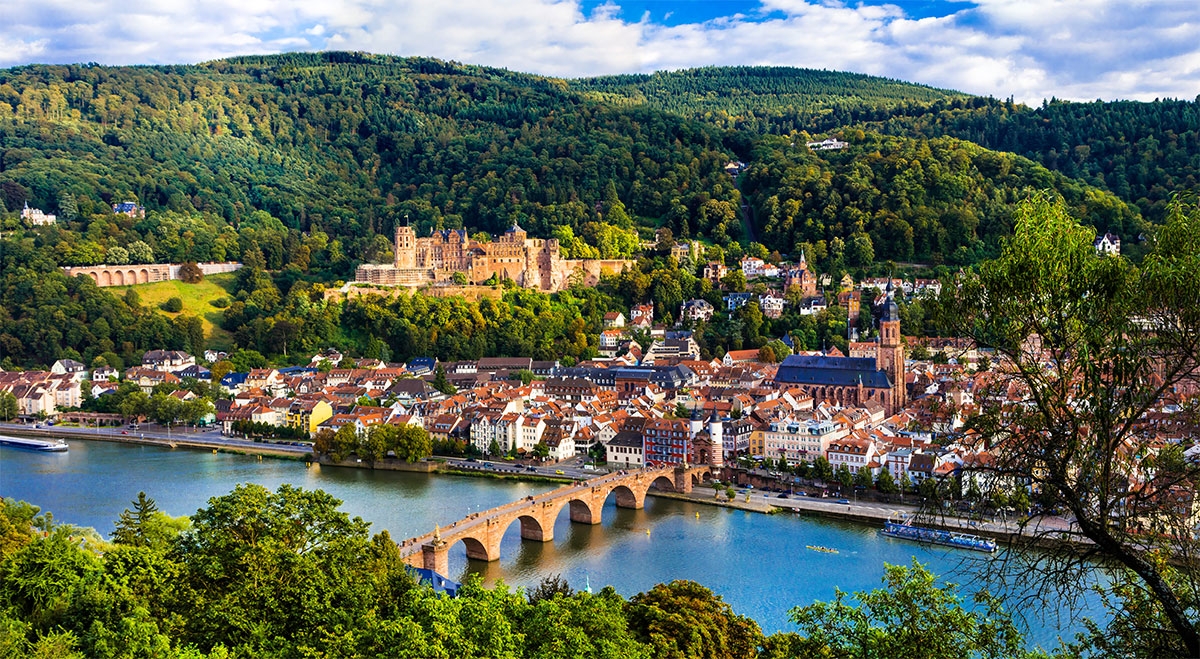
Leaving the Romantic Road, the route heads southwest to Heidelberg, a city that has captivated poets, artists, and philosophers for centuries. Nestled in the Neckar River valley and dominated by its magnificent ruined castle, Heidelberg is home to Germany’s oldest university, infusing the city with a youthful and intellectual energy.
Main Attractions in Heidelberg
Heidelberg Castle (Heidelberger Schloss): This iconic red sandstone ruin is one of Germany’s most important Renaissance structures. Take the funicular railway up to explore the grounds and enjoy stunning views of the city and river. Don’t miss the world’s largest wine barrel housed within.
Old Town (Altstadt): A long, picturesque main street (Hauptstrasse) lined with Baroque buildings, shops, cafes, and historic student pubs.
Old Bridge (Alte Brücke): The beautiful Karl Theodor Bridge, guarded by a medieval gate tower, is a perfect spot for photography.
Philosophers’ Walk (Philosophenweg): A path on the sunny side of the Neckar River opposite the Old Town, offering breathtaking views of the castle and city—a favorite stroll for philosophers and poets.
Student Jail (Studentenkarzer):A unique historical site where misbehaving university students were imprisoned from 1778 to 1914, leaving behind fascinating graffiti on the walls.
Food & Drink in Heidelberg
The culinary scene reflects both traditional Baden cuisine and the vibrant student population.
Heidelberger Studentenkuss: A delicious chocolate praline (“Student’s Kiss”) with a romantic history.
Regional Wines: Sample wines from the Baden region at a traditional Weinstube.
Heartier Fare:Schnitzel, Spätzle (egg noodles), and other comforting German dishes are widely available in the Old Town’s many restaurants.
Transportation & Accommodation in Heidelberg
The train journey from Rothenburg requires multiple changes (e.g., in Steinach and Mannheim) and takes approximately 2.5-3 hours. Driving is more direct. Accommodation in the Altstadt is ideal for exploring on foot, though it can be lively at night. Quieter options can be found across the river in the Neuenheim district.
Rüdesheim am Rhein: The Wine Village
The final stop before returning to Frankfurt is Rüdesheim, a charming town nestled in the UNESCO World Heritage Site of the Upper Middle Rhine Valley. This area is famous for its steep vineyard terraces, medieval castles perched on hilltops, and production of Riesling wine. Rüdesheim offers a quintessential Rhine Valley experience.
Main Attractions in Rüdesheim
Drosselgasse:A narrow, world-famous lane just 144 meters long, packed with wine taverns, restaurants, and live music. It is the epicenter of Rüdesheim’s lively atmosphere.
Siegfried’s Mechanical Music Cabinet (Siegfrieds Mechanisches Musikkabinett):A fascinating museum housing a collection of self-playing musical instruments from past centuries.
Niederwald Monument:A massive monument personifying Germania, built in the late 19th century to commemorate the unification of Germany. It is reached via a scenic cable car ride offering spectacular views of the Rhine Valley.
Rhine River Cruise:A must-do activity. Take a boat trip from Rüdesheim to St. Goar or beyond to see countless castles and vineyards from the water.
Food & Drink in Rüdesheim
The focus here is squarely on wine and regional specialties.
Rüdesheimer Kaffee:A famous local cocktail made with Asbach Uralt brandy, sugar, and flambéed before being topped with coffee and whipped cream.
Riesling Wine:The king of Rhine wines. Visit a local winery (Weingut) or a cozy wine tavern to sample different varieties.
Rheinischer Sauerbraten:A pot roast, traditionally made with horse meat but often with beef today, marinated for days and served with gravy, potato dumplings, and red cabbage.
Transportation & Accommodation in Rüdesheim
The train from Heidelberg to Rüdesheim involves at least one change (often in Mainz) and takes about 1.5 hours. Driving allows for scenic detours along the Rhine. Staying in a family-run guesthouse or a hotel with vineyard views enhances the experience. Rüdesheim is a popular day-trip destination, so an overnight stay allows visitors to enjoy a quieter evening.
The Return to Frankfurt
The final leg from Rüdesheim back to Frankfurt is short and straightforward. By regional train, with a change in Mainz, the journey takes just over an hour. By car, it’s approximately a 45-minute drive along the A60 autobahn. This brings the circular journey through Germany’s heartland to a satisfying close.
Cultural Insights and Practical Tips
“Gemütlichkeit”:A key German concept describing a state of warmth, friendliness, and coziness. It’s found in a quiet wine tavern, a bustling Christmas market, or a cozy corner of a beer garden.