A Comprehensive Travel Guide: Southern Germany and the Austrian Lake District
This guide details a classic circular route starting and ending in Munich, Germany. It takes you through the heart of the Bavarian Alps, to the fairytale castles of King Ludwig II, up to the highest peak in Germany, and across the border into the stunning Austrian Salzkammergut lake district before returning to the Bavarian capital.
1. Munich (München)
Munich, the capital of Bavaria, is a city that effortlessly blends traditional German culture with modern innovation. It serves as the perfect start and end point for this journey.
Key Attractions
Marienplatz: The central square and heart of the city, home to the Neues Rathaus (New Town Hall). Watch the Glockenspiel performance daily at 11 am and 12 pm (also 5 pm in summer).
Frauenkirche: The Cathedral of Our Blessed Lady, with its distinctive twin domes, is a symbol of Munich.
English Garden (Englischer Garten): One of the world’s largest urban public parks, where you can see surfers on the Eisbach river, relax in a beer garden, or visit the Chinese Tower.
Hofbräuhaus: The world’s most famous beer hall, offering a quintessential Bavarian experience with traditional food, music, and liter-sized beers.
Nymphenburg Palace: A magnificent Baroque palace with expansive, beautifully landscaped gardens.
Deutsches Museum: One of the world’s oldest and largest science and technology museums.
Viktualienmarkt: A daily food market and square in the city center, offering fresh produce, delicatessen items, and snacks.
Practical Information
Getting There: Munich Airport (MUC) is a major international hub. The city is also well-connected by high-speed train (ICE) from other German and European cities.
Getting Around: Munich has an excellent public transportation system (MVV) including U-Bahn (subway), S-Bahn (suburban train), trams, and buses. A rental car is useful for the rest of the trip but not necessary within the city.
Accommodation: Stay in the Altstadt (Old Town) for proximity to major sights, or in neighborhoods like Schwabing or Maxvorstadt for a more local vibe.
Food & Drink: Try Weisswurst (white sausage), Schweinshaxe (pork knuckle), Brezen (pretzels), and of course, Bavarian beer. Don’t miss a visit to a traditional beer garden.
2. Oberammergau
A scenic drive south from Munich brings you to the charming village of Oberammergau, nestled in the Ammergau Alps. It is world-famous for its Passion Play and its tradition of Lüftlmalerei.
Key Attractions
Lüftlmalerei (Frescoes): The entire village is an open-air art gallery, with buildings adorned with beautiful frescoes depicting biblical scenes, fairy tales, and local history.
The Passion Play Theater (Passionsspielhaus): Home to the world-renowned Oberammergau Passion Play, which is performed every ten years (next in 2030). Tours are available in non-performance years.
Woodcarving Tradition: Oberammergau has a centuries-old tradition of woodcarving. Visit local workshops and the Pilatushaus to see artisans at work.
Church of St. Peter and Paul: A lovely Rococo church in the center of the village.
Practical Information
Getting There: Approximately 1.5 hours by car from Munich via the A95 motorway. Alternatively, take a train from Munich Hauptbahnhof to Murnau, then change to a regional train to Oberammergau.
Accommodation: A variety of guesthouses (Gasthöfe), family-run hotels, and vacation apartments are available. It makes for a peaceful overnight stop.
3. Linderhof Palace
A short drive from Oberammergau lies Linderhof Palace, the smallest but most intimate of King Ludwig II’s palaces and the only one he lived to see completed.
Key Attractions
The Palace Interior: A masterpiece of Rococo revival style, heavily inspired by Versailles. The opulent rooms include the Hall of Mirrors and the king’s Bedchamber.
The Palace Gardens: A stunning combination of formal Baroque gardens and landscaped English-style parkland, featuring terraces, water parterres, and several ornate fountains.
The Grotto: An artificial dripstone cave with a lake and a shell-shaped boat, created for performances of Wagner’s operas. It features advanced (for its time) lighting and color effects.
Other Park Structures: Explore the Moroccan House, the Moorish Kiosk, and the Hunting Lodge.
Practical Information
Getting There: About a 15-minute drive from Oberammergau. Public transport is limited; a bus service (RVO Bus 9622) runs from Oberammergau, but having a car is highly recommended for this part of the itinerary.
Tickets & Tours: Tickets can be purchased on-site or online in advance. Access to the palace interior is by guided tour only. Allow at least 2-3 hours for your visit.
Parking: There is a paid parking lot near the palace entrance.
4. Neuschwanstein Castle & Füssen
The journey continues to Germany’s most iconic castle, Neuschwanstein, a fairytale vision that inspired Walt Disney. The nearby town of Füssen serves as the perfect base.
Neuschwanstein Castle
The Castle: Built by the “Fairytale King” Ludwig II as a personal retreat and homage to Richard Wagner’s operas. The interior is lavishly decorated with scenes from Germanic legends.
Marienbrücke (Mary’s Bridge): This bridge spans a gorge behind the castle and offers the classic, postcard-perfect photograph of Neuschwanstein.
Tours: Interior access is by timed guided tour only. Book tickets well in advance online via the official Bavarian Palace Department website.
Hohenschwangau Castle
Located just below Neuschwanstein, this yellow castle was the childhood residence of King Ludwig II and is also worth a visit. A combined ticket for both castles is available.
Füssen
A charming medieval town with a picturesque old quarter (Altstadt), located at the end of the Romantic Road.
Hohes Schloss (High Castle): A former palace of the Prince-Bishops of Augsburg, now housing a branch of the Bavarian State Art Collections.
St. Mang Monastery: A former Benedictine monastery with a beautiful Baroque church.
Practical Information
Getting There: From Linderhof/Oberammergau, drive via the scenic Plansee lake route to Füssen/Hohenschwangau (~1 hour). The castles are located in the village of Hohenschwangau, a short walk or shuttle bus from the ticket center.
Tickets: MUST be purchased at the Ticket Center in Hohenschwangau *before* ascending to the castles. Reservations are essential to avoid long queues and sell-outs.
Accommodation: Füssen offers a wide range of hotels and guesthouses. Hohenschwangau has a few hotels with spectacular castle views.
5. Zugspitze
A day trip from Füssen or Garmisch-Partenkirchen takes you to the Zugspitze, Germany’s highest peak at 2,962 meters (9,718 feet).
The Experience
Ascend by Cogwheel Train & Cable Car: Take the historic Bavarian Zugspitzbahn cogwheel train from Garmisch-Partenkirchen to the Zugspitzplatt glacier, then transfer to the Gletscherbahn cable car to reach the summit.
Ascend by Eibsee Cable Car: For a more dramatic ride, take the Tiroler Zugspitzbahn from Ehrwald (Austria) or drive to the Eibsee lake in Germany and take the Eibsee-Seilbahn cable car directly to the summit.
Summit Cross & Panoramic Views: Stand at the summit cross and enjoy breathtaking 360-degree views over 400 peaks in four countries: Germany, Austria, Italy, and Switzerland.
Snow & Glacier: Even in summer, you can find snow on the glacier. There’s a small ski area, a igloo village, and opportunities for snow tubing.
Munich Haus & Sonnalpin Restaurant: Dine at Germany’s highest restaurant while enjoying the unparalleled views.
Practical Information
Getting There: Garmisch-Partenkirchen is about a 30-minute drive from Füssen. From there, follow signs for the Zugspitzbahn.
Tickets: Zugspitze tickets are expensive but cover all cable cars and trains for the ascent and descent. Check the weather forecast before you go; a clear day is essential for good views.
What to Wear: Even on a warm summer day, it can be very cold and windy at the summit. Wear warm layers, sturdy shoes, and sunscreen.
6. Southern German Towns & Scenic Drive
The route from Füssen towards Austria passes through idyllic Bavarian landscapes dotted with charming towns. Consider stopping at:
Garmisch-Partenkirchen: A world-famous ski resort and mountain town at the foot of the Zugspitze. Stroll through its charming pedestrian zone.
Mittenwald: Known as “the village of a thousand violins” for its violin-making tradition. It is exceptionally picturesque, with frescoed houses set against a dramatic mountain backdrop.
Ettal: Famous for its magnificent Benedictine monastery, Ettal Abbey. Stop to see the stunning Baroque church and perhaps sample the liqueur produced by the monks.
The Alpine Road (Alpenstraße): Driving along parts of this scenic route offers continuous panoramic views of the Alps.
7. Hallstatt
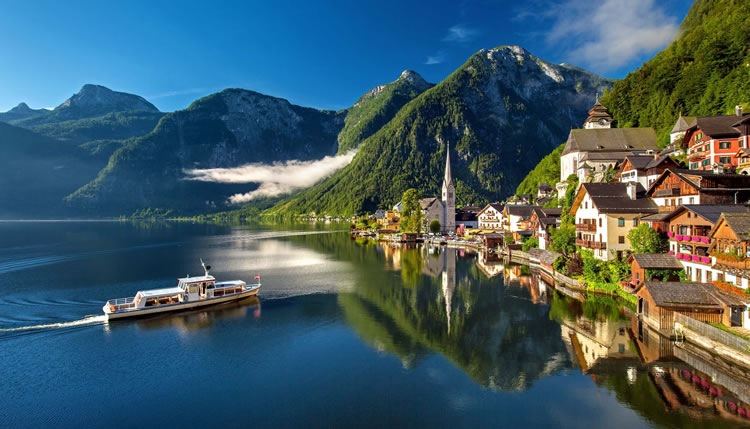
A journey across the German-Austrian border leads you to one of the most photographed villages in the world. Hallstatt, a UNESCO World Heritage site, is dramatically situated on the shore of Lake Hallstatt (Hallstätter See) and surrounded by towering mountains.
Key Attractions
The Market Square (Marktplatz): The charming central square lined with 16th-century houses.
The World Heritage Viewpoint: Take the funicular or a steep walk up to this famous viewpoint for the iconic shot of Hallstatt.
Salt Mine (Salzwelten Hallstatt): The world’s oldest salt mine, accessible via funicular. The tour includes wooden slides, an underground salt lake, and a prehistoric cemetery.
Bone House (Beinhaus): Located in St. Michael’s Chapel, this small charnel house contains over 600 painted skulls, a unique local tradition due to limited burial space.
Catholic Parish Church: Its prominent spire is a key feature of Hallstatt’s skyline.
Lake Cruise: Take a boat tour on Lake Hallstatt for stunning perspectives of the village and surrounding mountains.
Practical Information
Getting There: From Füssen/Garmisch, drive east (~2.5-3 hours) via Innsbruck or through Salzburg. Parking in Hallstatt is extremely limited and expensive; use one of the large parking lots at either end of town and walk in.
“Hallstatt Ticket”: If arriving by train and boat from Salzburg or Attnang-Puchheim, this combined ticket covers all transport.
Crowds: Hallstatt is extremely popular with day-trippers, especially from mid-morning to mid-afternoon. For a more peaceful experience, stay overnight.
Acommodation: Book hotels or guesthouses many months in advance due to high demand.
8. Bad Ischl (Bad Ischl)
A short drive from Hallstatt lies Bad Ischl, a elegant spa town that was the summer retreat of Emperor Franz Joseph I and the epicenter of Habsburg society in the 19th century.
Key Attractions
Kaiservilla (Imperial Villa):The summer residence of Emperor Franz Joseph and Empress Elisabeth (“Sisi”). The extensive grounds and historic rooms are open to the public.
Café-Konditorei Zauner:A world-famous pastry shop established in 1832, a favorite of the Emperor and a must-visit for coffee and cake.