A Comprehensive Travel Guide: From Munich to Frankfurt – A Journey through Bavaria and Franconia
This guide details a classic German travel route, a captivating journey from the vibrant capital of Bavaria to the financial hub of Germany, traversing storybook landscapes, historic towns, and architectural marvels. The itinerary covers Munich, the Passion Play town of Oberammergau, the opulent Linderhof Palace, the iconic Neuschwanstein Castle, the gateway town of Füssen, the medieval gem of Rothenburg ob der Tauber, the historic city of Nuremberg, the UNESCO-listed town of Bamberg, the baroque wine city of Würzburg, and finally, the cosmopolitan center of Frankfurt. This route offers a deep dive into southern Germany’s rich culture, history, and natural beauty.
Munich (München)
Munich, the capital of the Free State of Bavaria, is a city that effortlessly blends traditional Bavarian culture with modern urban sophistication. Known for its annual Oktoberfest, magnificent architecture, and world-class museums, it is the perfect starting point for this journey.
Attractions
Marienplatz: The central square and heart of the city since 1158. Visitors gather to watch the glockenspiel in the Neues Rathaus (New Town Hall) perform its daily show at 11 am and 12 pm (and 5 pm in summer).
Frauenkirche (Cathedral of Our Blessed Lady): The iconic twin-domed church is a symbol of Munich. Its south tower offers a panoramic view of the city and, on a clear day, the Alps.
English Garden (Englischer Garten): One of the world’s largest urban public parks, larger than New York’s Central Park. It features serene paths, a Japanese teahouse, and surfers riding the standing wave in the Eisbach river.
Nymphenburg Palace: A magnificent baroque palace and former summer residence of the Bavarian monarchs. The vast park with its smaller palaces and pavilions is equally impressive.
Deutsches Museum: One of the world’s oldest and largest museums of science and technology, with fascinating exhibits on everything from astronomy to mining.
Viktualienmarkt: A daily food market and a feast for the senses, offering fresh produce, cheeses, meats, spices, and traditional snacks.
Food & Drink
Weißwurst: A traditional Bavarian veal sausage, typically eaten before noon. Served with sweet mustard, a pretzel, and a wheat beer.
Schweinshaxe: A crispy roasted pork knuckle, a hearty and classic Bavarian dish.
Obatzda: A flavorful cheese spread made from camembert, butter, and paprika, perfect with a pretzel.
Beer Halls: Experience the communal atmosphere at historic beer halls like the Hofbräuhaus, Augustiner-Keller, or Löwenbräukeller.
Transportation & Accommodation
Munich has an excellent public transportation system (MVV) comprising U-Bahn (subway), S-Bahn (suburban train), trams, and buses. The city is a major international flight and train hub. For accommodation, areas around the Hauptbahnhof (main station) offer convenience, while the Altstadt (Old Town) provides a more historic ambiance. Schwabing is a trendy district with many cafes and shops.
Oberammergau
A picturesque town nestled in the Ammergau Alps, Oberammergau is world-famous for its Passion Play, held every ten years (next in 2030). However, its charm is year-round, renowned for its Luftmalerei (frescoes) on building facades and woodcarving tradition.
Attractions
Passion Play Theatre (Passionsspielhaus): Even outside of performance years, guided tours of the massive open-air theater are available.
Lüftlmalerei Frescoes: Stroll through the town to admire the beautifully painted buildings depicting fairy tales, religious scenes, and historical figures.
Pilatushaus: A historic house showcasing the local craft of woodcarving with demonstrations and a small museum.
Hiking in the Ammergau Alps: The surrounding area offers numerous trails for all levels of hikers, including routes to the nearby Ettal Abbey.
Cultural Insight
The tradition of the Passion Play dates back to 1633 when the townspeople vowed to perform a play depicting the life and suffering of Jesus if God spared them from the bubonic plague. The plague ceased, and the promise has been kept for nearly 400 years.
Linderhof Palace
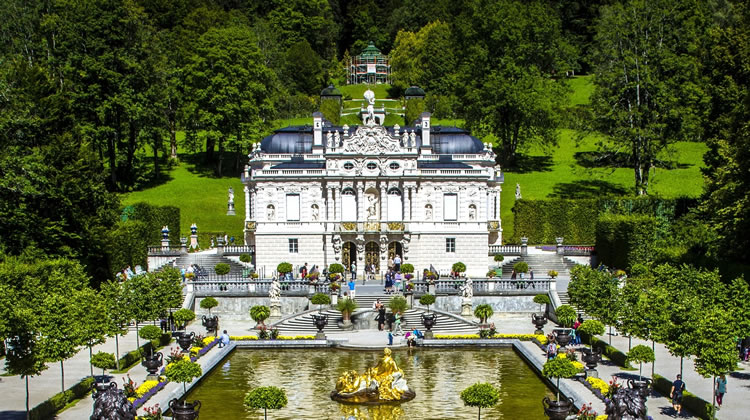
The smallest of King Ludwig II’s palaces, Linderhof is nonetheless a stunning creation. It was the only one he lived to see completed. Inspired by French absolutism and the Sun King, Louis XIV, it is a rococo masterpiece set in a beautifully landscaped park.
Attractions
The Palace Interior: Opulently decorated rooms including the Hall of Mirrors, the king’s bedroom, and the dining table that was set and then lowered to the kitchen to be reset—a testament to Ludwig’s desire for solitude.
The Park and Gardens: A formal garden with terraces, water parterres, and a magnificent fountain that shoots a jet of water 30 meters high. Scattered throughout are several whimsical structures like the Venus Grotto (an artificial cave with a lake and lighting effects) and the Moroccan House.
Practical Information
Linderhof Palace is located near Ettal and Oberammergau. It is best reached by car or regional bus (Bus 9622 from Oberammergau). Visiting the palace interior requires a timed ticket, which is highly recommended to book online in advance to avoid long waits.
Neuschwanstein Castle
The quintessential fairy-tale castle, Neuschwanstein was built by the “Fairytale King” Ludwig II as a personal retreat and homage to the operas of Richard Wagner. Perched on a rugged hill against a stunning Alpine backdrop, it is one of Germany’s most photographed and visited landmarks.
Attractions
Castle Interior: Though only 14 rooms were finished before Ludwig’s mysterious death, they are spectacular. Highlights include the Throne Hall, inspired by Byzantine churches, and the Singer’s Hall, depicting scenes from Wagner’s operas.
Marienbrücke (Mary’s Bridge): This bridge spans a gorge behind the castle and offers the classic, postcard-perfect view of Neuschwanstein. It can get very crowded.
Hohenschwangau Castle: The less-famous but equally charming yellow castle where King Ludwig II spent his childhood. It is located in the same village and can be visited on a combined ticket.
Ticketing & Access
Tickets must be purchased at the Ticket Center in Hohenschwangau at the foot of the hill, not at the castle itself. Reservations are essential, especially during peak season. From the ticket center, visitors can walk uphill (about 30-40 minutes), take a shuttle bus (which drops you near Marienbrücke), or a horse-drawn carriage.
Füssen
A charming old town nestled at the foot of the Alps, Füssen serves as the main gateway to the castles. With its colorful buildings and proximity to the Forggensee lake, it’s worth more than just a passing stop.
Attractions
Hohes Schloss (High Castle): A former summer residence of the Prince-Bishops of Augsburg, it features a stunning late Gothic courtyard and houses a branch of the Bavarian State Picture Collections.
St. Mang Monastery and Museum: A former Benedictine monastery showcasing the history of Füssen, including its renowned lute and violin making tradition.
Lechfall: A man-made waterfall on the Lech River just outside town, offering a beautiful natural spectacle and walking paths.
Accommodation Tip
Staying in Füssen provides a wider range of accommodation options compared to Hohenschwangau and allows for a more relaxed exploration of the castles and surrounding Alpine landscape.
Rothenburg ob der Tauber
Rothenburg ob der Tauber is Germany’s best-preserved medieval walled town. Its name means “Red Fortress above the Tauber River,” and it appears frozen in time with its half-timbered houses, cobblestone lanes, and intact fortifications.
Attractions
The Town Walls: Walk the entire 4-kilometer circuit on top of the fortified walls for incredible views over the town’s rooftops and into the Tauber valley.
Plönlein: The most famous spot in Rothenburg—a small triangular square with a half-timbered house framed by two gates. It is an iconic image of Germany.
Market Square (Marktplatz): Home to the Town Hall with its tall tower (which can be climbed), the ornate Councillors’ Tavern building with its glockenspiel, and charming cafes.
Criminal Museum (Mittelalterliches Kriminalmuseum): A fascinating and sometimes gruesome look at medieval law and order, featuring instruments of punishment.
St. Jakob’s Church: Houses an exquisite altarpiece carved by Tilman Riemenschneider.
Food & Cultural Insight
Schneeballen (Snowballs): A local pastry made from strips of dough that are fried or baked and then dusted with powdered sugar or coated in chocolate. It’s a must-try souvenir.
The Night Watchman’s Tour: A highly entertaining and informative evening walking tour led by a character dressed as the town’s medieval night watchman.
Nuremberg (Nürnberg)
A city of immense historical significance, Nuremberg was an unofficial capital of the Holy Roman Empire and a center of the German Renaissance. In the 20th century, it hosted Nazi party rallies and later the Nuremberg Trials. Today, it is a vibrant city that confronts its past while celebrating its rich heritage.
Attractions
Imperial Castle (Kaiserburg): The emblem of the city, this sprawling castle complex offers tours of the imperial halls and a deep well, plus panoramic views from its Sinwell Tower.
Albrecht Dürer House: The former home of Germany’s most famous Renaissance artist. The museum provides insight into his life and work.
Hauptmarkt (Main Market Square): Home to the beautiful Frauenkirche (with its mechanical clock, the Männleinlaufen) and the Schöner Brunnen (Beautiful Fountain), a 19-meter-high golden fountain. The city’s famous Christkindlesmarkt is held here.
Documentation Center Nazi Party Rally Grounds: A museum located in the unfinished Congress Hall of the Nazi party grounds, providing a critical examination of the Nazi regime and its propaganda.
Memorium Nuremberg Trials: Located in Courtroom 600 of the Palace of Justice, this exhibition details the history and impact of the trials of major war criminals after WWII.
Food & Drink
Nuremberg Rostbratwurst: Small, thin sausages grilled over beechwood, traditionally served “Drei im Weckla” (three in a roll) or with sauerkraut and potato salad.
Lebkuchen:
A Comprehensive Travel Guide: From Munich to Frankfurt – A Journey through Bavaria and Franconia
This guide details a classic German travel route, a captivating journey from the vibrant capital of Bavaria to the financial hub of Germany, traversing storybook landscapes, historic towns, and architectural marvels. The itinerary covers Munich, the Passion Play town of Oberammergau, the opulent Linderhof Palace, the iconic Neuschwanstein Castle, the gateway town of Füssen, the medieval gem of Rothenburg ob der Tauber, the historic city of Nuremberg, the UNESCO-listed town of Bamberg, the baroque wine city of Würzburg, and finally, the cosmopolitan center of Frankfurt. This route offers a deep dive into southern Germany’s rich culture, history, and natural beauty.
Munich (München)
Munich, the capital of the Free State of Bavaria, is a city that effortlessly blends traditional Bavarian culture with modern urban sophistication. Known for its annual Oktoberfest, magnificent architecture, and world-class museums, it is the perfect starting point for this journey.
Attractions
Marienplatz: The central square and heart of