A Comprehensive Travel Guide: Frankfurt, Heidelberg, Stuttgart, Metzingen, Dachau, and Munich
This travel guide outlines a classic German itinerary that blends modern finance, romantic history, automotive innovation, outlet shopping, sobering historical reflection, and Bavarian cultural immersion. The journey through Frankfurt, Heidelberg, Stuttgart, Metzingen, Dachau, and Munich offers a diverse and profound look into the heart of Germany.
Introduction to the Itinerary
This route is typically traversed from north to south, starting in the financial hub of Frankfurt and culminating in the vibrant capital of Bavaria, Munich. The cities are well-connected by Germany’s efficient autobahn and rail network, making train travel or renting a car equally viable options. The journey covers approximately 400 kilometers and can be comfortably completed in 7 to 10 days, allowing for a balanced pace between exploration and relaxation.
Frankfurt: The Gateway to Germany
Frankfurt am Main, often simply called Frankfurt, is Germany’s financial capital and a major transportation hub. While known for its soaring skyscrapers, it retains a charming, walkable old town that provides a stark and beautiful contrast.
Main Attractions in Frankfurt
Römerberg: This is the historic heart of Frankfurt, a picturesque square lined with beautifully reconstructed half-timbered houses. The Römer itself is the city hall and has been for over 600 years.
St. Bartholomew’s Cathedral (Frankfurter Dom): A grand Gothic cathedral from the 14th and 15th centuries, it was the traditional election and coronation church of the Holy Roman Emperors. Climbing the tower offers a panoramic view of the city.
Museum Embankment (Museumsufer): A unique cluster of museums on both sides of the River Main. Key institutions include the Städel Museum (European art), the German Film Museum, and the Liebieghaus (sculpture).
Main Tower: For the best view of Frankfurt’s modern skyline, visitors can go to the public viewing platform of this 200-meter skyscraper.
Palmengarten: A beautiful and expansive botanical garden offering a peaceful escape from the urban bustle.
Food and Drink in Frankfurt
Frankfurt has its own distinct culinary specialties. A must-try is
Grüne Soße (Green Sauce), a cold herb sauce made with seven specific herbs, typically served with boiled potatoes and eggs. The city is also famous for its Apfelwein (apple wine), a tart cider-like beverage. Enjoy it in a traditional apple wine pub in the Sachsenhausen district, often accompanied by Handkäs mit Musik, a pungent marinated cheese.
Transportation and Accommodation in Frankfurt
Frankfurt Airport (FRA) is one of Europe’s busiest, making it an easy starting point. The city’s public transportation system (RMV) includes U-Bahn (subway), S-Bahn (suburban train), trams, and buses, and is highly efficient. The Frankfurt Card offers unlimited travel and museum discounts. For accommodation, areas around the Hauptbahnhof (central station) are convenient but can be less scenic; the city center or Sachsenhausen offer more charming options.
Heidelberg: The Romantic City
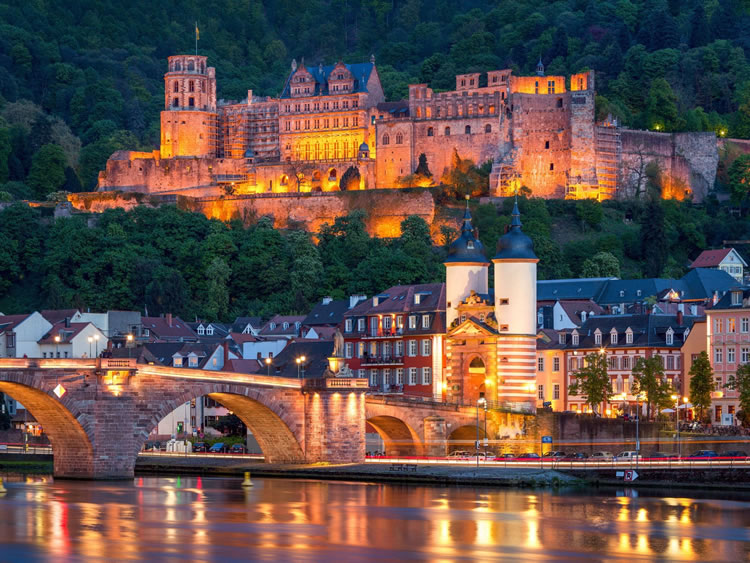
A short train ride south from Frankfurt lies Heidelberg, a city that embodies German Romanticism. Nestled in the Neckar river valley, its famous ruined castle, historic university, and charming old town have inspired poets and artists for centuries.
Main Attractions in Heidelberg
Heidelberg Castle: The iconic red sandstone ruin towers over the city. A funicular railway takes visitors up to the castle complex, where you can explore the gardens, see the world’s largest wine barrel, and enjoy breathtaking views.
Old Town (Altstadt): Stretching along the Neckar River, the Altstadt is a delightful maze of cobblestone streets, baroque buildings, and lively market squares like the Marktplatz.
Old Bridge (Karl-Theodor-Brücke): This beautiful stone bridge offers a classic photo opportunity back towards the castle and old town.
Philosophers’ Walk (Philosophenweg): A path on the sunny side of the Neckar river opposite the old town, it offers spectacular views and was once frequented by Heidelberg’s philosophers and academics.
Student Prison (Studentenkarzer): A unique attraction within the old university where misbehaving students were incarcerated from 1778 to 1914. The walls are covered in their graffiti and drawings.
Food and Drink in Heidelberg
Heidelberg’s culinary scene is influenced by its student population and regional Baden cuisine. Try dishes like
Schweinshaxe (roasted pork knuckle) or Spätzle (egg noodles). For dessert, sample a slice of Heidelberger Studentenkuss (Heidelberg Student’s Kiss), a chocolate praline with a romantic history.
Transportation and Accommodation in Heidelberg
Heidelberg is easily reached from Frankfurt by train (approx. 1 hour). The city is very walkable, but a bus network and the funicular are available for reaching higher points. Staying in or near the Altstadt provides the most atmospheric experience.
Stuttgart: The Cradle of the Automobile
Continuing south, Stuttgart is the capital of Baden-Württemberg and a powerhouse of German industry. It is the home of Mercedes-Benz and Porsche, surrounded by vineyards and offering a rich cultural scene.
Main Attractions in Stuttgart
Mercedes-Benz Museum: An architectural marvel that takes visitors on a journey through over 130 years of automotive history, from the first car to futuristic concepts.
Porsche Museum: Located in Zuffenhausen, this sleek museum showcases the history and iconic sports cars of the Porsche brand.
Stuttgart State Gallery (Staatsgalerie Stuttgart): A renowned art museum with an old masters collection and a famous postmodern extension housing 20th-century art.
Palace Square (Schlossplatz): The city’s central square, a large public space surrounded by the New Palace, the Old Castle, and shopping streets. It’s a perfect spot for people-watching.
Wilhelma Zoo and Botanical Garden: A unique combination of a historic Moorish-style garden and one of Europe’s most biologically diverse zoos.
Food and Drink in Stuttgart
Stuttgart is the heart of Swabian cuisine. Must-try dishes include
Maultaschen (large pasta pockets filled with meat or vegetables), Spätzle, and Linsen mit Spätzle (lentils with Spätzle). The city is also famous for its wine, particularly Trollinger and Lemberger reds, grown in the surrounding vineyards. Stuttgart is home to the Cannstatter Volksfest, the second-largest beer festival in the world after Munich’s Oktoberfest.
Transportation and Accommodation in Stuttgart
The train from Heidelberg to Stuttgart takes about 40 minutes. Stuttgart has an integrated public transport system (VVS) including S-Bahn, U-Bahn, and buses. For car enthusiasts staying outside the city center might be convenient if visiting the manufacturer museums. Accommodation ranges from business hotels to more charming options in the city center.
Metzingen: Outlet Shopping Paradise
A short detour south of Stuttgart (approx. 30 minutes by train) leads to Metzingen, a small town that has become a world-famous destination for outlet shopping.
Shopping in Metzingen
The outlet city began with Hugo Boss, which has its headquarters here, and has expanded to include over 100 designer and brand-name stores such as Bally, Burberry, Gucci, Prada, Nike, and Adidas. Prices are significantly discounted from retail, often by 30% to 70%. It’s advisable to check the official website for current opening hours and special sales events before visiting.
Practical Tips for Metzingen
The town is easily accessible by regional train from Stuttgart Hauptbahnhof. For those driving, ample parking is available. It’s best to visit on a weekday to avoid weekend crowds. Plan to spend at least half a day here.
Dachau Concentration Camp Memorial Site: A Sobering Historical Lesson
On the way from Stuttgart to Munich lies Dachau. A visit to the Dachau Concentration Camp Memorial Site is not a leisure activity but a profound and essential historical experience. It was the first Nazi concentration camp, opening in 1933, and served as a model for all others.
Visiting the Memorial Site
The Journey Gate (Jourhaus): The main entrance with the infamous slogan “Arbeit Macht Frei” (Work Sets You Free).
The Main Exhibition: Located in the former maintenance building, it provides a comprehensive history of the camp through photographs, documents, and survivor testimonies.
The Barracks: The foundations of the prisoner barracks are visible, with two reconstructions to show the living conditions.
The Crematorium Area: This includes the old and new crematoria and the “Barrack X” gas chamber, which was never used for mass murder at Dachau but stands as a chilling testament to the Nazi genocide machinery.
Religious Memorials: Several poignant memorials—including a Catholic, Protestant, and Jewish memorial—are located on the site.
Visitor Information and Etiquette
The memorial site is located in the town of Dachau, about 20 minutes northwest of Munich by S-Bahn (S2 line towards Dachau/Petershausen), followed by a short bus ride. Admission is free, but audio guides or guided tours are highly recommended for context. Visitors are expected to behave respectfully; photography is permitted but should be done with discretion and solemnity. The experience can be emotionally draining; it is advisable to plan a quiet evening afterward.
Munich: The Capital of Bavaria
The final destination is Munich (München), the vibrant capital of Bavaria known for its annual Oktoberfest, beautiful architecture, world-class museums, and beer gardens.
Main Attractions in Munich
Marienplatz: The central square and heart of the city, dominated by the New Town Hall (Neues Rathaus). Visitors gather to watch the Glockenspiel chime and perform its mechanical show daily at 11 am and 12 pm (and 5 pm in summer).
English Garden (Englischer Garten): One of the world’s largest urban parks, larger than New York’s Central Park. It features beer gardens, Japanese teahouses, and even surfers riding the standing wave in the Eisbach river.
Nymphenburg Palace: A magnificent Baroque palace with stunning gardens. It was the summer residence of the Bavarian monarchs.
Deutsches Museum: One of the world’s largest and oldest museums of science and technology, located on an island in the Isar river.
Viktualienmarkt: A daily outdoor food market near Marienplatz offering fresh produce, cheeses, meats, flowers, and more. It’s a great place to sample local delicacies.
Hofbräuhaus: The world’s most famous beer hall, offering a quintessential—if touristy—Bavarian experience with oompah music, hearty food, and liter-sized beers.
Food and Drink in Munich
Bavarian cuisine is hearty and flavorful. Essential dishes include
Weißwurst (white veal sausage), traditionally eaten before noon with sweet mustard and a pretzel; Schweinshaxe; and Obatzda (a spiced cheese-butter spread). Munich is synonymous with beer culture. Visit one of its many historic beer halls or relax in a beer garden like the one at the Chinese Tower (Chinesischer Turm) in the English Garden.
Transportation and Accommodation in Munich
Munich has an excellent public transportation system (MVV) comprising U-Bahn, S-Bahn, trams, and buses. The Munich City Tour Card offers unlimited travel and discounts on attractions. For accommodation, areas like Altstadt-Lehel offer proximity to major sights, while Schwabing or Glockenbachviertel provide a more local vibe. Booking well in advance is crucial during major events like Oktoberfest.
Cultural Insights and Practical Tips
Punctuality: Germans value punctuality highly. Be on time for tours, restaurant reservations, and trains.
Cash Culture: While card payments are becoming more common, Germany still has a strong preference for cash (especially in smaller shops, restaurants, and beer gardens). Always carry some Euros.
Sundays: Most shops are closed on Sundays by law. Plan accordingly for shopping or stock up on essentials beforehand. Museums and restaurants remain open.
Greetings: A simple “Guten Tag” (Good day) is a polite greeting. In Bavaria, you will often hear “Grüß Gott” (God greets you).
Sustainability: Germany has a sophisticated recycling system (Pfand). When buying drinks in plastic bottles or cans, you pay a deposit (Pfand) which you get back when you return the empty container to a supermarket.
Tipping: Service is usually included in the bill. It is customary to “round up” the bill or leave a tip of 5-10% for good service by stating the total amount you wish to pay when handing over your cash or card.
A Note on Responsible Travel: Visiting Dachau
A visit to Dachau requires specific sensitivity. It is a place of mourning and remembrance. Visitors should speak quietly, refrain from any boisterous behavior or inappropriate photography (e.g., selfies), and dress respectfully. The site serves as a powerful reminder of the horrors of the past and underscores the importance of tolerance and human rights—a crucial lesson that resonates deeply within this otherwise beautiful and prosperous region of Germany.