A Comprehensive Travel Guide: Bavaria’s Iconic Alpine Route
This guide details a classic circular itinerary through the heart of the German Alps, starting and ending in Munich. This journey encapsulates the very essence of Bavaria, blending royal fantasy, artistic tradition, and breathtaking natural landscapes. Travelers will experience world-renowned castles, charming villages, and majestic mountain peaks.
Munich (München)
Munich, the capital of Bavaria, serves as the perfect gateway for this Alpine adventure. It is a city that effortlessly balances traditional beer culture with high-tech industry, offering a rich tapestry of history, art, and modern urban life.
Main Attractions
Marienplatz: The central square and the city’s vibrant heart. Visitors should not miss the Glockenspiel in the Neues Rathaus (New Town Hall), which performs a charming mechanical show daily at 11 am, 12 pm, and 5 pm.
Frauenkirche: The Cathedral of Our Blessed Lady, with its two distinctive domed towers, is the iconic symbol of Munich’s skyline.
English Garden (Englischer Garten): One of the world’s largest urban public parks, where visitors can stroll, watch surfers ride the standing wave in the Eisbach river, or relax at the Chinese Tower beer garden.
Nymphenburg Palace: The magnificent summer residence of the Bavarian monarchs. The sprawling palace complex with its beautiful gardens is a testament to the Wittelsbach dynasty’s power and taste.
Deutsches Museum: One of the world’s oldest and largest science and technology museums, offering fascinating exhibits for all ages.
Food & Drink
Weißwurst: A traditional Bavarian veal sausage, typically eaten before noon. It is served with sweet mustard, freshly baked pretzels (Brezn), and a wheat beer (Weißbier).
Schweinshaxe: A crispy roasted pork knuckle, a hearty and classic Bavarian dish.
Beer Halls & Gardens: Experience the legendary beer culture at historic halls like the Hofbräuhaus or in one of the many beer gardens, such as Augustiner-Keller or the Viktualienmarkt beer garden.
Transportation & Accommodation
Munich has an excellent public transportation system (MVV), including U-Bahn (subway), S-Bahn (suburban train), trams, and buses. The Munich Card offers unlimited travel and discounts to attractions. For accommodation, areas around the Hauptbahnhof (main train station) offer convenience, while the Altstadt (Old Town) provides a more historic ambiance. Lehel and Schwabing are quieter, upscale neighborhoods.
Cultural Insight
Munich is a city of “Laptop und Lederhosen” (laptop and leather trousers), symbolizing its unique blend of cutting-edge innovation and deep-rooted traditions. Respect for this tradition is key; while full Tracht (traditional dress) is not expected of tourists, dressing neatly, especially when visiting churches or upscale restaurants, is appreciated.
Oberammergau and Linderhof Palace
Traveling approximately 90 minutes southwest from Munich brings you to the enchanting Ammergau Alps region, home to the famous village of Oberammergau and King Ludwig II’s intimate Linderhof Palace.
Oberammergau Attractions
Lüftlmalerei: The entire village is an open-air art gallery, famous for its beautiful frescoes painted on the exteriors of houses. These paintings depict biblical scenes, Bavarian folklore, and fairy tales.
Passion Play: Oberammergau is world-famous for its Passion Play, a dramatic reenactment of Christ’s suffering, performed by the villagers every ten years (next in 2030). The massive theater is a landmark in itself.
Woodcarving: The town has a centuries-old tradition of woodcarving. Numerous workshops and stores sell everything from intricate religious figures to whimsical Christmas ornaments.
Linderhof Palace
Linderhof is the smallest but most finished of King Ludwig II’s palaces and the only one he lived to see completed. Inspired by French absolutism and the Sun King, Louis XIV, it is a rococo masterpiece set in a beautifully manicured park.
The Palace Interior: Opulently decorated rooms, with the Hall of Mirrors being a particular highlight.
The Gardens and Park Structures: Explore the terraced gardens, the Venus Grotto (an artificial cave where Ludwig had a swan boat), the Moroccan House, and the Hunting Lodge.
Transportation & Practical Tips
The most flexible way to reach Oberammergau and Linderhof is by rental car. Alternatively, take a train from Munich Hauptbahnhof to Oberammergau (often with a change in Murnau). From Oberammergau, Bus 9622 runs to Linderhof. It is advisable to book palace tickets online in advance to secure a timed entry.
Neuschwanstein Castle and Füssen
A short journey south leads to Germany’s most famous castle and the picturesque town at its feet.
Neuschwanstein Castle
The iconic fairytale castle was built by the “Fairytale King,” Ludwig II, as a homage to the composer Richard Wagner and a romantic idealization of the medieval era. It is the inspiration for Disney’s Sleeping Beauty castle.
Ticket Reservation: Booking tickets online weeks or even months in advance is absolutely essential. Tickets are only available at the Ticket Center in Hohenschwangau at the foot of the hill.
Marienbrücke (Mary’s Bridge): This bridge, suspended over a gorge behind the castle, offers the classic, postcard-perfect photograph of Neuschwanstein.
Hohenschwangau Castle: The less-famous but equally beautiful childhood residence of King Ludwig II, located just opposite Neuschwanstein. Consider a combined ticket for both castles.
Füssen
This charming old town, with its brightly painted houses and cobblestone streets, is the southern terminus of the Romantic Road and an ideal base for exploring the castles.
Old Town (Altstadt): Stroll through the historic center, visit the Hohes Schloss (High Castle), a former papal palace with stunning illusionistic frescoes, and the St. Mang Monastery.
Lechfall: A scenic man-made waterfall on the River Lech, a short walk from the town center.
Food & Accommodation
In Füssen, try regional specialties like Kässpatzen (cheesy egg noodles) or a hearty Brettl (a platter of cold cuts and cheese). Accommodation in Füssen offers more variety and value than in Hohenschwangau. Booking well in advance is crucial during peak season.
Zugspitze and Southern Bavarian Towns
Heading east from Füssen, the route enters the realm of Germany’s highest peak and its idyllic surrounding villages, such as Garmisch-Partenkirchen and Mittenwald.
Zugspitze
At 2,962 meters (9,718 feet), the Zugspitze is Germany’s tallest mountain. The summit offers breathtaking panoramic views of over 400 peaks in four countries.
Ascension Options: Take the cogwheel train (Zahnradbahn) from Garmisch-Partenkirchen or Eibsee up to the Zugspitzplatt, then a cable car to the summit. Alternatively, a direct cable car ascends from the beautiful Eibsee lake.
Activities: Enjoy skiing and snowboarding in winter, and hiking and sightseeing in summer. Walk across the peak on the panoramic bridge.
Garmisch-Partenkirchen
A renowned ski resort and spa town, originally two separate villages merged for the 1936 Winter Olympics. It is characterized by its traditional Bavarian architecture and Lüftlmalerei.
Mittenwald
Often described as “the most beautiful village in Bavaria,” Mittenwald is famous for its violin-making tradition (visit the Geigenbaumuseum) and its incredibly colorful and photogenic streets.
Transportation
The Bayernticket (Bavaria Ticket) offers excellent value for regional train travel for up to five people after 9 am on weekdays and all day on weekends. It covers trains to Garmisch-Partenkirchen and the cogwheel train to the Zugspitzplatt (but not the final cable car to the summit).
Königssee and Berchtesgaden National Park
Venturing further east into Berchtesgadener Land, travelers find one of Germany’s most pristine natural landscapes.
Königssee (King’s Lake)
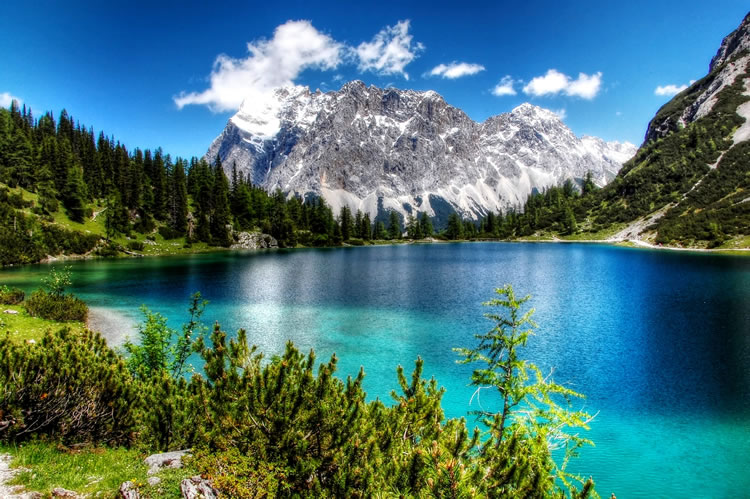
This emerald-green lake, nestled between steep mountain walls, is renowned for its crystal-clear water. To preserve its purity, only electric boats, rowboats, and pedal boats are permitted.
Boat Trip to St. Bartholomä: The quintessential Königssee experience. The silent electric boats take visitors to the picturesque pilgrimage chapel of St. Bartholomä. During the trip, a boatman plays a flugelhorn to demonstrate the famous echo.
Salet: At the far end of the lake from St. Bartholomä, another boat stop allows access to the smaller Obersee lake and the Röthbach waterfall, Germany’s highest waterfall.
Jennerbahn: A cable car that ascends the Jenner mountain, providing spectacular aerial views of the Königssee and the surrounding Alps.
The Eagle’s Nest (Kehlsteinhaus)
Perched atop the Kehlstein mountain at 1,834 meters (6,017 ft), the Eagle’s Nest was built as a 50th birthday present for Adolf Hitler. Today, it is a restaurant with historically significant architecture and unparalleled views.
Access: Access is controlled. Visitors must take a special bus from the Dokumentation Obersalzberg center (booking essential) up a steep, narrow road, followed by a brass-lined elevator that rises 124 meters through solid rock to reach the building.
Historical Context: A visit should be complemented with a trip to the Dokumentation Obersalzberg museum, which provides a critical examination of the area’s role during the Nazi era.
Accommodation & Practical Tips
The town of Berchtesgaden is the main hub for exploring the region. For a more tranquil stay, consider Schönau am Königssee. Due to the popularity of these sites, it is highly recommended to arrive early in the day, especially during summer and autumn. Purchase a combined ticket for bus and Eagle’s Nest access online to avoid long queues.
The Return Journey to Munich
The return trip from Berchtesgaden to Munich by train takes approximately three hours. This scenic journey provides time to reflect on a route that has traversed some of Europe’s most stunning landscapes and captivating histories. Upon arrival in Munich, travelers can enjoy one final Bavarian meal or beer before concluding their memorable Alpine circuit.
Itinerary Summary & Travel Tips
Recommended Duration: A minimum of 7-10 days is recommended to fully appreciate this itinerary without feeling rushed.
Best Time to Visit: Late spring (May-June) and early autumn (September-October) offer pleasant weather, fewer crowds, and beautiful colors. Summer is peak season with longer lines; winter offers magical snowscapes but some attractions may have limited access.
Getting Around: A rental car provides maximum flexibility for exploring remote villages and stopping at scenic viewpoints. However, Germany’s efficient public transport system makes this entire journey feasible by train and bus. The Bayern-Ticket is an economical choice for regional travel.
Cuisine: Embrace Bavarian cuisine. Beyond the classics, try Obatzda (a spiced cheese-butter spread), Radler (a beer-lemonade mix), and Apfelstrudel for dessert.
Crowd Management: For major attractions like Neuschwanstein and the Eagle’s Nest, pre-booking tickets online is non-negotiable. Start your days early to avoid the largest tour groups.
Cultural Respect: A simple “Guten Tag” (Good day) and “Danke” (Thank you) go a long way. Be mindful that Sundays are still widely observed as a quiet day of rest in Bavaria.