A Travel Guide to Bavaria’s Heart: Munich, Rothenburg, and Harburg
This travel guide outlines a classic Bavarian itinerary, taking travelers from the vibrant state capital of Munich to the medieval gem of Rothenburg ob der Tauber and the lesser-known fortress of Harburg Castle, before returning to Munich. This journey offers a perfect blend of urban energy, romantic fairy-tale scenery, and deep historical immersion.
Trip Overview and Itinerary
This circular route is ideally covered over 4 to 7 days, depending on the depth of exploration desired. The total driving distance is approximately 430 kilometers (270 miles). The journey begins and ends in Munich, utilizing Bavaria’s excellent Autobahn and rail networks. The recommended order is Munich → Rothenburg ob der Tauber → Harburg → Munich, which provides a logical geographical flow.
3-Day Express: 2 nights in Munich with day trips to Rothenburg and Harburg (intensive).
5-Day Standard: 2 nights Munich, 2 nights Rothenburg (including visit to Harburg).
7-Day In-Depth: 3 nights Munich, 3 nights Rothenburg (allowing for relaxed exploration and smaller villages).
Chapter 1: Munich – The Cosmopolitan Capital
Munich (München), the capital of Bavaria, is a city of contrasts, seamlessly blending centuries-old traditions with a modern, innovative spirit. It is a global center for business, science, and art, yet it retains a strong sense of regional identity and Gemütlichkeit (coziness).
Top Attractions in Munich
Marienplatz and the New Town Hall (Neues Rathaus): The central square and heart of the city. Visitors should time their visit to see the Glockenspiel, a captivating clock show with mechanically dancing figures that reenacts two stories from Munich’s history at 11 am, 12 pm, and 5 pm (daily from March to October).
Frauenkirche (Cathedral of Our Blessed Lady): The iconic twin-domed cathedral is a symbol of Munich. Its simple, Gothic interior offers a moment of tranquility, and one can ascend the south tower for a panoramic view of the city.
English Garden (Englischer Garten): One of the world’s largest urban parks. It’s a place for relaxation, sports, and even surfing in the Eisbach river. The Chinese Tower beer garden is a popular spot within the park.
Nymphenburg Palace: The magnificent summer residence of the former Bavarian rulers. The palace itself is stunning, but the expansive park with its smaller palaces, like the Amalienburg hunting lodge, is equally impressive.
Deutsches Museum: One of the world’s largest and oldest museums of science and technology. It offers interactive exhibits on topics from astronomy to marine navigation, appealing to all ages.
Viktualienmarkt: A daily open-air market offering fresh produce, local delicacies, flowers, and more. It’s a feast for the senses and a perfect place to sample Bavarian specialties.
Munich Food and Drink
Bavarian cuisine is hearty and flavorful. Essential experiences include:
Weißwurst: A traditional veal sausage, typically eaten before noon. It is served with sweet mustard, a freshly baked pretzel (Brezn), and a wheat beer (Weißbier).
Schweinshaxe: A crispy roasted pork knuckle, often served with potato dumplings and sauerkraut.
Obatzda: A flavorful cheese spread made from camembert, butter, and paprika, perfect with a pretzel.
Beer Gardens: Visit a classic beer garden like Hofbräukeller or the one at the Chinese Tower. The communal atmosphere is a core part of Munich culture.
Cafés: Indulge in a slice of Apfelstrudel (apple strudel) or Schwarzwälder Kirschtorte (Black Forest cake) at a traditional café like Café Frischhut for their famous Schmalznudel (a type of doughnut).
Transportation in Munich
Munich has an excellent public transportation system (MVV), comprising U-Bahn (subway), S-Bahn (suburban train), trams, and buses. A single day ticket or a strip card (Streifenkarte) can be cost-effective for groups or shorter stays. The city center is also very walkable. The Munich Airport (MUC) is well-connected to the city center via the S-Bahn S1 and S8 lines.
Accommodation Tips for Munich
For first-time visitors, staying within the Altstadt (Old Town) ring provides easy access to major sights. The neighborhoods of Ludwigsvorstadt-Isarvorstadt (near the Hauptbahnhof) and Schwabing offer a wide range of options and are well-connected by public transport. Booking well in advance is crucial, especially during major events like Oktoberfest.
Chapter 2: Rothenburg ob der Tauber – The Medieval Dream
A journey from Munich to Rothenburg ob der Tauber transports travelers back in time. Located on the Romantic Road, this impeccably preserved medieval town sits high above the Tauber River Valley. Its intact city walls, half-timbered houses, and cobblestone streets make it one of Germany’s most photogenic destinations.
Getting from Munich to Rothenburg
By Train: The journey requires at least one change, usually in Steinach or Ansbach. The total travel time is approximately 2.5 to 3.5 hours. The Rothenburg station is a short walk from the old town.
By Car: The drive takes about 2.5 hours via the A7 and A6 Autobahns. Driving offers flexibility to stop at other charming towns along the Romantic Road, such as Dinkelsbühl or Nördlingen.
By Tour Bus: Many companies offer day trips from Munich to Rothenburg, which can be a convenient, hassle-free option.
Top Attractions in Rothenburg
The Town Walls: Walk the entire 2.5-kilometer sentry path on top of the fortified walls for incredible views over the town’s rooftops and into the surrounding countryside.
Plönlein: This small fork in the road with a half-timbered house is arguably the most famous image of Rothenburg and a must-capture photo spot.
Market Square (Marktplatz): The central square is dominated by the Town Hall (Rathaus). Climb its Gothic tower for a breathtaking panoramic view. Also on the square is the Councillors’ Tavern (Ratstrinkstube), where the clock figures reenact the legendary Meistertrunk story.
St. James’s Church (St. Jakobskirche): This Gothic church houses an exquisite altarpiece by the famous woodcarver Tilman Riemenschneider.
Criminal Museum (Mittelalterliches Kriminalmuseum): A fascinating and sometimes gruesome look at medieval law and order, showcasing instruments of punishment and torture.
The Night Watchman’s Tour: A highly recommended and entertaining evening tour led by a character dressed as the town’s night watchman, who shares dark humor and historical tales.
Rothenburg Food and Drink
The local Franconian cuisine is distinct from Bavarian fare, often featuring wine from the nearby Tauber Valley.
Franconian Sausage: Typically smaller and served with sauerkraut or potato salad.
Schneeballen (Snowballs): The town’s signature pastry. Strips of dough are formed into a ball, fried, and dusted with powdered sugar or coated in chocolate or other toppings.
Local Wine: Sample Franconian wine (often sold in distinctive round Bocksbeutel bottles) in a cozy wine bar.
Accommodation Tips for Rothenburg
Staying within the walled city is a magical experience. Many guesthouses (Gästehäuser) and small hotels are located in historic buildings. For a truly authentic stay, look for a room in a half-timbered house. Be aware that some older buildings do not have elevators.
Chapter 3: Harburg Castle – The Fortress on the Wörnitz
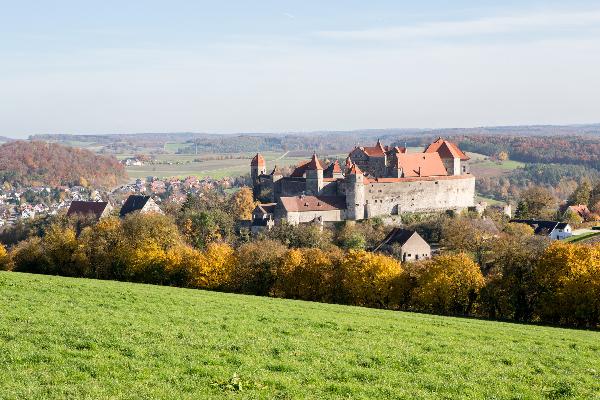
Situated roughly halfway between Rothenburg and Augsburg on the Romantic Road, Harburg Castle (Burg Harburg) is one of Germany’s best-preserved and largest medieval castle complexes. Unlike the more famous Neuschwanstein, Harburg feels authentic and lived-in, offering a raw and impressive glimpse into medieval fortification architecture.
Getting from Rothenburg to Harburg
By Car: This is the most straightforward method. The drive is about 50 kilometers and takes just under an hour via country roads. The castle is visible from afar and there is parking available at the foot of the hill below the castle.
By Public Transport: It is more challenging. One would take a train from Rothenburg to Donauwörth (with changes), and then a local bus to Harburg. The schedules can be infrequent, so careful planning is essential.
Exploring Harburg Castle
The castle is privately owned by the Princely House of Oettingen-Wallerstein but is open to the public through guided tours. It is not a single building but a vast complex of structures built between the 11th and 18th centuries.
The Guided Tour: The only way to see the interior courtyards and key rooms is by joining a guided tour. Tours are available in German, but English-language information sheets are usually provided. The tour covers the castle’s history, its defensive features, and the living quarters.
The Outer Bailey: Visitors can freely explore parts of the outer bailey, which includes massive gatehouses, towers, and walls that demonstrate the castle’s defensive prowess.
The Bridge and Gatehouse: The approach to the castle over a stone bridge and through a formidable gatehouse is an impressive experience in itself.
The View: The castle offers spectacular views over the historic town of Harburg and the Wörnitz river valley.
Practical Information for Harburg
A visit to the castle can be completed in 2-3 hours, including the tour. It makes for an excellent half-day trip from Rothenburg or a stop on the way back to Munich. There is a small café at the castle for refreshments. The town of Harburg below the castle is also charming for a short stroll.
The Return Journey: Harburg to Munich
The drive from Harburg Castle back to Munich takes approximately 1.5 to 2 hours via the A8 Autobahn. If traveling by public transport, one would typically take a bus from Harburg to Donauwörth and then a direct train to Munich Hauptbahnhof, with a total travel time of around 2 hours.
Cultural Insights and Travel Tips
Cash is King: While credit cards are accepted in larger hotels and restaurants in Munich, many smaller shops, beer halls, and guesthouses in Rothenburg and at Harburg Castle prefer or only accept cash (Euros).
Sundays and Holidays: In Germany, most shops are closed on Sundays and public holidays. Plan accordingly by visiting attractions, restaurants, or going for walks in nature on these days.
Punctuality: Germans value punctuality. This is especially important for train travel and guided tours.
The “Pfand” System: When buying bottled drinks in supermarkets, a deposit (“Pfand”) is included in the price. Bottles can be returned to any store that sells them to get your deposit back.
Greetings: