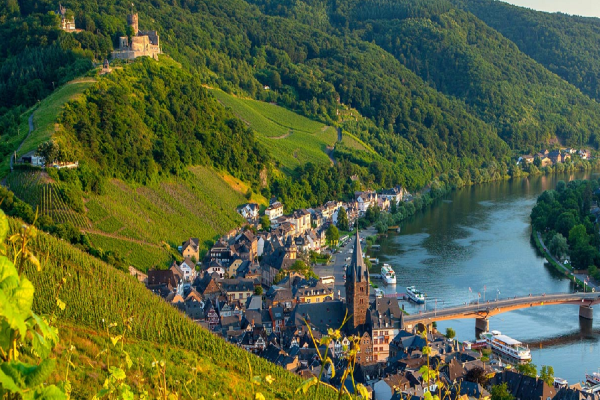
A Scenic Loop Through the Heart of the Rhineland: Cologne, Cochem, Trier, Bernkastel-Kues, Koblenz, and Andernach
This travel guide outlines a captivating circular journey through one of Germany’s most historically rich and visually stunning regions. Starting and ending in the vibrant metropolis of Cologne, this route takes you through the dramatic landscapes of the Moselle and Rhine River valleys, past steep vineyards, medieval castles, and towns steeped in Roman history. It’s a perfect blend of urban energy, romantic small-town charm, and breathtaking natural beauty.
Overview and Itinerary
This itinerary is designed as a 5 to 7-day road trip or train journey, allowing for a relaxed pace to fully appreciate each location. The total driving distance is approximately 400-450 km.
Day 1: Explore Cologne.
Day 2: Cologne to Cochem (approx. 150 km). Explore Cochem and Reichsburg Castle.
Day 3: Cochem to Trier (approx. 100 km). Discover the Roman treasures of Trier.
Day 4: Trier to Bernkastel-Kues (approx. 50 km). Enjoy Moselle wine culture and half-timbered houses.
Day 5: Bernkastel-Kues to Koblenz (approx. 110 km). Experience the German Corner and Ehrenbreitstein Fortress.
Day 6: Day trip from Koblenz to Andernach (approx. 30 km). Witness the Andernach Geyser.
Day 7: Koblenz to Cologne (approx. 100 km). Return to Cologne for departure.
1. Cologne (Köln)
Cologne is a dynamic, historic city on the banks of the Rhine, famous for its colossal cathedral and its cheerful, open-minded atmosphere.
Main Attractions
Cologne Cathedral (Kölner Dom): A UNESCO World Heritage site and Germany’s most visited landmark. This Gothic masterpiece took over 600 years to complete. Climb the 533 steps to the south tower for an unparalleled view of the city and the Rhine.
Old Town (Altstadt): Stroll through the reconstructed old town around the Rathaus (City Hall), with its charming squares, fountains, and pubs serving Kölsch, the local beer.
Museum Ludwig: Houses an excellent collection of modern art, including one of the largest Pop Art collections in Europe and a significant number of works by Pablo Picasso.
Roman-Germanic Museum (Römisch-Germanisches Museum): Located right next to the cathedral, this museum showcases Cologne’s Roman history, with the breathtaking Dionysus Mosaic as its centerpiece.
Hohenzollern Bridge: Famous for the thousands of “love locks” attached by couples. The bridge offers a classic photo opportunity of the cathedral and the river.
Chocolate Museum (Schokoladenmuseum): A delightful journey through the history and production of chocolate, complete with a flowing chocolate fountain.
Practical Information
Getting There: Cologne Bonn Airport (CGN) is a major international airport. The city is also a central hub for Germany’s high-speed rail (ICE) network.
Getting Around: The city center is very walkable. An extensive tram and U-Bahn (subway) system is available for longer distances.
Accommodation: Options range from luxury hotels near the cathedral to boutique hotels in the Belgian Quarter and hostels for budget travelers.
Culinary Specialties: Must-tries include Kölsch beer served in small, cylindrical glasses, and Himmel un Ääd (black pudding with fried onions, mashed potatoes, and apple sauce).
2. Cochem
A picture-perfect town on the Moselle River, Cochem looks like it’s been lifted from a fairy tale, dominated by the magnificent Reichsburg Castle perched high above.
Main Attractions
Reichsburg Cochem (Cochem Imperial Castle): This stunning castle, originally built in the 11th century and rebuilt in the 19th, offers guided tours that transport visitors back to the Romantic period. The views of the Moselle valley from the castle are spectacular.
Cochem Old Town: Wander through the narrow, winding streets with half-timbered houses, visit the Market Square with its St. Martin’s Fountain, and enjoy a glass of Riesling at a riverside wine tavern (Weinstube).
Moselle Promenade: A lovely walk along the river, perfect for watching boats pass and enjoying the serene landscape.
Chairlift to the Pinnerkreuz: Take the Sesselbahn chairlift to a viewing platform for a panoramic vista of Cochem, the castle, and the Moselle’s looping bend.
Boat Tours: Several companies offer scenic boat trips on the Moselle, providing a unique perspective of the vineyards and villages.
Practical Information
Getting There: Cochem is easily reached by train from Koblenz (approx. 45 minutes) or by car via the A48 and A1 motorways.
Getting Around: The town is small and best explored on foot. The castle can be reached by a steep walk, a shuttle bus, or the chairlift.
Accommodation: Charming guesthouses (Gästehäuser), family-run hotels, and vineyard inns are plentiful.
Culinary Specialties: The region is known for its crisp Riesling wines. Pair it with local dishes like Zwiebelkuchen (onion tart) in the autumn or Moselfischerteller (a platter of river fish).
3. Trier
Trier proudly holds the title of Germany’s oldest city, founded by the Romans in 16 BC. Its collection of well-preserved Roman monuments is unparalleled in the country.
Main Attractions
Porta Nigra: The massive northern gate of the Roman city, this is the largest Roman city gate north of the Alps. It is a UNESCO World Heritage site and the symbol of Trier.
Trier Cathedral (Trierer Dom): The oldest cathedral in Germany, built on the foundations of a Roman palace. It houses the Holy Robe, said to be the tunic of Christ.
Liebfrauenkirche: Located next to the cathedral, this is one of the earliest Gothic churches in Germany and is also a UNESCO site.
Imperial Baths (Kaiserthermen): The ruins of a vast Roman bath complex. You can explore the underground tunnels and get a sense of the scale of Roman engineering.
Aula Palatina (Basilica of Constantine): This immense Roman throne hall is now a Protestant church. Its sheer size is awe-inspiring.
Roman Amphitheatre: Just outside the old city walls, this arena once hosted gladiator contests and can seat up to 20,000 spectators.
Karl Marx House: The birthplace of the famous philosopher and economist has been turned into a museum detailing his life and influence.
Practical Information
Getting There: Trier is well-connected by train from Koblenz and Luxembourg. By car, it’s accessible via the A1 and A64 motorways.
Getting Around:The main Roman sites are within walking distance of each other in the city center.
Accommodation:A wide range of hotels and guesthouses are available, many located in historic buildings in or near the old town.
Culinary Specialties:Trier is part of the Moselle wine region. Try a local Viez (hard apple cider) and dishes like Dibbelabbes (a hearty potato casserole).
4. Bernkastel-Kues
This delightful twin town on opposite sides of the Moselle is the epitome of Moselle romance, with a world-famous market square and renowned vineyards.
Main Attractions
Bernkastel Market Square (Marktplatz): Often considered one of Germany’s most beautiful squares, it is surrounded by impeccably preserved half-timbered houses from the Middle Ages, including the iconic Spitzhäuschen (Pointed House).
Landshut Castle Ruin (Burg Landshut): Towering above Bernkastel, these ruins offer a fantastic viewpoint over the town and the Moselle valley. You can hike up or take a shuttle bus.
Cusanus-Stift: In Kues, visit this historical charitable foundation established by philosopher and theologian Nicholas of Cusa, which includes a late-Gothic chapel and a historic wine press.
Wine Tasting:The surrounding vineyards, particularly the Bernkasteler Doctor, produce some of Germany’s most celebrated Rieslings. Numerous wineries (Weingüter) and wine shops offer tastings.
Moselle Boat Tours:A relaxing way to see the town from the water and connect to other villages along the river.
Practical Information
Getting There:The easiest way is by car along the scenic B53 road. Train connections require a change in Wittlich.
Getting Around:The town centers of Bernkastel and Kues are easily walkable, connected by a bridge.
Accommodation:Romantic hotels and wine estates offering rooms are popular here. Booking in advance is recommended during wine festivals.
Culinary Specialties:The focus is squarely on wine. Enjoy a glass of Bernkasteler Doctor Riesling with river fish or a simple plate of local cheese and bread.
5. Koblenz
Situated at the dramatic confluence of the Rhine and Moselle rivers, Koblenz is a city of strategic importance with over 2,000 years of history.
Main Attractions
Deutsches Eck (German Corner):The headland where the two rivers meet, marked by an imposing equestrian statue of Emperor Wilhelm I. It is a powerful national monument.
Ehrenbreitstein Fortress (Festung Ehrenbreitstein):One of Europe’s largest preserved fortresses, located high on the opposite bank of the Rhine. Reach it via a scenic cable car ride from the Deutsches Eck, offering breathtaking views during the ascent. The fortress itself houses museums and hosts events.
Old Town (Altstadt):A pleasant area to explore with cobblestone streets, historical buildings like the Schängel Fountain in the City Hall square, and numerous wine bars.
Electoral Palace (Kurfürstliches Schloss):A fine example of early Neoclassical architecture, set beautifully on the banks of the Rhine. Its gardens are perfect for a stroll.
Base for Rhine Gorge Cruises:Koblenz is an ideal starting point for boat trips into the UNESCO World Heritage Upper Middle Rhine Valley, known for its high density of castles and legends like the Loreley rock.
Practical Information
Getting There:A major transportation hub with excellent train connections (ICE stop) and motorway access (A61, A48).
Getting Around:The city center is walkable. The cable car to Ehrenbreitstein is a must-use form of transport. Trams and buses cover the wider city area.
Culinary Specialties:A blend of Rhineland and Moselle influences. Try a Rhineland-style Sauerbraten (pot roast) with a glass of wine from either river valley.
6. Andernach
A historic town with a unique geological phenomenon: it is home to the world’s highest cold-water geyser.
Main Attractions
The Andernach Geyser (Geysir Andernach):The main draw. Visitors first go to the Geyser Center museum to learn about the volcanic activity that causes it, then take a short boat ride to a peninsula on the Rhine where the geyser erupts every 90-120 minutes, shooting water up to 60 meters into the air.
Andernach Old Town:A charming area with medieval town gates like the Rheintor and Round Tower (Runder Turm), cobbled streets, and St. Mary’s Cathedral (Mariendom).A charming area with medieval town gates like the Rheintor and Round Tower (Runder Turm), cobbled streets, and St. Mary’s Cathedral (Mariendom).