A Journey Through Montmartre: From Anvers Metro to the Moulin Rouge
This guide details a walking tour through the iconic Montmartre district of Paris, starting from the Anvers Metro station (Line 2) and culminating at the world-famous Moulin Rouge. This route is designed to immerse you in the bohemian history, artistic legacy, and charming village atmosphere that defines this unique hilltop neighborhood. Prepare for a day of steep climbs, breathtaking views, and stepping back in time to the era of Picasso, Toulouse-Lautrec, and van Gogh.
Starting Point: Anvers Metro Station (Line 2)
Your journey begins at the
Anvers station on Paris Metro Line 2. Exiting the station, you’ll immediately find yourself on the bustling Boulevard de Rochechouart, at the foot of the Montmartre hill. The area is lively, filled with shops and cafes, but your eyes will be drawn upwards to the gleaming white basilica of Sacré-Cœur perched at the summit.
Travel Tip: Before you start climbing, consider using the public toilets available near the station exit. The climb ahead is steep, and facilities can be sparse once you enter the more tourist-centric paths.
The Ascent to Sacré-Cœur
From Anvers, follow the signs for Sacré-Cœur. You have two main options for the ascent:
The Funicular: Located just a short walk from the metro, this is a paid funicular railway that counts as a standard metro ticket. It’s a quick and effortless way to reach the top and is highly recommended for those with mobility issues or who wish to save their energy.
The Stairs: The more traditional (and strenuous) approach is to climb the series of staircases that weave through the Square Louise-Michel. This park offers progressively stunning views of Paris unfolding below you, making the effort worthwhile. Be mindful of your belongings here, as it’s a known spot for pickpockets.
1. The Basilica of Sacré-Cœur
Arriving at the top, you are greeted by the magnificent
Basilica of Sacré-Cœur (Sacred Heart). Its Romano-Byzantine architecture, built with travertine stone that constantly exudes calcite, ensures it remains brilliantly white even through pollution and rain.
The Exterior: The exterior is dominated by its onion-domed towers. The central dome offers one of the best panoramic views of Paris, stretching up to 30 kilometers on a clear day.
The Interior: Inside, the atmosphere is one of serene contemplation. The highlight is the magnificent mosaic of Christ in Glory, one of the largest in the world. Remember to be respectful and maintain silence, as it is an active place of worship. Photography is often prohibited inside the main altar area.
The Dome Climb: For a small fee, you can climb 300 steps to the top of the dome. The view from here is even more spectacular than from the parvis (the square in front), offering a 360-degree perspective of Paris.
Local Insight: The basilica was built as a national penance after the defeat of France in the Franco-Prussian War of 1870. Its continuous prayer and adoration, 24/7 since 1885, is a testament to its spiritual significance.
2. Place du Tertre (The Hill Square)
A mere two-minute walk from Sacré-Cœur lies the
Place du Tertre. This is the beating heart of tourist Montmartre, a square once frequented by artists like Picasso and Utrillo, now filled with portrait artists, caricaturists, and painters hoping to capture your likeness.
The Atmosphere: The square is bustling, crowded, and vibrant. While it can feel overly commercialized, it retains a certain charm. The surrounding buildings date back to the 17th and 18th centuries, preserving the village feel.
Getting a Portrait: If you’re interested in a portrait, take a moment to walk around and view different artists’ styles and prices before committing. Negotiation is not common for set portrait sittings.
Food & Drink: The square is surrounded by cafes and restaurants with terraces. While convenient, they are typically overpriced compared to places on quieter side streets. It’s a nice spot for a coffee while people-watching, but for a full meal, venture further afield.
3. Montmartre Museum (Musée de Montmartre)
Just behind Place du Tertre, on Rue Cortot, you’ll find the peaceful
Montmartre Museum. Housed in one of the oldest buildings in Montmartre (17th century), this museum was once home to several artists, including Pierre-Auguste Renoir and Raoul Dufy.
The Exhibits: The museum chronicles the history of the district, from its time as a rural village to its heyday as the epicenter of the Belle Époque and the bohemian art world. You’ll find paintings, posters, and photographs that bring this history to life.
The Gardens: Don’t miss the charming gardens behind the museum. Renoir painted his famous “The Swing” here. They offer a tranquil escape from the crowds and a beautiful view of the last remaining vineyard in Montmartre.
Cultural Aspect: The museum provides essential context for your walk, helping you understand the radical transformation Montmartre underwent and why it became such a magnet for free-thinking artists and writers.
4. Montmartre Vineyard (Le Clos Montmartre)
Adjacent to the museum’s gardens is the surprise of Montmartre: a functioning vineyard.
Le Clos Montmartre was planted in 1933 to save the land from property developers. It produces around 500 bottles of wine annually.
Local Insight: The wine is not known for its exceptional quality but is a symbol of community spirit. The bottles are auctioned off at a high price during the annual Fête des Vendanges (Harvest Festival) in October, with proceeds funding local charitable projects. The public cannot usually enter the vineyard, but you can get excellent views from the surrounding streets like Rue des Saules.
5. Lapin Agile (The Nimble Rabbit)
Right next to the vineyard is one of Montmartre’s most legendary cabarets, the
Lapin Agile. This small, rustic building with its iconic painted sign (of a rabbit jumping out of a cooking pot) was a cornerstone of bohemian life in the late 19th and early 20th centuries.
History: Run by the eccentric Aristide Bruant, it was a gathering place for impoverished artists and writers like Picasso, Modigliani, and Apollinaire. They would trade paintings for food and drink, and enjoy evenings of poetry, song, and passionate debate.
Today: It still operates as a cabaret, offering traditional French chanson (folk-style singing) in an intimate, time-capsule setting. It’s a far cry from the flashy shows of Pigalle; here, the focus is on music and nostalgia.
Travel Tip: Attending a show requires booking tickets in advance. It’s a unique experience for those seeking an authentic slice of old Montmartre.
6. Statue of Saint Denis
As you wander down the hill from the vineyard towards Place Marcel-Aymé (where you can see the quirky “Passage through the Wall” statue), you may come across a small square holding the
Statue of Saint Denis. This statue depicts the decapitated patron saint of Paris holding his own head.
Cultural Aspect: According to legend, after being martyred on Montmartre (the “Mount of Martyrs”) around 250 AD, Saint Denis picked up his head and walked several miles before finally collapsing. The statue is a poignant reminder of the area’s deep religious history long before it became an artist’s enclave.
7. Moulin de la Galette
On Rue Lepic, you’ll find the last two of Montmartre’s original 30 windmills. The most famous is the
Moulin de la Galette, immortalized in paintings by Renoir and van Gogh.
History: The windmill was used to grind flour and later press grapes. In the 19th century, it became a popular open-air dance hall and cabaret, a favorite Sunday destination for Parisians looking for fun, wine, and the famous galette (a type of brown bread).
Today: The windmill itself is privately owned and not open to the public, but it stands as a powerful symbol of Montmartre’s past. You can dine at the restaurant at its base, which carries on the name and spirit of the original guinguette (outdoor cafe).
8. Bateau-Lavoir (The Washhouse Boat)
Tucked away on Place Émile-Goudeau is a significant but unassuming plaque marking the site of the original
Bateau-Lavoir. The name, meaning “Washhouse Boat,” came from its resemblance to the laundry boats on the Seine.
Cultural Aspect: This was arguably the most important artist’s residence in history. From 1890 to 1914, it was a warren of cheap, dilapidated studios inhabited by struggling artists who would change the face of modern art. Picasso lived here from 1904 to 1909 and painted his groundbreaking masterpiece, “Les Demoiselles d’Avignon,” here. Kees van Dongen, Juan Gris, and Modigliani also worked within its walls. The original building burned down in 1970, but a new structure was built on its footprint, housing modern artist studios.
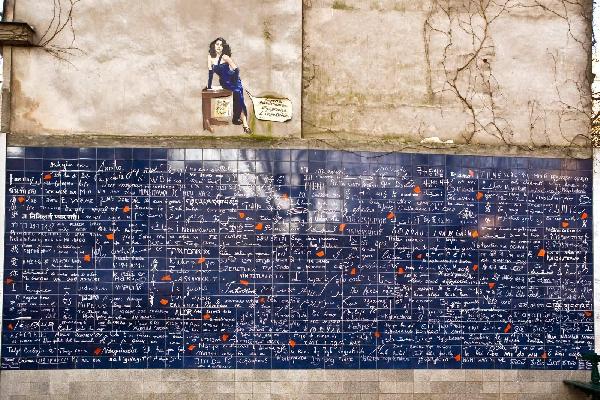
9. The Wall of Love (Le Mur des Je t’aime)
In the Jehan Rictus garden square, you will find a beautiful and romantic piece of public art:
The Wall of Love. Created in 2000 by artists Frédéric Baron and Claire Kito, it consists of 612 lava tiles on which the phrase “I love you” is inscribed 311 times in 250 languages.
Travel Tip: This is a popular spot for couples’ photos. The splashes of red on the tiles represent pieces of a broken heart, symbolizing a humanity that is fragmented but brought together by love. It’s a quick but touching stop on your tour.
Culinary Interlude: Food in Montmartre
Montmartre offers a range of dining options. Avoid the tourist traps on Place du Tertre and explore the side streets for more authentic experiences.
Crêperies: As you’re in a historically village-like area, enjoying a crêpe is a must. Look for a small crêperie on a side street for a delicious and affordable snack. A classic is crêpe au sucre (with butter and sugar) or galette complète (a buckwheat crêpe with ham, cheese, and egg).
Bistros: Rue des Abbesses and Rue Lepic are lined with excellent traditional bistros serving classic French fare like steak frites, onion soup, and duck confit.
Cafés: Stop at a historic café like La Maison Rose (the Pink House) for a coffee or glass of wine. It was famously painted by Utrillo and is incredibly picturesque.
Patisseries & Boulangeries: Don’t miss the chance to try a fresh baguette or a delicate pastry from one of Montmartre’s many award-winning bakeries.
The Finale: Moulin Rouge
Your walk concludes at the foot of Montmartre hill, back on Boulevard de Clichy at the world’s most famous cabaret: the
Moulin Rouge (Red Windmill). Established in 1889, it was the birthplace of the modern can-can dance and became synonymous with the decadent entertainment of the Belle Époque, immortalized in the posters of Henri de Toulouse-Lautrec.
The Exterior: The red windmill on its roof is an iconic Parisian landmark. It’s spectacularly illuminated at night.
The Show: Today, it presents “Féerie,” a lavish show featuring 100 performers in elaborate costumes, spectacular sets, and yes, the famous French Cancan. It’s a high-production-value spectacle.
Practicalities: Attending a show is expensive and requires booking well in advance. Dress code is smart (no shorts or sports shoes). The ticket often includes half a bottle of champagne per person. You can also just admire it from the outside for free, which is what most tourists do.
A Final Note on Transportation
The tour ends at Blanche Metro station (Line 2), right next to the Moulin Rouge. This conveniently places you back on the same metro line where you started at Anvers, making your return journey simple. This full-day walking tour covers approximately 3-4 kilometers (2-2.5 miles) with significant elevation changes. Wear comfortable walking shoes, take your time, and allow yourself to get lost in the enchanting streets of Montmartre.