A Journey from Salzburg to the Eagle’s Nest: A Comprehensive Travel Guide
This guide details a compelling day trip from the Baroque splendor of Salzburg, Austria, to the chilling historical site of the Eagle’s Nest (Kehlsteinhaus) perched high in the Bavarian Alps of Germany. This journey connects two distinct worlds: the harmonious city of Mozart with a stark relic of the Third Reich, all set against a backdrop of breathtaking alpine scenery. The following is an objective and practical account to help you plan this profound and scenic excursion.
Part 1: Salzburg – The Sound of Music and Baroque Grandeur
Your journey begins and ends in Salzburg, a UNESCO World Heritage site that serves as the perfect base. The city is a masterpiece of Baroque architecture, a testament to its historical wealth as an independent ecclesiastical state ruled by powerful prince-archbishops.
Key Attractions in Salzburg
Hohensalzburg Fortress (Festung Hohensalzburg): Dominating the city skyline, this is one of the largest and best-preserved medieval castles in Europe. You can reach it via a funicular (the Festungsbahn) or a steep walk. The views from the ramparts over the city’s spires and the Alps are unparalleled. Inside, you’ll find ornate state rooms, a marionette museum, and the fortress museum detailing its 900-year history.
Salzburg Altstadt (Old City): Get lost in the winding, narrow streets of the old town, nestled between the Salzach River and the Mönchsberg mountain. Key squares include the Residenzplatz, with its impressive fountain, and the Domplatz, home to the magnificent Salzburg Cathedral.
Mirabell Palace and Gardens (Schloss Mirabell): A beautiful palace built by Prince-Archbishop Wolf Dietrich for his beloved Salome Alt. The gardens are a geometric marvel, famous from the “Do-Re-Mi” scene in The Sound of Music. Don’t miss the Angel Staircase (Engelstiege) inside the palace.
Mozart’s Birthplace (Mozarts Geburtshaus) & Residence (Wohnhaus): For classical music enthusiasts, visiting the house where Wolfgang Amadeus Mozart was born on Getreidegasse is essential. Across the river, his later residence offers deeper insight into his life and family.
Getreidegasse: This famous shopping street is known for its ornate, wrought-iron guild signs hanging above high-end boutiques, traditional shops, and hidden courtyards.
Salzburg’s Culinary Scene
Salzburg offers a blend of Austrian classics and regional Salzburger specialties.
Classic Dishes: Indulge in Wiener Schnitzel (a thin, breaded, and fried veal or pork cutlet), Kasnocken (cheesy pasta dumplings), or Salzburger Nockerl (a sweet, soufflé-like dessert meant to represent the surrounding mountains).
Café Culture: Experience the timeless tradition of Austrian coffee culture at historic establishments like Café Tomaselli or Café Bazar. Order a Melange (a coffee similar to a cappuccino) and a slice of cake.
Stiegl Beer: As Austria’s most popular private brewery, Stiegl is a point of local pride. Visit the Stiegl-Brauwelt for a tour and tasting.
Balkan Grill (Würstelstand am Alten Markt): A legendary sausage stand next to the Christmas market square, famous for its Bosna (a spicy sausage in a roll with onions and curry powder).
Practical Tips for Salzburg
Salzburg Card: If you plan to visit multiple attractions, this card is highly cost-effective. It includes free single admission to all major attractions, free use of public transportation (including the fortress funicular and the Untersberg cable car), and various discounts.
Getting Around: The city center is very walkable. An efficient network of buses covers areas outside the core.
Accommodation: Stay in or near the Altstadt for the most immersive experience. Book well in advance during peak seasons like the summer festival or Christkindlmarkt.
Part 2: The Journey to the Eagle’s Nest (Kehlsteinhaus)
The Eagle’s Nest is located near the town of Berchtesgaden in Germany, approximately 30 kilometers (19 miles) from Salzburg. This requires crossing an international border.
Transportation: Step-by-Step
The journey involves multiple stages. Planning is crucial as the Eagle’s Nest is only accessible from mid-May to October, weather permitting.
Salzburg to Berchtesgaden:
By Bus: The RVO Bus 840 departs regularly from Salzburg Hauptbahnhof (main train station) and goes directly to Berchtesgaden Hauptbahnhof. The journey takes about 50 minutes. This is often the most straightforward option.
By Train: Trains also run from Salzburg to Berchtesgaden, but they often require a change in Freilassing. The bus is usually more direct.
Travel Tip: You will cross from Austria into Germany. While border checks are rare, always carry your passport or EU national ID card.
Berchtesgaden to the Documentation Center Obersalzberg:
- From Berchtesgaden train station, take the RVO Bus 838. Your destination is the “Dokumentation Obersalzberg” stop. This is a mandatory first stop.
The Eagle’s Nest Ticket & Access:
- You must purchase a combined ticket for the special bus and the elevator at the Eagle’s Nest Bus Ticket Counter at the Documentation Center. You
cannot drive your own car up the private road.
- The special bus takes you on a steep, winding 6.5km journey up the mountain to a bus terminal. The drive is an experience in itself, with stunning views and dramatic drop-offs.
- From the bus terminal, you walk through a cold, marble-lined 124-meter tunnel carved into the mountain. At the end, a lavish brass elevator, original to the building, whisks you up 124 meters to the Eagle’s Nest itself.
The Eagle’s Nest Experience
The Eagle’s Nest was a 50th birthday present for Adolf Hitler from the Nazi Party. Unlike other Nazi buildings in Obersalzberg, it was not bombed during WWII and remains largely in its original state.
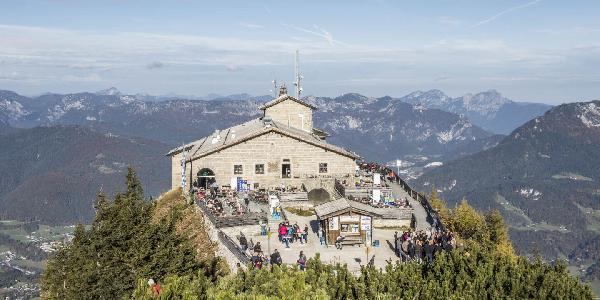
The Building: The structure itself is an engineering marvel, built on a sub-peak of the Hoher Göll at an elevation of 1,834 meters (6,017 ft). The main hall now functions as a restaurant. The original fireplace, a gift from Mussolini, is still there.
The Views: The primary reason for visiting is the panoramic view. On a clear day, you can see all the way to Salzburg and across the towering peaks of the Berchtesgaden Alps. It is objectively spectacular.
The Historical Context: There are no explicit Nazi exhibitions in the Eagle’s Nest itself. The historical weight of the place is conveyed through its existence. For a deep and critical understanding of the area’s dark history, a visit to the Documentation Center Obersalzberg is absolutely essential.
The Documentation Center Obersalzberg: This modern museum, built on the site of the former Nazi administration headquarters, provides a sobering and comprehensive look at the history of Obersalzberg as a second seat of Nazi power after Berlin. It covers the Nazi terror system, the bunker network underneath, and the post-war period. Do not skip this.
Culinary Aspects at the Summit
The Eagle’s Nest restaurant offers traditional Bavarian food and beer. While the food is standard alpine fare (sausages, dumplings, strudel), having a coffee or beer on the terrace is an experience defined by the setting rather than culinary excellence.
Practical Tips for Visiting the Eagle’s Nest
Book in Advance: During peak season, reserve your bus ticket online ahead of time to guarantee a spot and avoid long queues.
Check the Weather: The mountain weather is fickle. A clear day is essential for good views. If it’s foggy or rainy at the base, it will be worse at the top. Check the webcam on the official website before you go.
Dress in Layers: Even on a warm summer day, it can be cold and windy at the summit. Wear sturdy walking shoes for the paths around the peak.
Timing: Allocate a full day for this trip from Salzburg. The entire process—travel to Berchtesgaden, bus rides, waiting for the elevator, visiting the site and Documentation Center—takes 6-8 hours minimum.
Sensitivity: This is a site with a deeply troubling history. Visitors are expected to behave respectfully. The display of any Nazi symbols or gestures is illegal in Germany.
Part 3: Cultural Context and Local Insights
The Dual Heritage
This trip navigates two distinct cultural identities. Salzburg represents Austrian culture at its most refined—Baroque art, classical music, and centuries of Catholic ecclesiastical power. Just across the border, Berchtesgaden embodies traditional Bavarian culture: lederhosen, hearty food, and a deep connection to the Alps. The shadow of the Nazi era over Obersalzberg adds a complex and somber layer to this beautiful landscape.
The Sound of Music vs. History
Many visitors come to Salzburg because of
The Sound of Music. While the film is a significant part of the tourist industry, locals have a more nuanced relationship with it. It’s less a part of their cultural identity and more an American phenomenon based on a true story. Engaging with Salzburg’s own rich history beyond the film narrative is highly rewarding.
A Note on Terminology
The name “Eagle’s Nest” was coined by a French diplomat and popularized by the Allies. The Germans primarily refer to it by its original name, “
Kehlsteinhaus” (Kehlstein House). Using this term can sometimes feel more neutral and accurate to its current function as a mountain restaurant.
A Sample One-Day Itinerary
8:00 AM: Start at Salzburg Hauptbahnhof. Take RVO Bus 840 to Berchtesgaden.
9:00 AM: Arrive at Berchtesgaden station. Switch to RVO Bus 838 to Dokumentation Obersalzberg.
9:30 AM – 11:00 AM: Visit the Documentation Center Obersalzberg for crucial historical context.
11:15 AM: Purchase/validate your Eagle’s Nest bus ticket and board the special bus.
12:00 PM – 2:30 PM: Explore the Eagle’s Nest. Walk the mountain paths, take photos, and have lunch at the restaurant.
3:00 PM: Take the bus back down to the Documentation Center, then Bus 838 back to Berchtesgaden.
4:00 PM: Catch Bus 840 back to Salzburg.
5:00 PM: Arrive back in Salzburg, with an evening free to enjoy a traditional dinner and perhaps a Mozart concert.
Conclusion
The day trip from Salzburg to the Eagle’s Nest is more than just a scenic outing; it is a journey through contrasting layers of European history and culture. You move from the harmonious beauty of Mozart’s birthplace to a stark reminder of 20th-century tyranny, all while being surrounded by some of Europe’s most dramatic natural landscapes. With careful planning and respectful curiosity, this excursion will leave you with powerful memories and a deeper understanding of this complex and beautiful corner of the world.