A Comprehensive Travel Guide to Turkey’s Classic Circuit: Istanbul, Ankara, Cappadocia, Konya, Pamukkale, Ephesus, Kusadasi, Troy, Canakkale, Bursa
This guide outlines a classic and comprehensive circuit through Western and Central Turkey, offering a deep dive into the nation’s rich tapestry of history, culture, and stunning landscapes. The route connects the imperial capitals of the Byzantine and Ottoman empires with the heartland of the Seljuks, ancient Greco-Roman cities, and unique geological wonders. It is a journey through time, from the mythological age of Troy to the vibrant modern Republic.
Route Overview and Itinerary
This circular route typically requires a minimum of 14 to 21 days to fully appreciate. The logical flow starts and ends in Istanbul, moving east to Ankara, then south to the surreal landscapes of Cappadocia, followed by a journey through the spiritual center of Konya, the calcite terraces of Pamukkale, the ancient ruins of Ephesus, the coastal town of Kusadasi, the legendary site of Troy, the poignant Gallipoli battlefields near Canakkale, the early Ottoman capital of Bursa, and finally back to Istanbul. This sequence optimizes travel time and offers a varied experience.
Istanbul: Where Continents Collide
Istanbul, the only city in the world straddling two continents, Europe and Asia, is a mesmerizing metropolis that served as the capital of the Roman, Byzantine, and Ottoman Empires.
Key Attractions
Sultanahmet District: The historic heart of Istanbul. Here, visitors will find the Hagia Sophia, a breathtaking architectural marvel that has been a cathedral, mosque, and now a museum. Opposite it is the Blue Mosque, famous for its exquisite Iznik tile work. The nearby Basilica Cistern offers an eerie and beautiful subterranean experience.
Topkapi Palace: The primary residence of Ottoman Sultans for nearly 400 years. Its sprawling complex includes lavish courtyards, the Harem quarters, and treasury rooms housing priceless jewels and relics.
Grand Bazaar & Spice Bazaar: Immerse yourself in the vibrant chaos of these historic markets. The Grand Bazaar is one of the largest and oldest covered markets in the world, while the Spice Bazaar is a sensory delight filled with the aromas of herbs, spices, and Turkish delight.
Bosphorus Cruise: A boat tour along the Bosphorus Strait is essential. It provides stunning views of palaces, mosques, and wooden mansions (yalıs) lining the shores of Europe and Asia.
Food & Drink
Breakfast (Kahvaltı): A lavish affair with cheeses, olives, tomatoes, cucumbers, honey, kaymak (clotted cream), and menemen (scrambled eggs with vegetables).
Street Food: Don’t miss simit (a sesame-encrusted bread ring), balık ekmek (fish sandwich from the Eminönü docks), and roasted chestnuts.
Dinner: Try classic dishes like kebabs, meze platters (assorted appetizers), and lahmacun (Turkish “pizza”). For a unique experience, dine at a rooftop restaurant with views of the illuminated Hagia Sophia.
Transportation & Accommodation
Istanbul has two main airports: Istanbul Airport (IST) on the European side and Sabiha Gökçen Airport (SAW) on the Asian side. The city’s public transport system, including trams, metro, and ferries, is efficient for navigating major sights. The Istanbulkart is a rechargeable card that provides access to all. For accommodation, the Sultanahmet area offers proximity to historic sites, while Beyoğlu (including Taksim and Karaköy) provides a more modern and vibrant nightlife scene.
Cultural Insight
Istanbul embodies layers of history. Respectful dress is required when entering mosques (headscarves for women, covered shoulders and knees for all). The call to prayer (ezan) echoing from minarets five times a day is a fundamental part of the city’s soundscape. Engaging with friendly locals in shops and cafes can be a highlight of the visit.
Ankara: The Modern Capital
Ankara, Turkey’s capital, presents a contrast to Istanbul with its planned layout and role as the political and administrative center of the Republic.
Key Attractions
Anıtkabir: The monumental mausoleum of Mustafa Kemal Atatürk, the founder of modern Turkey. It is a site of immense national pride and features a museum detailing his life and the War of Independence.
Museum of Anatolian Civilizations: Housed in a 15th-century covered market, this world-class museum offers a chronological journey through Anatolia’s history, with exceptional collections from Paleolithic, Neolithic, Hittite, Phrygian, Urartian, and Roman periods.
Ankara Castle: The old citadel offers panoramic views of the city from its walls. The surrounding neighborhood is a charming area of narrow streets and traditional Ottoman houses now converted into shops and cafes.
Transportation
Ankara is well-connected by high-speed train (YHT) from Istanbul (approx. 4 hours), which is a highly recommended and comfortable option. Esenboğa Airport (ESB) serves domestic and international flights. The city has a reliable metro and bus system.
Cappadocia: A Surreal Landscape
Cappadocia is a geological wonderland famous for its “fairy chimneys,” cave dwellings, and underground cities, shaped by millennia of volcanic activity and erosion.
Key Attractions
Hot Air Balloon Ride: A sunrise hot air balloon flight over the valleys is an iconic and unforgettable experience, offering a bird’s-eye view of the unique terrain.
Göreme Open-Air Museum: A UNESCO World Heritage site featuring a complex of rock-cut churches, chapels, and monasteries adorned with beautifully preserved Byzantine frescoes dating from the 10th to 12th centuries.
Underground Cities: Explore Kaymaklı or Derinkuyu, multi-level subterranean cities that could house thousands of people, complete with ventilation shafts, stables, churches, and wine presses, used by early Christians for protection.
Hiking the Valleys: Hiking through valleys like Ihlara, Love Valley, or Rose Valley reveals stunning rock formations, hidden churches, and pigeon houses carved into the cliffs.
Food & Drink
Testi Kebab: A meat and vegetable stew cooked in a sealed clay pot that is dramatically cracked open at the table.
Pottery Kebab: Similar to Testi Kebab, a local specialty.
Wine Tasting: Cappadocia has a long history of viticulture. Many local wineries offer tastings of wines produced from indigenous grapes.
Transportation & Accommodation
The nearest airports are Kayseri (ASR) and Nevşehir (NAV). The region is best explored by renting a car or joining guided tours. A unique accommodation experience is staying in a cave hotel, which range from budget-friendly hostels to luxurious boutique hotels with modern amenities carved into the rock.
Konya: The City of Whirling Dervishes
Konya is a city of deep spiritual significance as the home of the Mevlevi Order, founded by the poet and mystic Rumi.
Key Attractions
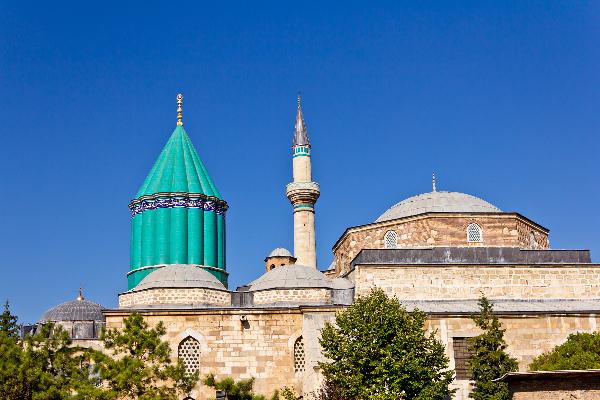
Mevlana Museum: The former lodge of the Mevlevi dervishes and Rumi’s mausoleum. It is one of Turkey’s most visited pilgrimage sites and a place for quiet contemplation.
Sema Ceremony: Witness the hypnotic Whirling Dervishes ceremony, a spiritual ritual representing a mystical journey towards God. Performances are held at the Mevlana Cultural Center.
Cultural Insight
Konya is one of Turkey’s more conservative cities. Visitors should dress modestly out of respect for the local culture and the religious significance of the sites. The atmosphere is noticeably more tranquil and devout than in coastal or metropolitan areas.
Pamukkale: The Cotton Castle
Pamukkale is a natural wonder consisting of dazzling white travertine terraces filled with thermal waters, cascading down a mountainside.
Key Attractions
The Travertine Terraces: Visitors can walk barefoot on the warm, mineral-rich waters flowing over the terraces. The sight is particularly spectacular at sunset when the white rock glows with warm hues.
Hierapolis: The ancient Greco-Roman city built on top of the hot springs. Highlights include a remarkably well-preserved theater, a vast necropolis (cemetery), and the Antique Pool, where you can swim amongst submerged Roman columns.
Practical Tips
The nearest towns for accommodation are Pamukkale village or the larger city of Denizli. Access to the terraces is restricted to specific paths to preserve the delicate calcite formations. It is best to visit early in the morning or late in the afternoon to avoid crowds.
Ephesus & Kusadasi: Ancient Glory & Aegean Coast
The ancient city of Ephesus is one of the most complete and magnificent Roman archaeological sites in the world, while Kusadasi serves as a popular coastal base for exploration.
Key Attractions in Ephesus
The Library of Celsus: The iconic facade is one of the most photographed structures in Ephesus.
The Grand Theatre: A massive theater that could hold 25,000 spectators, where St. Paul is said to have preached.
Temple of Artemis: One of the Seven Wonders of the Ancient World; though little remains today, its historical significance is immense.
Terraced Houses: Extraordinarily well-preserved homes of the wealthy elite, featuring intricate mosaics and frescoes (requires a separate ticket).
Kusadasi & Surroundings
Kusadasi is a bustling resort town with a lively seafront promenade and bazaar. It’s an excellent base for visiting Ephesus, as well as the House of the Virgin Mary (Meryemana), believed to be her final resting place, and the picturesque village of Şirince, known for its fruit wines.
Food & Accommodation
The Aegean coast offers superb seafood. Try grilled sea bass or mezes like octopus salad. Kusadasi has a wide range of accommodation, from all-inclusive resorts to boutique hotels. For a quieter stay, consider nearby Selçuk town.
Troy & Canakkale: Legendary Battles
This region is steeped in history, both mythical and modern.
Troy (Truva)
The archaeological site of Troy reveals layers of nine different cities built on top of each other over thousands of years. While the ruins require some imagination, standing before the replica of the famous Trojan Horse brings Homer’s Iliad to life. The onsite museum provides excellent context.
Canakkale & Gallipoli
The city of Canakkale is a pleasant university town and the gateway to both Troy and the Gallipoli Peninsula. A visit to Gallipoli is a solemn and moving experience. The battlefields and memorials commemorate the fierce campaign of World War I where thousands of Allied (including ANZAC) and Ottoman soldiers lost their lives. Key sites include ANZAC Cove, Lone Pine Cemetery, and Chunuk Bair.
Bursa: The First Ottoman Capital
Nestled at the foot of Mount Uludağ, Bursa was the first major capital of the Ottoman Empire and is known for its early Ottoman architecture and lush greenery.
Key Attractions
Grand Mosque (Ulu Cami): An impressive 14th-century mosque with 20 domes and a beautiful interior fountain.
Green Mosque & Green Tomb (Yeşil Türbe): Famous for their exquisite turquoise and green Iznik tile work.
Cumalıkızık Village: A charming Ottoman-era village with cobblestone streets and historic houses, now a UNESCO World Heritage site.
Mount Uludağ: A popular ski resort in winter and a great spot for hiking and picnics in summer, accessible by cable car from Bursa.
Food & Drink
Bursa is the birthplace of the İskender Kebab, thinly sliced doner meat served over pita bread with tomato sauce and browned butter. Also try candied chestnuts (kestane şekeri) and Bursa peach.
Transportation
Bursa is easily accessible from Istanbul via a combination of ferry (from Yenikapı or Pendik to Yalova) and bus. It is also connected by bus to Canakkale.
General Travel Tips for Turkey
Visa: Many nationalities require an e-Visa, which should be obtained online before travel.
Currency: The Turkish Lira (TRY). Credit cards are widely accepted in cities, but it’s wise to carry some cash for smaller establishments and markets.
Bargaining: Expected in bazaars and for certain services like taxis (agree on a price or insist on the meter beforehand).
Tipping: Around 10% is customary in restaurants if a service charge is not included. Tip small amounts to hotel staff, hamam attendants, and tour guides.
Language: Turkish is the official language. English is spoken in tourist areas but learning a few basic Turkish phrases (Merhaba – Hello, Teşekkür ederim – Thank you) is appreciated.
Cuisine: Turkish cuisine is diverse and superb. Be adventurous and try local specialties in each region.
This grand circuit through Turkey offers an unparalleled journey through epochs and empires. From the bustling energy of Istanbul to the serene spirituality of Konya, from the otherworldly landscapes of Cappadocia to the ancient echoes in Ephesus and Troy, this route captures the profound depth and breathtaking beauty that define this transcontinental nation.