A Comprehensive Travel Guide to Mexico City and its Surroundings
This guide provides a detailed itinerary and essential information for travelers exploring the vibrant heart of Mexico, from its ancient ruins and spiritual centers to its bustling city life and unique cultural experiences. The journey encompasses the rich tapestry of history, art, and flavor that defines this remarkable region.
Introduction to the Destination
Mexico City, one of the world’s largest metropolitan areas, is a captivating blend of ancient civilization and modern energy. Built upon the ruins of the Aztec capital of Tenochtitlan, the city serves as the perfect gateway to explore the profound history and vibrant culture of Mexico. A trip starting from one’s point of origin and culminating in a return journey can be packed with awe-inspiring archaeological sites, world-class museums, colorful canals, and profound spiritual landmarks. This guide covers the essential loop: from arrival, to the spiritual site of the Basilica of Our Lady of Guadalupe, the monumental Pyramids of Teotihuacán, a city tour, unique experiences like the Tequila and Mezcal Museum and Xochimilco, the modernist University City, the unparalleled National Museum of Anthropology, and finally, departure from Mexico City.
Basilica of Our Lady of Guadalupe
The Basilica of Our Lady of Guadalupe is not just a church; it is the spiritual heart of Mexico and one of the most important Catholic pilgrimage sites in the world. It commemorates the apparition of the Virgin Mary to an indigenous man named Juan Diego in 1531. The site complex includes the Old Basilica, which dates back to the 1700s and is noticeably sinking into the soft ground, and the modern New Basilica, a circular building designed by architect Pedro Ramírez Vázquez and completed in 1976. The most sacred object here is the original tilma (cloak) of Juan Diego, which bears the image of the Virgin and is displayed above the altar in the New Basilica.
Cultural Insight: The Virgin of Guadalupe is a powerful symbol of Mexican identity, representing a fusion of indigenous and Spanish Catholic beliefs. Her image is ubiquitous throughout Mexico.
Transportation: The basilica is located in the northern part of Mexico City. The easiest way to reach it is via the Metro Line 6, getting off at the “La Villa-Basílica” station. From there, it’s a short walk to the complex.
Food Recommendation: The area around the basilica is filled with food stalls. Try a classic Torta de Chilaquiles or a warm Atole, a traditional corn-based beverage, to experience local flavors.
Pyramids of Teotihuacán (The Sun and Moon Pyramids)
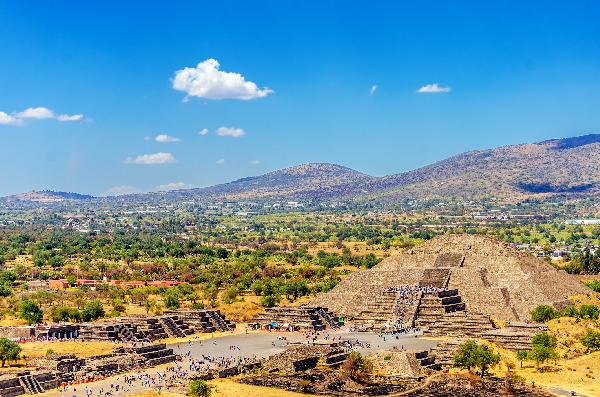
Located about 50 kilometers northeast of Mexico City, Teotihuacán is one of the most significant archaeological sites in the Americas. Known as “The City of the Gods,” it was a massive metropolis long before the Aztecs arrived, who gave it its current name. The site is dominated by two colossal pyramids: the Pyramid of the Sun and the Pyramid of the Moon. Walking down the massive Avenue of the Dead, with these monumental structures looming ahead, is a humbling experience. Visitors can climb the pyramids for breathtaking views of the entire ancient city and surrounding valley.
Cultural Insight: The original builders and the reason for Teotihuacán’s collapse around 550 AD remain a mystery. For the Aztecs, it was a sacred place of origin, and they conducted pilgrimages here.
Transportation: Public buses to Teotihuacán depart frequently from Mexico City’s Terminal del Norte (North Bus Station). Look for buses labeled “Pyramides.” The journey takes about an hour. Alternatively, organized tours offer convenient transportation and a guide.
Food Recommendation: Near the site’s exits, restaurants serve traditional pre-Hispanic food. Sample dishes like Escamoles (ant larvae, considered a delicacy) or Sopa de Flor de Calabaza (squash blossom soup). A more accessible option is a hearty plate of Carnitas.
Accommodation Tip: While most visitors day-trip from Mexico City, for a deeper experience, consider staying at a hotel near the ruins, such as Villas Arqueológicas Teotihuacán, which allows for early morning access before the crowds arrive.
Mexico City Downtown Tour
The historic center of Mexico City, a UNESCO World Heritage site, is a bustling area packed with landmarks. The main square, the Zócalo (officially Plaza de la Constitución), is one of the largest public squares in the world. It is flanked by the Metropolitan Cathedral, a monumental building that took nearly 250 years to complete, and the National Palace, which houses famous murals by Diego Rivera depicting Mexico’s history. A short walk away is the Templo Mayor museum and archaeological site, the main temple of the Aztec capital Tenochtitlan, discovered by accident in 1978.
Cultural Insight: The Zócalo has been a central gathering place since Aztec times. You can see the layers of history literally stacked on top of one another at the Templo Mayor site.
Transportation: The historic center is best explored on foot. The Zócalo is easily accessible via Metro Line 2 at the “Zócalo/Tenochtitlán” station.
Food Recommendation: Don’t miss the historic Café de Tacuba for a traditional Mexican meal in a beautiful, atmospheric setting. For a quicker bite, head to the San Juan Market to sample a vast array of local foods, or try street food like Tacos al Pastor from a reputable vendor.
Tequila and Mezcal Museum
Located in the heart of the city, this interactive museum offers an engaging introduction to Mexico’s most famous spirits. Visitors can learn about the history and production process of both tequila (made exclusively from blue agave) and mezcal (which can be made from over 30 types of agave and is known for its smoky flavor). The museum typically includes a guided tasting session, helping visitors distinguish between different types and ages of these beverages.
Cultural Insight: Tequila and Mezcal are deeply woven into Mexican culture and are protected by designation of origin. Understanding their production is to understand a part of Mexico’s soul and its connection to the land.
Transportation: The museum is on Plaza Garibaldi, famous for its mariachi bands. It is accessible by Metro Line 8 at the “Garibaldi/Lagunilla” station.
Food Recommendation: Pair your tasting with some Botanas (bar snacks). Afterward, enjoy the lively atmosphere of Plaza Garibaldi and perhaps hire a mariachi band to play a song.
Xochimilco
Xochimilco offers a unique and colorful experience, often described as the “Venice of Mexico.” It is a network of canals and artificial islands called
chinampas, a farming system developed by the pre-Hispanic inhabitants of the valley. Visitors rent brightly painted wooden boats called trajineras, which are piloted through the canals. It’s a festive atmosphere with floating mariachi bands, vendors selling food and drinks from their canoes, and beautifully decorated boats.
Cultural Insight: The chinampas are a UNESCO World Heritage site and are a testament to ancient Aztec engineering. They are still used for agriculture today.
Transportation: Take the Tren Ligero (light train) from the Tasqueña metro station (Line 2) to the Xochimilco terminal. From there, it’s a short taxi or walk to the main embarcaderos (piers).
Food Recommendation: On the boat, you can buy food and drinks from passing vendors. Try Pulque, a traditional fermented agave drink, or enjoy a michelada. Food like roasted corn (elote) and tacos are also commonly available.
University City (Ciudad Universitaria)
The main campus of the National Autonomous University of Mexico (UNAM) is a masterpiece of 20th-century modernist architecture and also a UNESCO World Heritage site. The campus is an open-air art gallery, featuring murals by some of Mexico’s greatest artists. The most famous is the Central Library, whose entire facade is covered by a mosaic created by Juan O’Gorman depicting Mexico’s historical evolution. The University Olympic Stadium and the Rectorate Tower are other notable buildings adorned with murals by Diego Rivera and David Alfaro Siqueiros.
Cultural Insight: UNAM is one of Latin America’s most prestigious universities and has been a central hub for intellectual and political thought in Mexico. The campus art reflects the post-revolutionary ideals of education and national identity.
Transportation: The campus is served by Metro Line 3 (Copilco or Universidad stations) and Metrobús Line 1 (C.U. station). The campus is vast, so be prepared for walking.
Food Recommendation: Experience authentic student life by eating at one of the many comedores (dining halls) or cafes on campus. The food is affordable and typically very good.
National Museum of Anthropology
Widely regarded as one of the world’s finest museums, the National Museum of Anthropology in Chapultepec Park offers a comprehensive overview of Mexico’s pre-Hispanic heritage. Its vast collection includes legendary artifacts like the Aztec Sun Stone (often mistakenly called the Aztec Calendar), giant Olmec heads, and a reconstruction of Pakal’s tomb from Palenque. The museum is organized by cultural regions, making it easy to understand the diversity and complexity of ancient Mexican civilizations.
Cultural Insight: The museum’s architecture itself is symbolic, with a massive umbrella-like pillar in the central courtyard that channels rainwater—a tribute to Tlaloc, the Aztec rain god.
Transportation: The museum is located in Chapultepec Park. The closest metro station is Auditorio (Line 7) or Chapultepec (Line 1), both requiring a walk through part of the park.
Food Recommendation: The museum has an excellent restaurant on-site that serves high-quality Mexican cuisine. For a more casual option, there are cafes inside, or you can pack a picnic to enjoy in Chapultepec Park afterward.
Departure from Mexico City
The journey concludes with a departure from Mexico City’s Benito Juárez International Airport (MEX). It is advisable to confirm flight details in advance and allow ample time for travel to the airport, as Mexico City’s traffic can be heavy. The airport is well-connected to the city center via the Metro (Terminal Aérea station on Line 5), official airport taxis, and ride-sharing services.
Accommodation Tip for Departure: For an early morning flight, consider staying at one of the many hotels located near the airport for convenience. In other cases, neighborhoods like Polanco or Reforma offer easy access to major arteries leading to the airport.
General Travel Tips
Best Time to Visit: The dry season, from November to April, offers pleasant weather. The rainy season (May to October) has afternoon showers but lush scenery.
Getting Around: Mexico City has an extensive and inexpensive Metro system. The Metrobús on dedicated lanes is efficient for longer distances. Ride-sharing apps like Uber and DiDi are also widely used and convenient.
Accommodation Areas:
Historic Center: Ideal for being close to major landmarks.
Polanco/Roma/Condesa: Trendy neighborhoods with great dining, nightlife, and boutique hotels.
Zona Rosa/Reforma: Business and tourist district with many hotel chains.
Safety: As with any large city, be aware of your surroundings, don’t flash valuables, use official taxis or ride-sharing services, and stick to well-trafficked areas, especially at night.
Cuisine Must-Tries: Beyond what’s mentioned, be sure to try Chiles en Nogada, Mole, Tamales, and for breakfast, Huevos Rancheros. Always drink bottled water.
A journey through Mexico City and its surrounding wonders is an immersion into layers of time—from ancient empires to colonial conquests and modern dynamism. It is a destination that engages all senses and leaves a lasting impression of its profound cultural depth and vibrant spirit.