A Journey Through Bavaria: Munich, Castles, and Alpine Wonders
This travel guide outlines a classic circular route through the heart of Bavaria, Germany, starting and ending in the vibrant state capital of Munich. The journey takes travelers through a landscape of breathtaking Alpine scenery, world-famous fairy-tale castles, charming villages, and deep cultural traditions. The itinerary covers the essential highlights of Southern Germany, providing a blend of royal history, natural beauty, and local culinary experiences.
Part 1: Munich (München) – The Cosmopolitan Capital
Munich, the capital of Bavaria, is a city that effortlessly blends traditional German culture with a modern, cosmopolitan vibe. It serves as the perfect start and end point for this adventure.
Key Attractions in Munich
Marienplatz and the New Town Hall (Neues Rathaus): The central square and heart of the city. Visitors gather to watch the Glockenspiel chime and perform a reenactment of a 16th-century wedding, a captivating spectacle at 11 am and 12 pm (and 5 pm in summer).
Frauenkirche (Cathedral of Our Blessed Lady): The iconic twin-domed church is a symbol of Munich. Its simple, imposing interior offers a stark contrast to its exterior, and visitors can ascend the south tower for panoramic city views.
English Garden (Englischer Garten): One of the world’s largest urban public parks. It’s a place for relaxation, sunbathing, river surfing at the Eisbachwelle, and enjoying a beer at the Chinese Tower beer garden.
Nymphenburg Palace: The magnificent summer residence of the Bavarian monarchs. The sprawling palace complex with its ornate rooms, vast park, and picturesque canals is a testament to the Wittelsbach dynasty’s wealth and power.
Viktualienmarkt: A daily food market offering fresh produce, local delicacies, flowers, and more. It’s an excellent spot to sample Bavarian specialties and soak in the local atmosphere.
Deutsches Museum: One of the world’s oldest and largest museums of science and technology, with fascinating exhibits on everything from astronomy to maritime navigation.
Food & Drink in Munich
Bavarian cuisine is hearty and flavorful. Must-try dishes include
Weißwurst (veal sausage), Schweinshaxe (roasted pork knuckle), Obatzda (a spiced cheese-butter spread), and Leberkäse (a type of meatloaf). No visit is complete without experiencing a beer hall or garden. The Hofbräuhaus is world-famous, but for a more local feel, try Augustiner-Keller or the beer garden at Hirschgarten. For a sweet treat, sample a Apfelstrudel or Kaiserschmarrn (shredded pancake).
Transportation & Accommodation in Munich
Munich has an excellent public transportation system (MVV), including U-Bahn (subway), S-Bahn (suburban train), trams, and buses. A day pass (
Tageskarte) is cost-effective for extensive travel. For accommodation, the Altstadt (Old Town) is ideal for first-time visitors due to its proximity to major sights. The neighborhoods of Schwabing and Maxvorstadt offer a vibrant, slightly quieter atmosphere with great cafes and museums.
Part 2: Day Trip to Linderhof Palace & Oberammergau
This day trip heads southwest from Munich into the Ammergau Alps, exploring the opulence of King Ludwig II and the artistry of a famous village.
Linderhof Palace (Schloss Linderhof)
Linderhof is the smallest but most intimate of King Ludwig II’s palaces and the only one he lived to see completed. Inspired by French absolutism and the Sun King, Louis XIV, its Rococo style is overwhelmingly ornate. The palace’s compact size makes its lavish interior even more impressive. The surrounding park is a masterpiece of landscape gardening, featuring fountains, a terraced garden, and several whimsical structures like the Venus Grotto—an artificial cave where the king was rowed in a shell boat while listening to operas.
Travel Tip: Entry is by timed ticket only. It is highly recommended to book tickets online in advance from the official Bavarian Palace Department website to secure a spot.
Oberammergau
A short drive from Linderhof lies the picturesque village of Oberammergau, world-renowned for two things: its Passion Play and its
Lüftlmalerei (frescoes). The town’s buildings are adorned with beautifully painted facades depicting biblical scenes, fairy tales, and rural life. Oberammergau is also a center for woodcarving, with numerous shops selling exquisite crafts. Every ten years (next in 2030), the town stages its famous Passion Play, a tradition dating back to 1634.
Transportation for the Day Trip
The most flexible way to visit both Linderhof and Oberammergau is by rental car. The drive from Munich takes about 1.5 hours. Alternatively, travelers can take a train from Munich Hauptbahnhof to Oberammergau (often requiring a change in Murnau), and then use a local bus (RVO Bus 9622) to reach Linderhof Palace. Organized day tours from Munich are also a popular and convenient option.
Part 3: The Fairy-Tale King’s Dream – Neuschwanstein Castle
The journey continues to Germany’s most famous castle, an emblem of romantic architecture and the troubled genius of King Ludwig II.
Neuschwanstein Castle (Schloss Neuschwanstein)
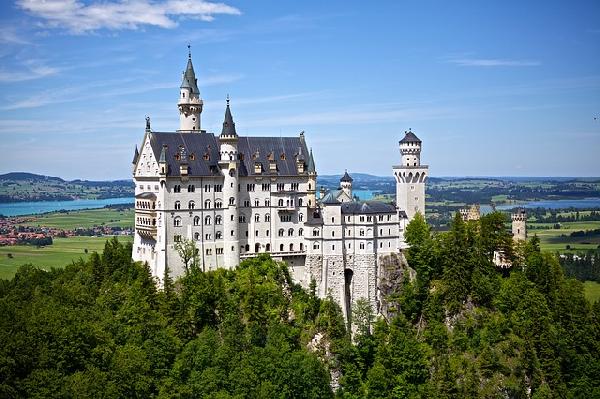
Perched on a rugged hill against a backdrop of mountains and lakes, Neuschwanstein Castle looks like it has been lifted from the pages of a storybook—which it famously inspired Walt Disney’s Sleeping Beauty Castle. Built in the 19th century, it was a personal refuge for the reclusive king, dedicated to the operatic works of Richard Wagner. The interior is a theatrical homage to Germanic legends, with murals depicting scenes from sagas like Lohengrin and Tannhäuser.
The Tour: Access to the castle interior is by guided tour only. Tickets must be purchased at the Ticket Center in Hohenschwangau village at the foot of the hill. Bookings must be made well in advance online.
Marienbrücke (Mary’s Bridge): For the iconic postcard view of the castle, visitors must walk to this bridge, which spans a dramatic gorge behind the castle.
Hohenschwangau Castle: The less-famous but equally beautiful yellow castle where King Ludwig II spent his childhood. It can be visited with a combined ticket.
Nearby Towns: Füssen & Schwangau
The town of Füssen is a charming medieval town with a well-preserved old center, located just a few kilometers from the castles. It serves as an excellent base for exploration. Schwangau is the municipality that directly hosts the castles. Both offer a range of accommodation and dining options.
Transportation & Accommodation
From Munich, take a direct train to Füssen (approx. 2 hours). From Füssen station, a frequent local bus (RVO Bus 73 or 78) takes visitors to the Hohenschwangau Ticket Center. Staying overnight in Füssen or Schwangau is highly recommended to experience the area without the day-trip crowds and to get an early start for the castle tour.
Part 4: Return to Munich & Journey South to Berchtesgaden
The route now heads back to Munich briefly before embarking on the next leg south-east to the pristine Alpine region of Berchtesgadener Land.
Travel Note: This part of the itinerary involves returning to Munich to switch from a western castle route to a southeastern Alpine route. Alternatively, more adventurous travelers with a car could take the scenic Deutsche Alpenstraße (German Alpine Road) directly from Füssen to Berchtesgaden, which is a longer but spectacular drive.
The Enchanting Magic Forest (Zauberwald)
Located near the village of Ramsau, the Magic Forest is a natural wonderland. A well-maintained path winds through a forest of moss-covered boulders, twisted tree roots, and alongside the crystal-clear waters of the Ramsauer Ache river. The play of light through the trees creates an ethereal, “magical” atmosphere. It’s an easy and family-friendly hike that offers stunning views of the surrounding mountains, including the Reiteralpe.
Part 5: Königssee – The King’s Lake
Königssee is often considered Germany’s most beautiful lake. Nestled deep within Berchtesgaden National Park, its emerald-green waters are surrounded by steep mountain walls, creating a fjord-like landscape.
Experiencing Königssee
Electric Boat Tour: To preserve the lake’s pristine water quality, only electric boats are allowed. The boat trip is an attraction in itself. Halfway through the journey, the boat stops at St. Bartholomä.
St. Bartholomä: A picturesque pilgrimage chapel with distinctive red domes, set on a peninsula. It’s a perfect spot for photographs and enjoying fresh fish from the smokehouse.
Salet: At the southern end of the lake, visitors disembark at Salet and take a short 15-minute walk to see the smaller Obersee lake. The view of the Obersee with the Röthbach waterfall in the background is one of the most iconic in all of Germany. For the more active, a longer walk leads to the waterfall itself.
Echo Wall: During the boat ride to St. Bartholomä, a boatman will traditionally play a flugelhorn to demonstrate the impressive echo that reverberates from the surrounding cliffs.
The Town of Berchtesgaden
The main town in the region, Berchtesgaden, is a charming Alpine resort with a historic salt mine (
Salzbergwerk) that offers fun underground tours. It serves as the central hub for exploring Königssee, the Magic Forest, and other local attractions like Hitler’s former Eagle’s Nest (Kehlsteinhaus).
Food & Accommodation in Berchtesgaden
The culinary focus here is on hearty Alpine food. Try
Kaspressknödelsuppe (cheese dumpling soup) or fresh trout from the local streams. Accommodation ranges from luxury hotels to cozy guesthouses (Gästehäuser) and family-run inns (Gasthöfe). Staying in Berchtesgaden or in one of the smaller villages like Schönau am Königssee provides easy access to nature.
Transportation from Munich to Berchtesgaden
The most straightforward way is by train from Munich Hauptbahnhof to Berchtesgaden Hauptbahnhof (approx. 2.5-3 hours, usually with one change in Freilassing). From Berchtesgaden town, local RVO buses connect to the Königssee boat dock and other points of interest. Having a car offers more flexibility for exploring remote areas.
Part 6: Final Return to Munich
The journey concludes with a return trip to Munich from Berchtesgaden. This is an opportunity for last-minute souvenir shopping, visiting any missed attractions in Munich, or simply enjoying one final Bavarian meal and beer at a traditional beer hall before departure.
Crucial Travel Tips for Bavaria
The Bavaria Ticket: For regional travel by train and bus (excluding IC/EC/ICE trains), the Bavaria Ticket is exceptional value. It is valid for one day across Bavaria for up to 5 people traveling together after 9 am on weekdays and all day on weekends.
Crowds & Booking: Neuschwanstein Castle and Königssee are extremely popular. Book castle tickets months in advance and arrive early at Königssee to avoid long queues for boats.
Cash Culture: While credit cards are becoming more common, Germany still has a strong preference for cash (Bargeld), especially in smaller restaurants, guesthouses, and markets.
Weather & Clothing: Mountain weather can change rapidly. Pack layers, a waterproof jacket, and sturdy walking shoes, even in summer.
Punctuality: Public transport in Germany is generally very punctual. Plan to be at your platform or bus stop on time.
Cultural Etiquette: A friendly “Guten Tag” (Good day) when entering a shop or “Prost” (Cheers) while making eye contact during a toast are small gestures that are appreciated.
This itinerary through Bavaria offers a profound journey into Germany’s cultural soul, from its royal history and artistic traditions to its awe-inspiring natural landscapes, ensuring an unforgettable travel experience.