Central European Grand Tour: Frankfurt to the Heart of Europe
This comprehensive travel guide details a classic Central European circuit, taking you from Germany’s financial hub through the scenic landscapes of Bavaria, into the heart of the former Austro-Hungarian Empire, and back. This route is rich in history, architecture, music, and culinary delights, offering a diverse experience across five distinct yet interconnected countries.
Trip Overview
This itinerary is typically undertaken over a period of two to three weeks. The route is designed for efficient travel by train and car, connecting major cities and charming towns. You will experience the modern dynamism of Frankfurt, the royal grandeur of Munich, the musical heritage of Salzburg and Vienna, the romantic atmosphere of Budapest, the compact charm of Bratislava, the fairy-tale beauty of Prague, and the historical significance of Nuremberg.
Countries: Germany, Austria, Hungary, Slovakia, Czech Republic
Primary Cities: Frankfurt, Metzingen, Munich, Salzburg, Vienna, Budapest, Bratislava, Prague, Nuremberg
Recommended Duration: 14-21 days
Best Time to Visit: Late spring (May-June) and early autumn (September-October) for pleasant weather and fewer crowds.
Detailed Itinerary and Destinations
1. Frankfurt am Main, Germany
Often the gateway to this tour due to its major international airport, Frankfurt is a city of contrasts, where modern skyscrapers stand alongside reconstructed historical buildings.
Main Attractions:
Römerberg: The historic heart of Frankfurt with beautifully reconstructed medieval buildings, including the Römer city hall.
St. Bartholomew’s Cathedral (Kaiserdom): A 14th-century Gothic cathedral that was the election and coronation site for Holy Roman Emperors.
Museum Embankment (Museumsufer): A unique cluster of museums on both sides of the River Main, including the Städel Museum.
Main Tower: Offers a spectacular panoramic view of the city skyline.
Practical Information:
Getting There: Frankfurt Airport (FRA) is one of Europe’s busiest hubs. The city center is easily reached by S-Bahn (S8 or S9) in about 15 minutes.
Getting Around: The city has an excellent public transport system (RMV). The city center is very walkable.
Local Dish: Grüne Soße (Green Sauce) with boiled potatoes and eggs; Apfelwein (apple wine).
2. Metzingen, Germany
A short detour south from Stuttgart, Metzingen is a paradise for shoppers, home to the headquarters and giant outlet stores of Hugo Boss and many other high-end fashion brands.
Main Attraction:
Outletcity Metzingen: A vast complex of outlet stores featuring brands like Boss, Bally, Michael Kors, Puma, and more, offering significant discounts.
Practical Information:
Getting There: Best reached by train from Stuttgart Hauptbahnhof (approx. 25 minutes). From Frankfurt, take a direct ICE train to Stuttgart and then a regional train.
Getting Around: The outlet stores are concentrated in a small area easily navigated on foot.
Tip: Check the outletcity website for opening hours and special events. Weekdays are less crowded than weekends.
3. Munich (München), Germany
The capital of Bavaria, Munich seamlessly blends traditional German culture with a modern, cosmopolitan vibe. It is known for its beautiful architecture, annual Oktoberfest, and beer gardens.
Main Attractions:
Marienplatz: The central square, home to the New Town Hall (Neues Rathaus) and its famous Glockenspiel.
Nymphenburg Palace: A magnificent Baroque palace with stunning gardens.
English Garden: One of the world’s largest urban public parks, perfect for cycling, walking, and seeing surfers on the Eisbach river.
Hofbräuhaus: The world’s most famous beer hall, offering a quintessential Bavarian experience.
Dachau Concentration Camp Memorial Site: A sobering and important day trip located just outside Munich.
Practical Information:
Getting There: Direct trains from Frankfurt take about 3.5 hours. Munich Airport (MUC) is also a major international hub.
Getting Around: An extensive U-Bahn (subway) and S-Bahn (suburban train) network. The city center is very walkable.
Local Dish: Weißwurst (white sausage) with sweet mustard and a pretzel; Schweinshaxe (pork knuckle).
4. Salzburg, Austria
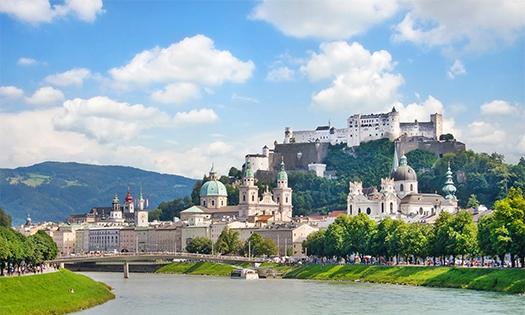
A picturesque city nestled on the banks of the Salzach River, Salzburg is famed as the birthplace of Wolfgang Amadeus Mozart and the setting for “The Sound of Music.” Its Baroque architecture is a UNESCO World Heritage Site.
Main Attractions:
Hohensalzburg Fortress: One of the largest and best-preserved medieval castles in Europe, offering breathtaking views of the city and Alps.
Mirabell Palace and Gardens: Beautiful Baroque gardens featured in “The Sound of Music.”
Getreidegasse: A charming, narrow shopping street known for its ornate wrought-iron shop signs.
Mozart’s Birthplace (Geburtshaus): A museum dedicated to the composer’s life and work.
Salzburg Cathedral (Dom): A magnificent 17th-century Baroque cathedral.
Practical Information:
Getting There: A direct train from Munich takes approximately 1.5-2 hours.
Getting Around: The Altstadt (Old Town) is compact and best explored on foot.
Local Dish: Salzburger Nockerl (a sweet soufflé dessert); Mozartkugeln (chocolate balls).
Currency: Euro (€).
5. Vienna (Wien), Austria
The imperial capital of Austria, Vienna exudes elegance and refinement. It is a city of music, art, and coffeehouse culture, with a legacy shaped by the Habsburg monarchy.
Main Attractions:
Schönbrunn Palace:The former summer residence of the Habsburgs, with stunning rooms, vast gardens, and the world’s oldest zoo.
St. Stephen’s Cathedral (Stephansdom):A Gothic masterpiece and Vienna’s most important religious building.
Belvedere Palace:A beautiful Baroque complex housing an art museum with Gustav Klimt’s “The Kiss.”
Vienna State Opera (Wiener Staatsoper):One of the leading opera houses in the world.
The Hofburg:The former imperial palace, now home to the Austrian president and several museums, including the Sisi Museum and Imperial Apartments.
Practical Information:
Getting There:A direct train from Salzburg takes about 2.5 hours.
Getting Around:A comprehensive U-Bahn, tram, and bus network. The inner city (Innere Stadt) is a UNESCO site and very walkable.
Local Dish:Wiener Schnitzel (breaded veal cutlet); Sachertorte (chocolate cake); visit a traditional coffee house for a melange coffee.
Currency:Euro (€).
6. Budapest, Hungary
The “Pearl of the Danube,” Budapest is actually two cities—Buda and Pest—unified in 1873. It is known for its stunning Parliament building, thermal baths, and vibrant nightlife.
Main Attractions:
Buda Castle & Castle Hill:A historical castle and palace complex offering panoramic views of Pest. Includes Matthias Church and Fisherman’s Bastion.
Hungarian Parliament Building:A magnificent Gothic Revival building on the banks of the Danube, best seen from across the river or on a boat tour.
Szent István Bazilika (St. Stephen’s Basilica):The largest church in Budapest.
Thermal Baths:Such as Széchenyi Baths (a vast, yellow complex in City Park) or Gellért Baths (Art Nouveau style).
Chain Bridge:The iconic suspension bridge connecting Buda and Pest.
Practical Information: