A Journey Through Bavaria: Munich, the Magic Forest, and Königssee
This travel guide outlines a classic and enchanting Bavarian itinerary, taking you from the vibrant capital of Munich, through the fairytale landscape of the Magic Forest, to the breathtaking alpine majesty of Lake Königssee. This route offers a perfect blend of urban culture, mythical natural beauty, and serene mountain scenery, providing a comprehensive taste of Southern Germany’s unique charm.
Part 1: Munich (München) – The Cosmopolitan Heart of Bavaria
Munich, the capital of the Free State of Bavaria, is a city that masterfully balances rich tradition with modern innovation. Known for its annual Oktoberfest, magnificent palaces, and world-class museums, Munich serves as the ideal starting point for this adventure.
Key Attractions in Munich
Marienplatz and the New Town Hall (Neues Rathaus): The central square of Munich is always buzzing with activity. The main draw is the Glockenspiel in the Neues Rathaus, a clock tower with animated figures that perform daily at 11 a.m., 12 p.m., and (from March to October) 5 p.m.
Frauenkirche (Cathedral of Our Blessed Lady): The twin domed towers of this cathedral are the iconic symbol of Munich’s skyline. Visitors can enter the church and, for a small fee, take an elevator up to the south tower for a panoramic view of the city.
English Garden (Englischer Garten): One of the world’s largest urban parks, it’s a place for relaxation and activity. Visitors can watch surfers ride the standing wave at the Eisbach river, enjoy a beer at the Chinese Tower beer garden, or simply stroll through its vast, beautiful landscapes.
Nymphenburg Palace: The summer residence of the Bavarian monarchs, this magnificent Baroque palace features stunning staterooms, a vast park with hidden pavilions like the Amalienburg hunting lodge, and the Marstallmuseum, which displays royal carriages.
Viktualienmarkt: A daily food market and a Munich institution. Here, one can find fresh produce, cheeses, meats, spices, and flowers. It’s also a great spot to grab a quick bite and soak in the local atmosphere.
Deutsches Museum: Located on an island in the Isar river, this is one of the world’s oldest and largest museums of science and technology, with fascinating exhibits on everything from astronomy to maritime navigation.
Culinary Delights in Munich
Bavarian cuisine is hearty and flavorful. Must-try dishes include:
Weißwurst: A traditional white sausage, typically eaten before noon. The proper way is to “zuzeln” (suck it out of the skin) or remove the skin and enjoy it with sweet mustard, a pretzel (Brezn), and a wheat beer (Weißbier).
Schweinshaxe: A crispy roasted pork knuckle, often served with potato dumplings (Knödel) and sauerkraut.
Obatzda: A flavorful cheese spread made from camembert, butter, and paprika, perfect for spreading on a pretzel.
Beer Garden Culture: No visit is complete without a visit to a beer garden like Hofbräukeller, Augustiner-Keller, or the one at the Chinese Tower. Bring your own food to some (where allowed) or enjoy the traditional fare offered.
Transportation in and to/from Munich
Getting There: Munich International Airport (MUC) is well-connected globally. The S-Bahn S1 and S8 lines connect the airport to the city center in about 45 minutes. The Hauptbahnhof (main train station) is also a major hub for national and international rail travel.
Getting Around: Munich has an excellent public transportation system (MVV) comprising U-Bahn (subway), S-Bahn (suburban train), trams, and buses. A day pass (“Tageskarte”) is often the most economical option for tourists.
To the Next Destination: The journey to the Berchtesgaden area (for the Magic Forest and Königssee) is most efficiently done by train. Direct trains run from Munich Hauptbahnhof to Berchtesgaden Hauptbahnhof, taking approximately 2.5 to 3 hours with stunning alpine views.
Accommodation Tips for Munich
Staying near the Altstadt (Old Town) provides easy walking access to major sights. The areas around the Hauptbahnhof offer convenience for arrivals and departures but can be busy. For a more local feel, consider neighborhoods like Schwabing, Glockenbachviertel, or Haidhausen.
Part 2: The Magic Forest (Zauberwald) – A Fairytale Landscape
Located near the village of Ramsau, just a short distance from Berchtesgaden, the Magic Forest is a natural wonderland that lives up to its name. It’s a place where sunlight filters through dense canopies of trees, illuminating moss-covered boulders and a turquoise-blue river, the Ramsauer Ache.
Exploring the Magic Forest
The Hike: The main path through the forest is a relatively easy and well-maintained trail suitable for all ages and fitness levels. The classic route starts at the Hintersee lake and winds its way along the river for about 2-3 kilometers. The interplay of light, water, and forest creates a constantly changing, magical atmosphere.
The Hintersee: This crystal-clear mountain lake is the perfect starting or ending point for the Magic Forest walk. Its emerald-green waters, set against the backdrop of the Reiteralpe mountains, offer stunning photo opportunities. One can rent a rowboat or simply enjoy a drink at a lakeside guesthouse.
Photography Tips: The best light for photography is in the early morning or late afternoon when the sun casts long, dramatic shadows. A tripod can be useful for capturing the smooth flow of the water in the shaded forest.
Culinary Stops near the Magic Forest
The area around Ramsau and Hintersee has several traditional Bavarian guesthouses (Gasthöfe) where you can enjoy a well-deserved meal after your walk.
Gasthof Auzinger: A historic inn near Hintersee known for its hearty Bavarian dishes and beautiful beer garden.
Himbäckstub’n: A cozy restaurant in Ramsau specializing in local delicacies, including fresh trout from the region’s streams.
For a Snack: Pack a “Brotzeit” (a traditional Bavarian snack) from a local bakery or supermarket—some bread, cheese, and sausage—to enjoy on a bench by the Hintersee.
Transportation to the Magic Forest
The Magic Forest is best accessed from the town of Berchtesgaden.
By Bus: From Berchtesgaden Hauptbahnhof, take the RVO bus 846 towards “Hintersee.” The journey takes about 20-25 minutes. Get off at the “Ramsau Kirche” stop to start from the church side or at “Hintersee” to start from the lake.
By Car: Driving offers flexibility. There are parking lots at both ends of the trail (near Ramsau Church and at Hintersee), but they can fill up quickly during peak season.
Accommodation near the Magic Forest
For a peaceful alpine stay, consider lodging in Ramsau itself. It offers a more rustic and quiet experience compared to Berchtesgaden. Alternatively, staying in Berchtesgaden provides more amenities and serves as a central base for exploring both the Magic Forest and Königssee.
Part 3: Königssee – Germany’s Deepest and Cleanest Alpine Lake
Königssee is a fjord-like lake nestled in the Berchtesgaden Alps. Its emerald-green waters, surrounded by steep mountain walls including the famous Watzmann massif, create a scene of breathtaking natural beauty. The lake is so clean that only electric-powered passenger boats, rowboats, and pedal boats are allowed on its waters.
Experiencing Königssee
The Electric Boat Tour: This is the quintessential Königssee experience. The boats depart regularly from Schönau am Königssee. Midway through the journey, the boat stops, and the captain plays a flugelhorn to demonstrate the spectacular echo that reverberates between the cliffs. The first stop is at St. Bartholomä.
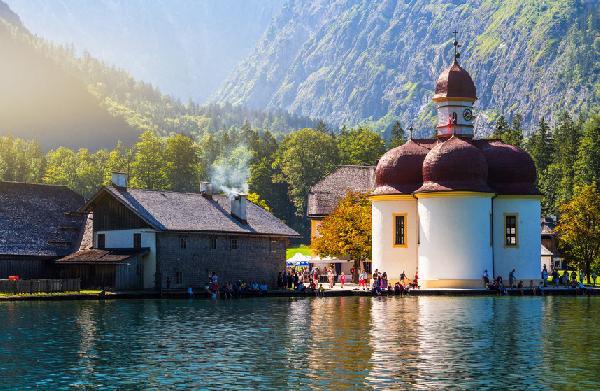
St. Bartholomä: This picturesque pilgrimage chapel with its red domes is one of the most photographed landmarks in Germany. From here, visitors can enjoy short walks along the lakefront, visit the old hunting lodge, or sample fresh fish from the restaurant.
Salet: The final stop of the boat trip. From here, a 15-20 minute walk leads to the smaller and even more secluded Obersee lake. The view of the Obersee with the Röthbach waterfall—Germany’s highest waterfall—plunging down the far end is simply unforgettable. More adventurous hikers can continue to the waterfall or to the Fischunkelalm, a traditional alpine pasture hut.
Jennerbahn Cable Car: Located right next to the boat docks, this cable car takes visitors up to the 1,874-meter summit of Jenner Mountain. The panoramic view from the top over Königssee, Watzmann, and the entire Berchtesgaden National Park is absolutely stunning.
Culinary Delights at Königssee
Forelle (Trout): Freshly caught trout from the lake is a local specialty, often served smoked (“Räucherforelle”) or grilled (“Forelle blau”).
St. Bartholomä Gaststätte: The restaurant at the chapel is famous for its “Bartholomä Fisch,” which is traditionally prepared according to an old monastic recipe.
Fischunkelalm: On the Obersee, this rustic Alm offers simple food and drinks in an idyllic setting. Note that it’s only open during the summer months and requires a hike from Salet.
Transportation to Königssee
The lake is located in Schönau am Königssee, about 5 kilometers from Berchtesgaden town.
By Bus: The RVO bus 841 runs frequently from Berchtesgaden Hauptbahnhof directly to “Königssee” (the boat dock). The journey takes approximately 10-15 minutes.
By Car: There is a large paid parking lot at Königssee. During high season, it is advisable to arrive early in the day as it can become very crowded.
Accommodation near Königssee
The town of Berchtesgaden offers the widest range of accommodation, from hotels and guesthouses to vacation apartments. Schönau am Königssee also has hotels and pensions for those who want to be right at the lake’s doorstep.
The Return Journey: Königssee/Berchtesgaden to Munich
The return to Munich follows the same route in reverse. A direct train from Berchtesgaden Hauptbahnhof will take you back to Munich Hauptbahnhof. It is recommended to book train tickets in advance for better prices, especially for specific long-distance trains (ICE/IC). The journey offers another chance to enjoy the beautiful Bavarian countryside.
Cultural Insights and Practical Tips
“Moin” vs. “Grüß Gott”: While “Moin” is a common greeting in Northern Germany, in Bavaria you will almost exclusively hear “Grüß Gott” (literally “Greet God”) as a standard hello.
Cash is King: While card payments are becoming more common, many smaller restaurants, guesthouses, and markets in Bavaria still prefer cash (Euros). It’s wise to always have some on hand.
Punctuality: Public transport in Germany is renowned for its punctuality. Be on time for buses and trains.
Weather Preparedness: Mountain weather can change rapidly. Even in summer, pack layers, a waterproof jacket, and sturdy walking shoes.
Sundays and Holidays: In Germany, most shops are closed on Sundays and public holidays. Plan accordingly by buying snacks or necessities in advance.
Sustainability: The Berchtesgaden National Park is a protected area. Follow the principle of “Leave No Trace,” stay on marked paths, and do not disturb wildlife.
The Bavarian Ticket (Bayern-Ticket): If traveling by regional train within Bavaria, this ticket offers unlimited travel for one day for one to five people at a very low cost per person. It is valid on regional trains (RE, RB, S-Bahn) and often on local buses as well. It is an excellent way to save money on this itinerary.