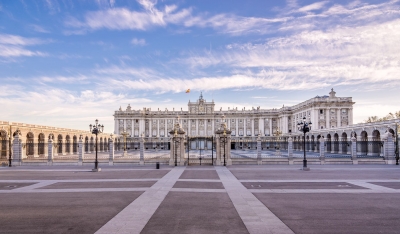
Madrid’s Royal Palace was constructed in the 18th century under the direction of Philip V, replacing the old Alcázar fortress, which was originally a Moorish castle.
Construction began in 1738, led by architect Sachetti, and the palace was completed in 1764. It features a square layout centered around a spacious courtyard. The southeast wing and the impressive Great Staircase, known as the Staircase of Honor, were designed by Sabatini. The Puerta del Príncipe, located on the eastern side, provides access to the central courtyard.
Among the palace’s many attractions are the Sabatini and Campo del Moro Gardens, as well as its various façades. Experts debate its architectural style, with some categorizing it as Baroque while others see it as Neo-classical. Noteworthy rooms include the Royal Guards’ Room, the Columns Room, the Hall of Mirrors, and the chamber of King Charles III. The palace also houses masterpieces by renowned artists such as Velázquez, Goya, Rubens, El Greco, and Caravaggio.
As the largest royal palace in Western Europe and the world, covering over 135,000 square meters and containing 3,418 rooms, it has been a witness to centuries of Spanish history. It stands out as one of the few royal residences open to the public, attracting nearly two million visitors each year eager to explore its unique art and treasures.
The Royal Palace Today
The Royal Palace of Madrid, managed by Patrimonio Nacional, is still actively used by Their Majesties, the King and Queen of Spain, for official audiences and events. It remains the official residence of the King and is unique as the only Head of State residence that is accessible to the public. This ensures that the palace is vibrant, hosting official ceremonies, the changing of the guard, and numerous activities for visitors.